Friday, January 28, 2022

Costa's Hummingbird and its (often) Frustration


 The Costa's is one of our most spectacular hummingbirds down here in southern Arizona. The problem is, it's practically impossible to photograph in such a way as to show it. Right now (in mid winter creeping towards spring), the male is in its brightest plumage. Here is an example of a photograph of a prime male. It's a  perfectly nice bird, but that is all you can say about it. The top of the head, and the throat are dark, but sort of purplish underneath. But if this were the real bird in the flesh that you were looking at, here is the experience you would have: First the bird would appear more or less black on the throat and crown, then it would glance towards you and the color would suddenly flash up brilliantly. Then it would turn away, and the color would dull down again.

 Now, I think two things are operating. First of all, the bright colors on a hummingbird's throat are not real colors (not, in other words, created by a pigment). They are created by narrow microscopic ridges which from a certain angle split up their basic colors into a prism as oil does when its individual colors break up in water or ice crystals in a rainbow. When you are looking at the bird's feathers from just the right angle they shine, from any other angle they are likely to show up as black.

Now if it sounded like I didn't know what I was talking about there, I really don't understand this second part.  Someone recently explained to me why, when you take a photograph of a rainbow, or a brilliant fiery sunset, it comes out so disappointing, with all the color washed out of it. Well, that's another reason it's hard to get a picture of a Costa's that does it any justice, and apparently you can do something or other to overcome the failing, or maybe it takes a special kind of lens, but I don't remember.

But I've taken so many picture's of Costa's Hummingbirds that some of them have got a little color into them. Much of the color on them is on phalanges that stick way out on either cheek, and the rest on the throat and crown.


The first picture here shows some color, the next one from nearly the same position, show the color reduced to black. Note the famous "ear flaps" on these.


And here is the female Costa's, pretty in her own way


Monday, November 22, 2021

A Timely Appearance

 We live on a cul-de-sac just off the Catalina Highway. Our acre of fairly untouched desert is on land beginning to rise up towards the 8000 foot peak of Mt. Lemmon. This is in a good position from which to write a nature blog.  Just when I'm thinking it's about time to write a blog, I can count on something appropriate to pop up for me to write about.

For instance, once or twice a year mule deer (black-tailed deer) appear in our yard. They don't seem to appear at any particular time of the year (these times over the years: 22 May, 23 June, 22 August, 20 November, 23 November). There might be one deer, there might be several; they might stay one day, they might stay several (in which case they bed down at a distance from our house and pile up droppings), and the one rule is, they are all adult bucks, either in velvet or with enormous racks of antlers. We've never seen a doe. We don't know why they come, or where they come from. We assume they drop down from the higher elevations, but we really don't know.

At any rate one appeared the other day, looking healthy and well fed. As always it's a sudden surprise, and they always look as big as a horse. Of all the animals that occur in our yard, they are the largest and heaviest. 

And this one gave me to an opportunity here to speculate about them, and now my blog is written.


To round things off, we then a much smaller creature, one that we had never seen before, and which caused a bit more consternation.


Saturday, November 13, 2021

Male Anna's Hummingbird Changes into Adult Plumage

 Autumn changing into winter is not my favorite time of year. You can scarcely complain about the weather here in southern Arizona now in November, day after sunny day, the temperature a mild 80, but things are closing down, you can feel it. This past summer, for instance, we often went out after dark on our back porch as the evening cooled off, enjoying the nectar-drinking bats swarming around us and draining the sugar water out of the half-dozen feeders we put out daily for the hummingbirds. But by now our bats have returned to Mexico for the winter, and the porch is empty. And anyway the air is getting too nippy for us to go out at night.

All through the year we had been watching another gradual change, the hummingbirds (we have five species) giving over the rather plain plumage they started life with to don (the males, anyway) the startlingly beautiful breeding plumage they will put on to win the females with. That change is at its peak now. Let me show you step by step what one species can do. Here is the male Anna's Hummingbird in sub-adult plumage.


This is a totally plain hummingbird with almost nothing to distinguish it. But notice the black spot on the side of the throat; there is also one on the other side. That is what it starts with.

Now note the spot again. When you look at the spots from an angle, they appear black, but when they are exactly opposite to the observer, they shine up bright red. That "black" spot is actually red, and you can see that some other spots are beginning to appear on the throat, and you can see that they're going to be red too. Some black spots are also appearing on the back of the head, and they also will prove to be red.

 The red on the throat is gradually expanding.

Suddenly the entire head and throat (except for a white area around the eye) is bright red (though from this angle the crown and throat appear black). Note how what started as a small spot on the side of the throat has thickened into a flange which is beginning to stand out from the throat.


Here is how it would appear from a slightly altered angle.

And here finally is the fully adult male Anna's Hummingbird.


Thursday, October 14, 2021

The Rattle Trap


 I have recently done some blogs about packrats, saying that there is nothing ratty about them, but that  with their big eyes and their big ears they are really rather attractive. But then going on to say they are notorious for getting into the wiring of your car where they can cause very expensive damage. Since when they move into your house, usually it is your garage they move into, there is no tolerating them;  you must get rid of them.

We are getting quite efficient at this. The previous owner of our house, knowing I would have problems with them, left with me a Havahart live trap, which catches them easily, and leaves us with no blood on our conscience. We then carry them down to the bottom of our yard and release them, and that seems to be far enough that they won't immediately return. I bait the trap with a spoon-full of peanut butter and their nose is so sharp the smell on the trap never goes away for them, so I never have to bait the trap again after that first time.  I would check around the floor of the garage where they usually came in and look for fresh droppings or other signs they might leave behind, and if I found any trace, I would set out the trap.

Then I thought I would make things even more efficient if I simply set out the trap permanently, then all I would have to do would be to glance at the far side of the garage every day and see if the trap was sprung. The problem  with that is, the longer it stays out, the more unintended creatures end up getting caught in it.

Here, for instance, is what I expect to find when I inspect the trap.


Here is what I found instead the other day.


It might be a bit hard for you to make it out. It was hard for me to see what was in the trap, or rather, to believe what I saw. It proved to be a four-and-a-half foot long Western Diamond-backed Rattlesnake (the rattle is easily visible in the lower right corner).


I have no idea what the snake was doing in the garage, or what prompted it to enter the trap. Perhaps it was attracted, not by peanut-butter, but by the lingering odor of a juicy packrat. Whatever the explanation, there it was. I told Cheryl and she came out and the two of us regarded it grimly, both of us thinking about the difficulty of shaking a packrat out from the complications of the tricky corners of the trap, especially getting the doors open without risking a bite from the rat. From a rattlesnake it would be more than a bite. We decided to leave the snake in overnight while we tried to think about it.

Here is what we came up with.

The trap is quite ingenious. Everything works by gravity, one thing falling making the next thing fall, and it is designed so that each step only works in one direction and so can't be undone. Here is the trap set with the overhead door open. The animal walks in and heads to the rusty-looking baited platform at the end, steps on it which pushes down the hair-trigger which allows the door to swing shut. As the door goes down (in an instant) the sort of mouse-trap like tang (?)  that hangs from the outer edge of the door opening slides down following it until it is caught on the flap in the middle of the door.


 Here is how it looks.


The door, which is hanging down by gravity, is not attached at the bottom, so the animal could easily just push its way out except that the tang fell down (by gravity) and locked itself into that flap.

Now, when we carried the rats we caught down to the bottom of the yard. it was very complicated trying to lift the tang up and hold open the door while we tried to shake the animal out, and that was just what we didn't want to do with a very poisonous and perhaps angry snake.

But suddenly we saw that the solution was right there.  We carried the trap by the handle very gingerly a distance from the house then set it on the ground and used a stick to turn it upsidedown. Cheryl jiggled the tang to stop it from hanging up, and from that side everything that had been down was now up and the tang released itself and the doors all fell open (by un-gravity?) and the snake, just as relieved as we were, went racing out of there, and we never saw it again.


Saturday, September 25, 2021

Post Script

 In the blog I just sent I showed some pictures of a Tarantula Hawk carrying a  paralyzed Tarantula to a spot where it was going to put an egg on it then bury it in a pre-prepared hole. This battle between these mighty opposites, I am sure, has been going on for millions of years, the fiercest wasp, the largest spider. Cheryl and I were lucky to see this dramatic action that very few people have seen, and after I sent the blog I was afraid I had not done it justice, the pictures had not given it sufficient strength and, I think, beauty.

I think perhaps I just didn't make the pictures large enough. Let me try again.


Friday, September 24, 2021

Tarantula and its Nemesis

Not long after we moved into our house in the desert (this is two or three years ago now), we were sitting in our breakfast room looking out over our backyard when Cheryl saw a commotion about sixty feet away and said, "There's a tarantula and a wasp fighting."

We had been eating our lunch, but without saying another word we dropped our silverware, grabbed our cameras, and tore out of the house. This was entirely reasonable behavior for people like us who were heavily into nature photography. What Cheryl with her brief sentence had described was a Tarantula Hawk, a large and ferocious wasp with the most painful sting of any wasp in the country, which was in the act of attacking a tarantula. This creature hunts down tarantulas, stabs them into paralysis, then lays an egg on them so that the larval wasp can feast on its still living flesh. Photographing the battles between these formidable creatures is one of a nature photographer's holy grails and there it was right outside the door.

Well, yesterday history seemed to be repeating itself. I was looking out the same window at almost exactly the same place, and I could pick out the bright red wings of a Tarantula Hawk, and when I put my binoculars on it I could see that it was rolling over the limp body of a tarantula. It had already paralyzed  its prey and was carrying it back to its pre-dug hole (you can see the hole behind it that it is backing into) to bury it.

The first thing it did was crawl down inside its hole, and try to pull the spider under, but the spider wouldn't fit.


So it came back up and got another grip.


Now it's got a better grip and it is trying again to pull it down into the hole (on top of its head.).


And now it is gone.


The larval wasp will continue developing inside the tarantula's body while the wasp mother flies off to find another tarantula, to repeat the whole process.


Saturday, September 11, 2021

What is happening around here

Well, what is the most fun right now continues to be our bats. We have four hummingbird feeders hanging along the front of our porch which we have freshly topped up with sugar water. About 7:00 in the evening it is completely dark, and we turn on the porch light, a weak light but strong enough to illuminate the activity. Suddenly the bats are coming in waves, and when we go outside these sturdy little creatures seem like they are barely missing our heads. We try to estimate how many we have, but they are coming so fast, appearing out of and disappearing into the darkness, it is impossible, but we think at times we have seen up to ten at once.


 These are Mexican Long-tongued Bats visiting us at this time of year from farther south. They are not the bats that use echo-locating to catch insects in flight; these are nectar-drinking bats, designed for drinking from flowering cacti, but if hummingbird-lovers want to set out sweets for them that's okay with them too. It's true many people are exasperated when they get up in the morning and find all their hummingbird feeders have been robbed and are totally empty, but we try to re-educate those people to show them how much fun the robbers themselves can be. We and our guests often sit out on the porch on a cool evening to watch them for an hour or so. And fair play, they do feed from flowers too. Here's a picture of one showing its long tongue, and notice its fur is yellow from pollen, from the flowers it has rubbed up against.


The second event here for the last few weeks, more on the exasperating side, less on the entertaining, is that this is  a "Snout year." Snouts (see Cheryl's photo) are small rather drab butterflies whose only distinguishing features are long extended palps (like snouts) that still would scarcely make them noticeable if it wasn't for their propensity to explode their population, often into millions in a small area. That is exactly what is happening right now, which is making people who drive above twenty miles an hour on narrow rural roads feel like mass murderers, the movement of the car stirring up a tide-line of corpses. If you walk by a bush which for some reason is attractive to them you can slap it and they will fly up in clouds. At its peak one day we looked up into an open stretch  of sky and it was filled with butterflies from top to bottom, all traveling in one direction. I had often read about snout years; this is the first I have witnessed.


The third event, and you have to live right for this one, you can sit at your breakfast nook table looking through the window to the porch where a very handsome young bobcat is standing about six or seven feet away, paying no attention to you.


Wednesday, September 1, 2021

The Porch at night #3

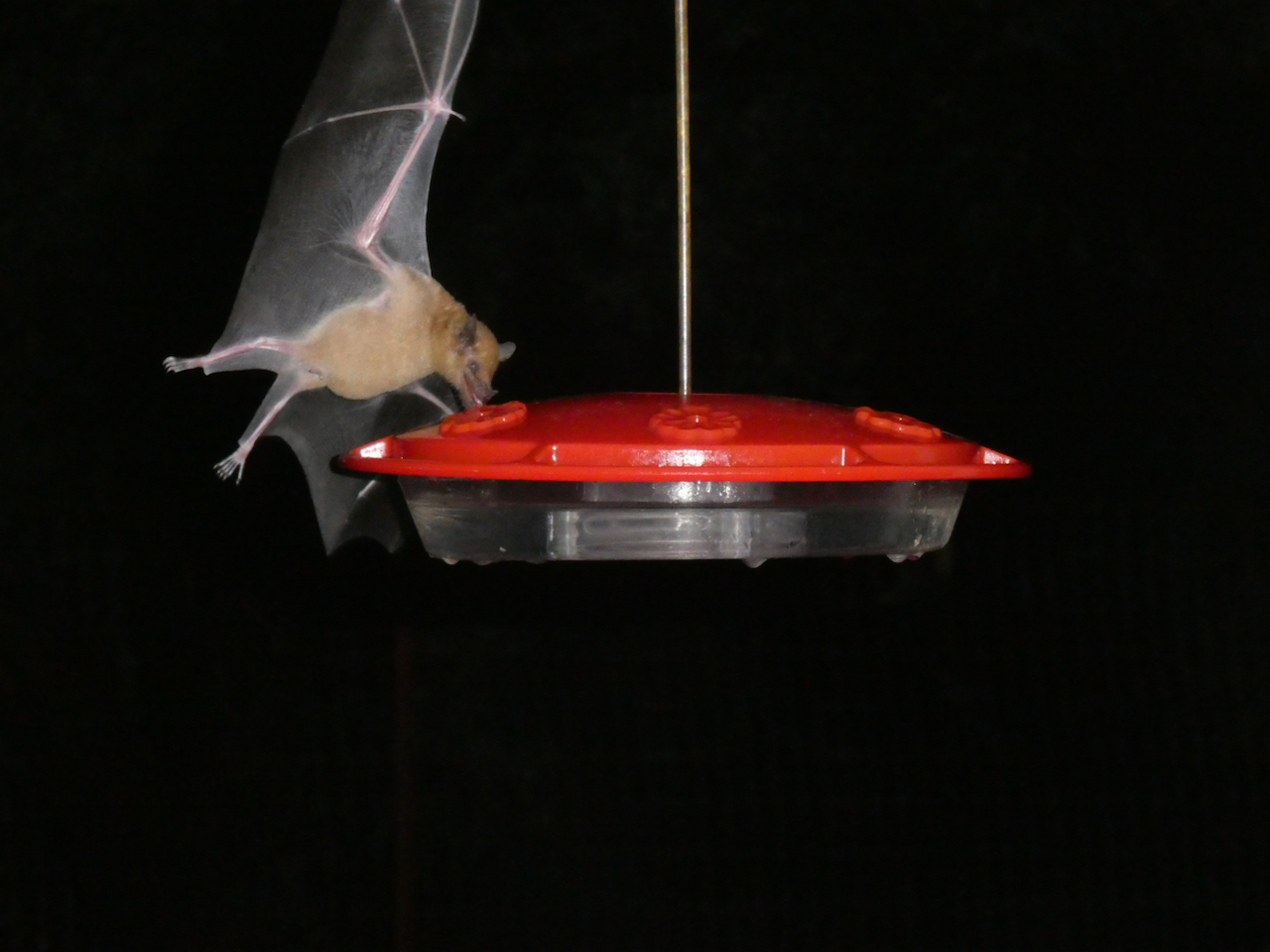
Well. here we are, trying once more to write a blog about the bats, and instead writing  about every other thing on the porch. I was explaining all the tricks I needed to use to get even a not-very-good picture of a fast-moving bat in the dark. And in the meantime Cheryl walked up to the hummingbird feeder, held up her camera, went click quick, and look at these amazing pictures, the best I have ever seen of these creatures in the act of feeding.


I had wanted for a long time to write about pack rats, because they are so astonishing, and next the long-tongued bats, because they are so astonishing. Now I've finally done something on both of them. I almost feel like retiring, except I know I am sure to discover something else astonishing.

Tuesday, August 31, 2021

Our Porch at Night (part two)

In the previous blog (Our Porch at Night [part one]) I was talking about our bats, and how we entertained dinner guests and ourselves sitting in the window that gave onto our porch with the outside light on, watching the bats streaking by emptying our hummingbird feeders.  It looked like a close-in bombing raid, in a sinister way rather like the attack on Pearl Harbor, especially with the distant thunder rumbling. I had always wanted to get a good photo of these bats in flight, though it seemed impossible, but I made some progress this time, and I will make another try tonight.

But what I'm writing about here is that once we came outside in the dark to try to photo the bats, we were quite astonished at the variety of life we found on the porch. We took our big flashlight and flashed it against the back of the porch, in other words, the outer wall of our house, and the first thing we saw was a red-spotted toad, unexpected so far from any water. And right next to it, not unexpected, but certainly

 making us take notice, was a Bark Scorpion, the most venomous  of the scorpions. It's true I  kept one briefly as a pet, but that was contained within an aquarium, not wandering free to climb into our shoes before we put them on in the morning.

Next was a Mediterranean Gecko, not a surprise, as they must be in everybody's home in Tucson, but usually this introduced species is found inside the house. These exotic creatures are always welcome.


Most fun was to find the porch was teeming with Pocket Mice. These tiny creatures resemble miniature Kangaroo Rats. In fact I believe they also, at least occasionally. walk upright on their hind legs.

And finally, and most dramatic, an enormous jet-black tarantula.


During the day the porch is generally inhabited by more "normal" creatures, round-tailed ground squirrels, three or four species of lizards, two or three dozen species of birds, an unending line of harvester ants, an occasional rattlesnake, most of these attracted by the meal worms we throw out, and the hummingbird feeders we refill after the bats have emptied them.

And at the very moment I wrote these words about the daytime inhabitants of the porch, a brand new species appeared there for the first time. We saw what we thought was a large swallowtail butterfly out the window, and, looking to identify which swallowtail it was, we could see it was dark with almost no visible markings. We grabbed our cameras and rushed outside and saw it wasn't a butterfly at all, it was an enormous moth: a Black Witch. In our experience, these big day-flying moths appear out of nowhere, can be seen in the yard for a few days usually flying at tree-height, than go on their way, enwrapped in the mystery their name suggests.


Monday, August 30, 2021

Our Porch at Night (part one)

 At this time of year Mexican Long-tongued Bats come up from Mexico into southern Arizona where they feed on nectar from flowers and on sugar water from hummingbird feeders. Bird lovers often get annoyed to find all their hummingbird feeders drained dry every night, but if you have an outside light on so that you can see them it is worth it just to to see the waves of bats sweeping through your yard. I decided I would attempt to get some pictures of them. It turned out to be more complicated than I thought it would be. You see, they move very fast, and they don't have wings shaped to make an air foil which would give them lift, so they are unable to hover in front of a flower or hummingbird feeder; they have to keep traveling forward or they will simply fall out of the sky. So when they get in front of a hummingbird feeder, they can only pause for a second to get a quick slurp. That means, first of all, you only get that one second to click the shutter. And next, it is  dark night, very difficult visibility to aim the camera and focus it, in that one second.

We have a porch along the side of our house overlooking the backyard, and that porch has a number of hummingbird feeders on it, so that is the area the bats are attracted to. I thought the solution would be to use our light- and movement-sensitive game camera, which would be automatically tripped by the bats. We tied the camera to a post pointed to a feeder, and went to bed assured that by the next morning we would have dozens of images.

Well, the bats were so fast they came and went before the camera had a chance to see them and so no  pictures were taken.

All right: I decided I would have to sit out there, and trip the camera myself. But it turned out the porch light produced so little light I couldn't see to aim or focus the camera any better than the automatic camera could. So I thought I would make one more try before giving up. First of all, the next morning,  I put the camera on a tripod so I could point the camera at a feeder and focus it by daylight, and then I left it out there pre-aimed and pre-focused. That night (which was last night) once the bats started circling the porch at high speed I sat next to the camera and every time a bat made its one-second pause in front of the feeder I clicked the shutter, and I could see when the flash revealed the bat's brown color and I would know I had timed it right.

The first picture shows a bat from behind, the underside of its head reaching down to drink some sugar-water. The second picture shows a bat from the side.

So this showed the bats, which was our intention, but in the act of going out on the porch in the darkness, something evidently we had not done before, we learned that the porch at night is teeming with totally unexpected life. In part two part of this blog I will show the life we discovered.