Saturday, August 13, 2022

Black-headed Grosbeak

 We usually see the Black-headed Grosbeak in the mountains, with only an occasional visitor to our yard, But some years they come down here in numbers, and we always stop what we are doing to watch them. They are quite striking (I am describing the males, the females are plainer)with their black head and heavy two-tone beak, with their black and white wings, their deep orange body, and the comic postures they get into as they twist around to watch us. Especially the comical postures.

This year they surprised us, quietly insinuating themselves into our notice, and now they seem to be increasing: a Black-headed Grosbeak year!


They often seem to look at you out of the corner of their eye.


They can look impressive and commanding.


Then turn around and look silly again.

Half the things they do look noble, and then they ruin it. For instance


here is a female black-headed on top of a log of tasty food we put out for the birds. She would like to get down to the choice fodder, but look how she goes about it. Here is a dove watching her.


She's dived in head-first and the dove can scarcely believe it!

Well, I shouldn't make fun of her. She' a handsome bird, 


 and all the other birds like her.


Friday, July 15, 2022

A Visitation


Once a year since we have lived here, we have looked outside and been startled to see from two to ten Black-tailed (or Mule) deer wandering through our yard. They are the largest and heaviest animal that has ever appeared in our yard, and by comparison to the usual bobcat or coyote or javelina, they look enormous with their big bodies and long legs, moose-sized practically. This effect is increased by the fact that they are virtually all adult males with full racks of antlers (usually in velvet). And they are made even more impressive by the fact that they are often standing just a few feet outside or front window, having come there (by memory?) to drink at a small birdbath.


Here is one of the three that appeared yesterday. We have no idea where they came from, but we assume they came down from the mountains. Everything about them is a mystery, For instance, they dependably come once a year, but it is never at some special time. They have appeared at scattered months throughout the year. They are almost always only adult bucks, only occasionally a doe. They are almost always in velvet but you could see that when their antlers have fully grown they would be immense. Sometimes they appear skinny and emaciated and mangy, sometimes, as now they are full and prime.

Often they hang out in a far corner of our yard for a few days, then drift away, and when we walk through the place where they were we are stepping on piles of their droppings.

We'll be looking forward to them next year.

Friday, July 8, 2022

Orioles

  When we moved here to Tucson a couple of years ago I began photographing the wonderful wildlife around us, the bobcats and wolf-sized coyotes, the javelinas, the mule deer, the Gila Monsters, the Western Diamond-backed Rattlesnakes, the tarantulas, the scorpions. It's how I got in touch with them, how I learned to really see them.

Birds are a special case. They come in discrete containers, and so can receive priority attention depending on their charisma. So it was no surprise I began with hummingbirds. First of all, there was their amazing flying, and their brilliant colors they suddenly flashed just by turning to look at you, and their tameness so you can photograph from just inches away. In the past I had lived in places that only had one or two species; suddenly I had half-dozen species to sort out by age or sex, and that was my first bit of business.

And of course I spent great time on the raptors, who lived their savage lives in front of us, plucking their prey with snow-storms of white body feathers.

This year suddenly we had orioles. Cheryl began putting out little tubs of grape jelly, and the sweetness is bringing bring them  up close to the house and my camera.  I knew they were colorful birds but I hadn't realized just how photogenic they were. Like the hummingbirds, and the raptors, they vary with age and gender.

Here is the female Hooded Oriole. It is the plainest form, darkish on the back and wings and tail, yellow below. It is the commonest species here in Tucson. The name is because the male appears to be wearing a yellow hood over its neck (other oriole species are dark on the head and neck).


Here is the immature male. It differs by having a black chin and black breast.

And finally, here is the adult male, going to a beautiful orange and black.

 And as a bonus, if we hadn't been observing the hooded orioles so carefully, I would have missed out on another species, looking exactly like the hooded, except it didn't have a hood, but a black head and back, and this one was a Bullocks Oriole, a species I had never seen before.


Sunday, June 26, 2022

Lizards taking over


 Meal worms are costing us a fortune, but they are our magic potion to tame the smaller animals on our porch. A creature comes up on our porch a first time, then when we come out to greet it it timidly rushes away. But by the second time it comes it realizes all that happens is a scatter of delicious worms appears at its feet, and it doesn't ask any more questions.

For instance we had a pair of roadrunners for going on three years coming up on the porch for handouts  and they ended by nesting in our front yard and raising young. They weren't tame in the sense that we could pet them or touch them, but they would walk around at our feet and snap up the meal worms we tossed among them.  We already had blocks set out for the quail, and half a dozen feeders for the hummingbirds. And now whatever birds were in season began getting in line for the worms,  And then, a  surprise,  we soon had a row of lizards lined up in the vegetation on the edge of the porch that would dart out and grab a worm then race back into hiding.

That's where the trouble came. You see, we loved our roadrunners, but we quickly came to love our lizards too, and roadrunners eat lizards, and it seemed our lizards were disappearing. We didn't know quite how to handle this, but this year the roadrunners seem to have moved over to an adjoining yard, and suddenly our lizards are returning. And amazingly the roadrunners almost instantly stopped coming, and one by one the lizards began reappearing.


This is one of the first to come back, the Desert Spiny Lizard (Sceloporus magister). They are often brightly colored with golden scales (and often a purple square on their backs), the males all swashbucklers, standing sideways to each other, making their chests as deep and masculine as possible, and doing their pushups. The biggest ones dash in for the most meal worms, and sometimes they get  into real battles.


Here's one making its chest look larger.
 
There are several lizards in the "Spiny Lizard" complex. The next most common is Clark's Spiny Lizard, which is separated from the "Desert Spiny Lizard" from the fact that it has four or so black bars going around its forelegs, which I sometimes have a difficult time recognizing, and find a better  mark in the fact that it is often a greenish color.


Once they have determined which males are the fiercest, the males notice all the females and then instead of looking fiercest they try to look their handsomest, showing bits of the blue on the underside.


 And when the female sees a man she likes (females generally have reddish coloring around the head) they get close together with the male and begin going around and around  in a tightening circle.


They can end up being as violent as they were competing for meal worms.


But then peace returns to the land.


Monday, May 16, 2022

The Porch at Night

On these perfect evenings we like to sit out on the porch in the darkness and listen for whatever life might be present, crickets mostly, or a neighbor's dog barking (we like to imagine it's responding to the scent or sound of a creeping mountain lion). There's a weak light bulb on the porch that we turn on so we won't miss a big spider or some other such creature coming out into the open. It was how we discovered last year that we had a little colony of pocket mice on the porch. But last night the dim lighting turned up the most dramatic creature we had seen.

Something about the proportions of a smallish mouse slipped by virtually between our feet. I shouted for Cheryl to keep sight of it while I raced into the house and came out again with a glass jar to plop over it and put a note-card under it to close up the top. Cheryl turned the jar up level again and we looked inside. A creature was leaping about inside, most impressively crashing its impressive jaws at us so that we were glad they were inside the glass.


We examined it in the light. The colors cadaverous, it  looked rather like a dead maggot, but its eight legs showed relationship to spiders. It also had an extra, thicker pair of legs in front, which were not for walking, but for sensing things that it touches. Note the fat round head. Near the top of it is a tiny, touching-together, almost imbecilic pair of eyes looking straight up in the air. No wonder it needs sensitive forelegs. The front half of the head is divided into two bulging lumps which are in fact massive muscles for clamping down with their jaws which are, for their size, the most powerful jaws of almost any creature.
 
This is a Wind Spider, a Solifugid (the name means that it "runs from the sun"), and indeed they can run so fast they are difficult to see. There are about 200 species in North America, though not much is known about them. A couple of years ago I kept one as a pet  (a different species) for about a year, which is about as long as they live. Anything I put into its aquarium it tore to pieces and devoured. I haven't got this one to feed yet, but I hope I can eventually, so I can keep it for a while.


Monday, May 2, 2022

The Monster's Return

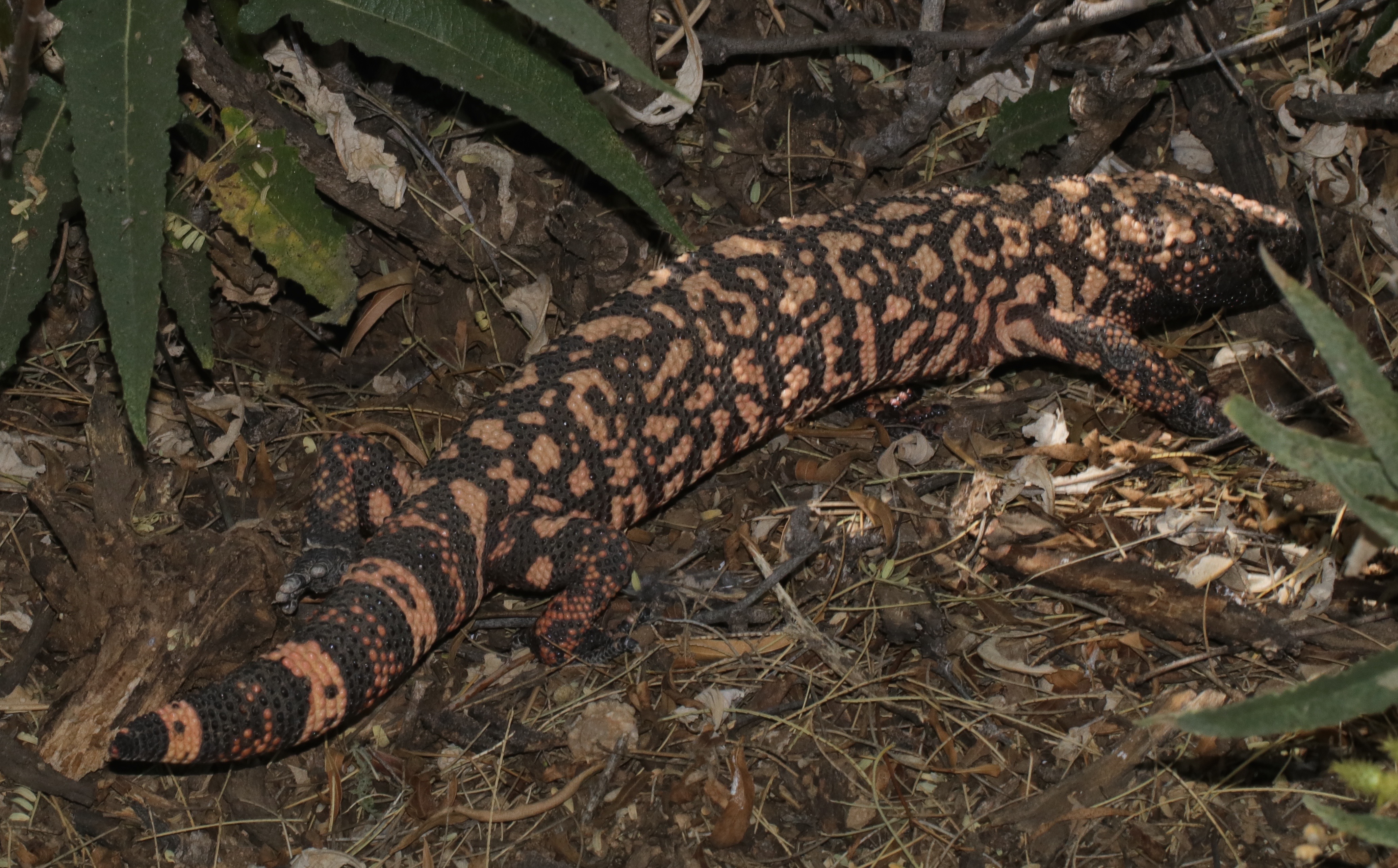
 When we bought our house here in Tucson a few years go we could tell by looking at it it would be wonderful for wildlife, and it has lived up to our expectations, bobcats, wolf-sized coyotes, Javelinas, rattlesnakes, huge tarantulas hunted by huge wasps. There was one creature we hoped we would get to see, but didn't think there was much chance of it: the Gila Monster, the brightly-colored slow-moving poisonous lizard. They stay underground most of the year only coming out for  few months in the summer to do all their feeding (they eat small mammals) and mating. Most people in Tucson, we are told, have never seen one. So we were delighted in our first year here when we began to see them crawling around the backyard. 

We guessed we probably had five or six living here. We took careful photographs of every one we saw, because it appeared that each one had an individual pattern, so all we would have to do is count how many different patterns we had, and that would tell us our population. Well, we looked as carefully as we could, and could only find two patterns, meaning we only had that many.

And now they appear every year, usually around the end of April, and each time it is those two. 

Well, we rearranged parts of our backyard last year, doing a lot of digging, and we were a little afraid we might have disturbed them while they were in their underground phase, and we wouldn't see them anymore.  But at the very last minute this year, April 30th, one appeared. We got out all our past years' photos, and we could tell it was one we had seen regularly since 2019.

Below is a picture from 2019.


Here is a picture from 2022. Notice on the 2019 the lower-case letter "g" on top towards the back and the same mark on the 2022 photo. (Their patterns are so complex the easiest thing to do is to look for something very distinct in the pattern.)


Below is a picture from 2019 from the other side showing, around the middle,  a "3."


 Here is a picture from 2022 showing the same "3".


Now we are waiting for the second monster to show up, or, even more interesting, a completely different, third individual.


Friday, April 8, 2022

Filming the Great Purple Hairstreak

We have a Mesquite Tree in front of our house that is doomed, in fact it is already more or less dead. The killer is hanging from all over the tree. It is a parasitic mistletoe that attaches to a tree at several points and drains it dry.


 The mistletoe has a saving grace, however: it is the foodplant of one of the most startlingly beautiful butterflies we have here, The Great Purple Hairstreak. The butterfly finishes its larval and pupal stage about the first of April, and then drops down to a hedge of Little-Leaf Sumac below it, just as that plant begins blooming.

If we can remember in time, we go out and try to photograph it. The problem is, it is a very tiny butterfly and very nervous and you need to get very close to it, and exactly at right angles. And you need to photograph it almost the first day it comes out, because its wings and elaborate tail are fragile and subject to tearing. After two or three days it is a wreck.

You have to photograph it at right angles because that is the only angle from which your picture will show the finest details of the colored scales on the wings. The unhelpful butterfly gets on a bloom and then slowly walks around in a circle on it, so that you constantly lose the right angle. The only thing you can do is take lots of pictures hoping some of them will be in the right place. 

Let's see how I just did.


Well it looks like the head in the top picture is in focus, but the tail isn't.

The middle picture is twisted around, and the tail is messed up.

 And the bottom picture finally has everything in place.


Thursday, March 10, 2022

PART TWO: BIRDS AT THE FEEDER

Birds at the Feeder

(Southwestern) Cardinal 


This bird, common at our feeder, looks like the common Cardinal seen throughout the east, but it may not be. Look at this picture below, which I took in Arkansas. It is the eastern Cardinal, an overall bright red, a modest crest, and black all around the mouth. The upper picture, taken here in Tucson, is the "southwestern" Cardinal. Note the taller, bushier crest, the overall paler red, and reduced black around the mouth. The song is also somewhat different. There are enough differences that some ornithologists think it is a different species, a Southwestern Cardinal.


 To complicate things we have here also a close relative of the Cardinal: the Pyrrhuloxia. It is as exotic as its name.


You might not think so from these close-up pictures, but this species is sometimes tricky to tell from a Cardinal. The best thing to do if you are trying to separate the two species, is to pay attention to the bill. An immature cardinal has a black bill, which slowly becomes red with maturity. So a black bill, or  bill with any red on it, is a cardinal. The Pyrrhuloxia has a shortened almost rounded bill which is  yellowish or grayish in color.

END OF PART TWO

Friday, March 4, 2022

Birds at the Feeder


I decided I have not been giving enough attention to the ordinary birds at our feeders, so that is what I am going to try to do here. 

We have a porch that goes along the back of our house and gives a view out along our back yard, the land sloping away from us, so that the porch overlooks the scene from above. Immediately below the porch is a flat area that has a pole standing up about eight or ten feet tall with a cut-out of a bird on top, and a short arm on each side. On one arm a little cage full of peanuts is hanging, on the other a  block of suet. 

Gila Woodpecker:

There is no time of day we can't see or hear from one to eight Gila Woodpeckers dominating all the feeders. They are there first thing in the morning, sitting on some aluminum thing on the roof and giving it a quick drumming to be sure we are all awake. Then they come sweeping into the feeders, bossing all the other birds away from them and calling out deafeningly their repeated Pow! Pow! Pow! like bullets striking garbage can lids. If another bird doesn't get out of their way instantly they begin jabbing it in the stomach with their heavy woodpecker bills. They are gray on the underside except for a bright yellow belly, and from neck to tail on the back they have a "ladderback" marking.


Ladder-backed Woodpecker:

This second bird, also very common, and also having a "ladderback" pattern, is much smaller than the Gila and much more demure and peaceful, and in addition to its smaller size it has a black line on the back of it neck. On this species the very attractive male has the whole top of the head red, on the Gila (I didn't show a male) only a small circle on top of the head is red.  The female Ladder-back has no red and a very noticeable black line on the back of the neck. Some men working in our yard recently wondered if the bigger ladderback (the Gila) was the mother, and the smaller was its child.


These two woodpeckers are with us all year. Very occasionally we see a flicker here. Otherwise no other woodpeckers at all.

In the summer we have Lucy's Warbler here as a common breeding bird, but as I am writing this (the beginning of March) they have not arrived  yet. We haven't lived  here long enough to work out if there is a regular  migration of warblers passing through the yard. But we have two species of warblers that stay with us through the winter, usually only one or two of each.

 Orange-crowned Warbler:

The Orange-crowned Warbler is a quiet yellowish bird with a sweet tooth, that comes to grape jelly feeders that are put out for Verdins and Orioles.


Yellow-rumped Warbler

Or better known as Butter-butt, this species remains farther north in winter compared to other warblers. Most warblers feed mainly on insects and so couldn't remain in the snowy insectless north, but the Yellow-rumps can make do with berries and the suet cakes bird lovers put out for them. Usually their pattern and plumage are immaculate. This one I found to take a picture of unfortunately is a little bit rumpled, but he's still quite handsome.


END OF PART ONE