Thursday, April 15, 2021

The Coming Year

I finished my last blog bemoaning the fact that the special birds, the ones we had fed and tamed all winter, now that spring has arrived have deserted us without a backward glance. A fiery purple-faced Costa's Hummingbird that had been coming several times a day to our feeder, was the last to go.


Well, on reflection I decided I was going too far. I had forgotten one of the most dramatic, most faithful birds, an all-year bird, the tamest (it will sit in our laps while it swallows meal worms we give it), and, at the end of the season it will bring its young-of-the-year to show them how to collect the free-meal worms; the bird that is most enjoyable for visitors to watch from closeup as it races around under our feet: Our Road Runner. I will indeed be back talking about it because this year it was a pair and they showed us their whole courtship and now have built their nest in a knot of mistletoe over our front door. We will want to follow all the developments.

And as it happens, the first new creature of the year running towards us to take meal worms from our fingers is not a bird but a reptile: a beautiful Spiny Lizard.


I'm quite sure it was one returning from last year, as it already knew where to go to get the meal worms. And the first of our Gila Monsters has come out of hibernation, perhaps as we were looking at it, and we watched it taking a monstrous drink, perhaps its first drink of the year. So far we haven't learned how to feed them, but judging by last year they will hang around anyway. We hear that at this time of year, counting on the fat stored in their tail, they are less interested in food, and more interested in finding a mate.

And of course who knows what totally unexpected birds or reptiles will show up. I should know that. That's the real fun.


Tuesday, March 23, 2021

I'm (Mostly) Happy Winter is Leaving

 Winter is my least favorite season here in Tucson. It's not the weather, which is mild enough. In fact it might be more reasonable to wait for torrid summer temperatures to relent. After all, in winter all you need to do is put on a sweater, then you can go out and enjoy the fresh out-of-doors. Harder to do in summer when it is 115 outside. Well, that's the kind of thing people say.

But I've always loved summer. I think it was because I grew up in the San Francisco Bay Area. As a kid I was always disappointed with our summer. All I wanted to do was jump out of bed in the morning and go out looking for snakes and spiders and insects. But before I got up I would wait in bed sampling the air in the house. If it smelled of heated dust rising from the top of the furnace, it could only mean the central heating had been going all night, and that would mean the cold drenching fog was in, and probably would be in at least till noon which killed most of the day. No living thing would be stirring.

It's nothing like that here.When it gets to be summer, it pretty dependably stays summer. And when it is 115, well, we live on a cul-de-sac off the Catalina Highway, and we can get in the car and drive to Inspiration Pt. at 7,000 feet, in 45 minutes, where the temperature is a balmy 80.

No, it's winter I don't care as much for. It's not for the most part terribly cold, but the birds aren't singing and everything sort of shuts down. By the time we get up to our favorite Inspiration Point there is often a bitter wind blowing.

But there is or there might be a problem this fast-approaching summer. You see, it is at the change of season that new birds come down from the mountain top, or new birds come up from Mexico. But it works the other way, and we may lose birds, too.The last couple of years a hummingbird has moved in along the bushes on the front side of our house, and we got to watch it making a nest and raising a young bird, and we got to watch the whole operation directly out the window. Each time, it was a Broad-billed Hummingbird, and each time it only laid one egg, when usually I believe hummingbirds have two young, and each time it was very tame, and all this made us think it was the same bird--our bird. Also it had what looked like a bent bill from crashing head-on into a window sometime in the past. Our nickname for it was Broken Bill (rather inappropriate since only female hummingbirds build a nest and raise young). I had some close up hummingbird nest photography planned this summer, but so far there is no bird hanging around in the bushes there.

 
And we had already lost two birds. First of all, for the last few months we had had a tame Bewick's Wren that we were very fond of. When we got up in the morning and went into the breakfast room, it was already waiting for us looking in the window, its long tail twitching back and forth. We would pick up a small handful of meal worms and carry them outside. As soon as we opened the backdoor it would rush back to a spot peeking out from a behind a bush waiting for us, and it would shoot around and grab every meal worm we threw it, and it would rush back around behind the bush (for some reason it would always insist on eating in privacy. It was so small it had trouble swallowing the worm, and it was as though it were embarrassed to have us see its awkwardness). After it swallowed each one it would come back out from behind the bush and wait for the next one. After five or six its tiny stomach would be full, and it would go on about its business.


And a second bird was hanging around that we got used to seeing every day, a Lincoln's Sparrow, a very pretty, very precisely marked bird.


 And now on a single day both Bewick's Wren and Lincoln's Sparrow have left, taking off for wherever they go in summer, which is not here.
 
So maybe some very special bird will suddenly appear and stay with us for the winter, but for the moment we don't have any special bird, just all the usual ones, and we feel sort of bereft.


Wednesday, March 10, 2021

How Many Hummingbirds?

 When we first moved in here we put up bird feeders, with grain or suet for the regular birds, and with sugar water for the hummingbirds. I was especially interested in what hummingbirds we would get. I had always lived in northern places where you could expect one species regularly, with perhaps another species that would make a wrong turn in migration and occasionally appear in the midst of winter. I was sure Tucson, deep in the southwest, would turn up more variety.

We quickly learned we had three evidently year-round species, Anna's, Costa's and Broad-billed. The adult males of all three were brilliantly colored in breeding plumage, so we couldn't complain about the selection we had drawn. I had never before lived in a place that had so many species. But like a typical birdwatcher, I wasn't satisfied. I wanted more than three.


The thing that galled me is, I had almost certainly seen another species, and a real rarity to boot. Not long after we had moved in, I woke up early one morning and walked through the quiet house to one of our feeders outside a window, and there was a hummingbird on it. What I noticed at once is it had a strongly curved bill, and though I couldn't remember its name, I knew there was such a bird, and it was very special. Adult male hummingbirds usually have bright colors that serve to identify them, but sub-adult,  or female birds, often don't have distinctive marks and can be difficult to identify. This was one of those drabber birds, but I tried to memorize any marks I could see on it.

It flew away before I could wake up Cheryl to witness it with me. And it never occurred to me to try to photograph it. I looked up the books, which told me the bird I thought it was was the Lucifer Hummingbird. The special mark I had memorized was that the throat was pure white (hummingbird throats are often spotted or brightly colored), and that low down  on the throat were two or three dark, lozenge marks.

The bird I saw was exactly like the illustration of the sub-adult male Lucifer Hummingbird in The Sibley Guide to Birds, Second Edition (p. 298). I have never again seen a bird like that. But I was too new at looking at the hummingbirds here to trust my judgment. So, I was still at three species.

But then I began seeing a brownish species I couldn't make head or tails of, and I sent a picture I had taken of it to bird-watcher neighbors who in turn sent it to their friend who happened to be the author of the Peterson Guide to Hummingbirds of North America and she said it was a Black-chinned Hummingbird, and so that was my fourth species, and indeed I have now seen adult male Black-chinned examples that I can ID myself (though one has still never stopped so I could photo it).


 There is a species  (Broad-tailed Hummingbird) I thought I would never record on my property, because it stays up at the top of the mountains and never comes down, but the other day one, perhaps in migration up from Mexico, did travel through our yard, and spent two or three days coming to the feeders in our backyard, and even let me take a picture of it. It is a handsome bird with a bright red throat with a white bib beneath it, and a green crown to set off the throat and bib, and that is the fifth species, and a clear moral that if you wait patiently, new species will go on showing up. Who knows, one day even the Lucifer.


Monday, February 22, 2021

Coyotes


I expect most people know that wolves and coyotes have bushy tails that hang straight down, whereas by the time dogs were domesticated, they had acquired a gene that made their tales curve up at the end. Every few days from one to three coyotes (often, what looks like a pair with a younger one) come trotting up from the wash at the bottom of our land, crossing through the back yard at a wide front so only one would be visible at a time. A rabbit, seeing it, might be tricked into fleeing to the side and running straight into the others.  Invariably they come just as we are not expecting them, traveling so fast they are gone before I can find my camera, so I have never managed to record them but get only a quick sense of surprise at how large they look ("Like wolves!" I can't help shouting to Cheryl), and a sense of admiration for the wild look of their plump hanging tails. They have wonderful coats at this time of year.

Well, the other day I got my chance. It was that day late in February when the round-tailed ground-squirrels came up from their burrows for their first day out of hibernation, and while they were still possibly confused by the sudden sun-brightness a family of coyotes was frantically trying to dig them out. While they were occupied with that I was close-up beside them with my camera clicking away trying to make their tails the center of my pictures.


Monday, February 15, 2021

A Puzzle that May (or May Not) be Solved

Not long after we moved to Tucson (June, 2018) we were sitting at the breakfast table having breakfast and looking out the window over our extensive back yard, when Cheryl with her sharp eyes suddenly said "There's a tarantula and a tarantula hawk fighting." 

This, of course, is one of the nature-photographer's Grails. We grabbed our cameras and ran down there. (I paced it off later, and she had spotted them when they were seventy-five feet away).

They were racing around each other in an area dug-over by ground-squirrels. One move I recall the spider making was to get up on its tiptoes and make a sort of floating run across the bank. Then everything stopped and stayed frozen, and we realized we might have been interfering with the action and so we backed off. When we cautiously returned a few minutes later, nobody was there. So that was frustrating. We didn't know if we had seen everything, or missed everything.

It stayed like that until recently, when I read something that surprised, and sort of disillusioned, me. The desert blond tarantula (Aphonopelma chalcodes) with a leg span of four inches, is a major predator capable of capturing mice and other small vertebrates; the tarantula hawk (Pepsis mexicanus) has a sting that can put a person to bed for a couple of days with a fever. I imagined the two of them would fight head to head, kicking and scratching, rolling over and over. But what I read was, the wasp, being careful not to get too close, stings the spider on the tip of its leg, then gets out of the way while the spider falls over paralyzed from the venom. 

Did we see it, but just not recognize what we were seeing? I got out the photographs we took then and looked at them newly to see what I could make of them.

Here is the wasp.

Here is the wasp in a position from which it might have stung the tarantula in its second leg.

Here is the tarantula in a position in which it is apparently no longer moving. It has withdrawn its second leg.

We have not witnessed a spider/wasp conflict since.


Sunday, January 31, 2021

Towhees

It has been pointed out to me that I haven't written a blog for a long time. The reason has to do partly with laziness, but also partly because this early winter season is pretty quiet, and I am having a hard time finding something to write about. But then I remembered towhees.  

Towhees are, mainly, extra large sparrows, often with brighter patterns and colors than the usually brown stripey sparrows. And, more to the point, we have four of the six North American species right here in the southwest, and I had always wanted to write something about them.

However, let me start with the Eastern Towhee, which is not found here. We have only recently moved here from Arkansas, where the Eastern Towhee is common, and for completeness let me put here a picture of one I took in Arkansas.

Note, on this handsome bird, the red eye, the black back, and the orange side, with a spot of white right about the middle. This species is  common, and the only towhee, in almost exactly the right half of the United States.

In almost exactly the left half of the United States (this time including Arizona) is the nearly identical  Spotted Towhee, except for its namesake spots.


 The second towhee found in Arizona, in fact almost confined to Arizona, is also one of the plainest. Abert's Towhee is plain gray-brown with a bit of black around the mouth, and a bit of richer brown under the tail. To jazz it up a little bit, I'll show it doing something dramatic.


The third Arizona towhee, the Canyon Towhee, is just about as drab as Abert's. Supposedly it has a reddish crown, but it's pretty hard to see. The only thing that puts it ahead of the Abert's is that it has a necklace of black streaks on a tawny throat.

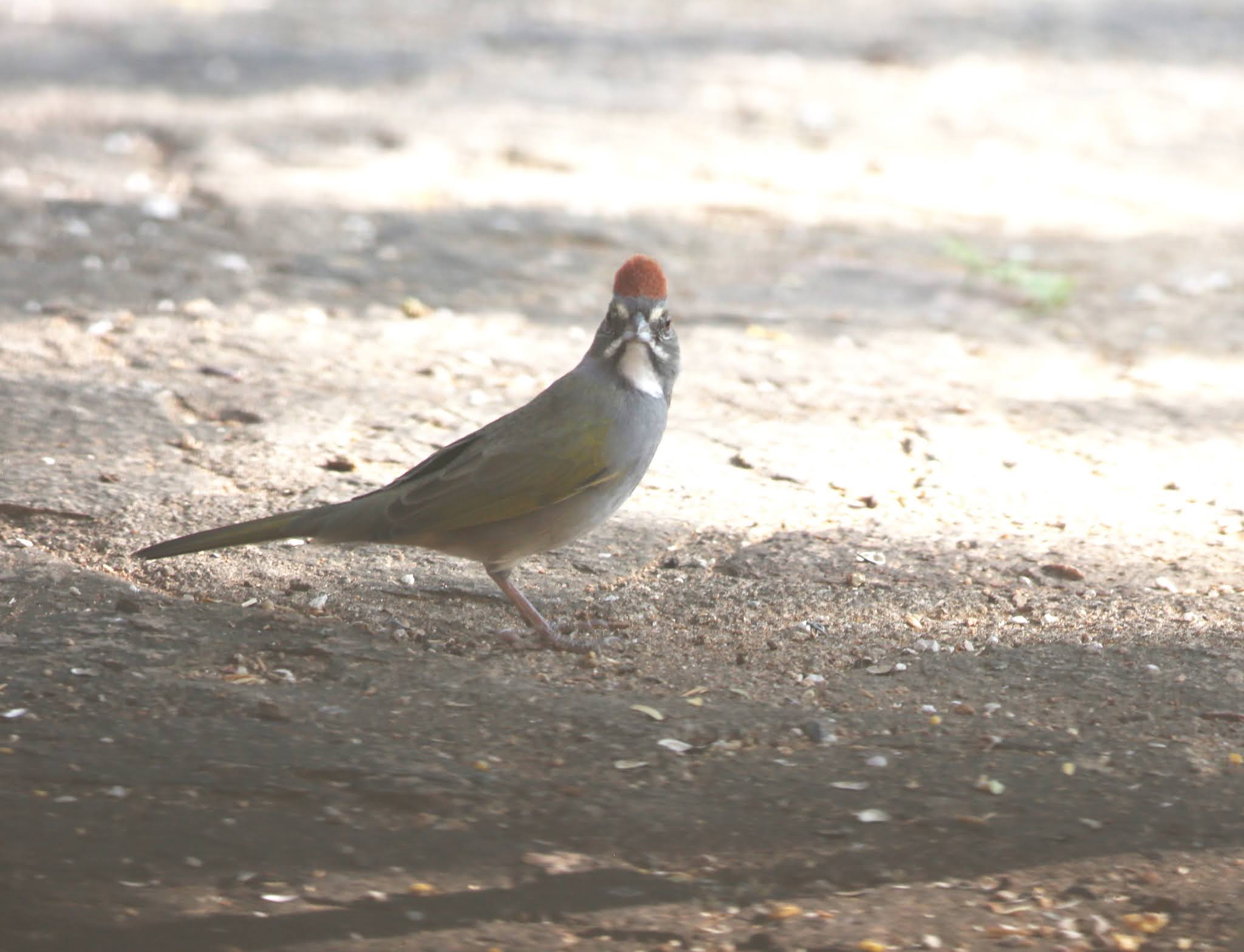
Of course I'm saving the best for last, the Green-tailed Towhee.  At least it is my favorite. The bird is gray with a bright red crown, a strongly contrasting white throat, and the finest  patina of green over the wings and tail. When you first begin seeing them, in late summer, they are skulking around in the brush, only showing glimpses of the red crown, the white throat, and then, towards September, they keep getting more and more numerous, from the bottom of the garden to the top of the mountain, until they are everywhere, the commonest bird around. At first you are thrilled to see them in he open, posing for any kind of photo you want. Finally you are jaded, and looking for something else to point your camera at.


The California Towhee, another plain brown job, is found up and down the Pacific Coast. And finally, the Rufous-crowned Sparrow is often considered along with the Towhees. It occurs in Arizona, but we haven't seen it so far.


Saturday, January 9, 2021

The Year in Review

Well. at the beginning of 2020 the pandemic began, and Cheryl and I went into lockdown. We were told not to travel anywhere, so we didn't travel. We were told not to spend close-up time with anyone outside our immediate family, so we did not spend close-up time with anyone except our immediate family, and do you know what? That's how we live anyway. The only major change is, now we have our groceries delivered. For entertainment we watch and photograph the wildlife that comes to our house, or that we find on Mt. Lemmon (we live on a cul-de-sac just off the Catalina Highway, only a couple of miles to where the road starts winding upward), and that's good enough for us.

What I want to show now is the variety of wildlife we can generally see here every year. I'll do mammals first, and on my next blog I'll show some of our favorite birds and reptiles.

Bobcat, common (evidently) in the foothills; they probably specialize on rabbits. I have found their kills, where they have eaten everything except the entrails, just as, on a smaller scale, a domestic cat would do with a mouse.

Coyote. Family parties of three or more often pass through the yard. It is always a pleasure to see their lightness of foot, and quickness of travel.


Javelina (Collared Peccary). Herds prowl up and down the streets at night. On garbage day the garbage  is picked up early, and you need to get up early to set it out. It would seem to make more sense to set it out the night before, except the javelinas would come by and with their strength tip the garbage can over and scatter the garbage all over the street.


Mule Deer (Black-tailed Deer). Look at this healthy well-fed Mule Deer doe with its gray winter coat. I don't know where they come from, but every year a group of deer (the males with enormous racks) show up, and spend several days with us, to judge by the mat of  droppings they leave at their roost over at a distant corner of our lot, before they quietly drift away.


Desert Cottontails are plentiful on our land and, during their courtship ( called "cavorting"), you can almost constantly see somewhere in the yard a wild chase going on, which ends with a male and female facing each other tensely three or four feet apart, when one of them suddenly charges the other, and the other leaps straight up in the air while the charger rushes straight underneath him.


Round-tailed Ground Squirrels and Harris's Antelope Squirrels (the ones with their tails carried up over their backs) are the smallest of these mammals but taken together by sheer numbers probably make up the greatest biomass.


Cliff Chipmunks seem to occur at higher elevations, and seem to be the only species of chipmunk found here. 


Abert's Squirrel, surely one of the handsomest of the squirrels, occurs in the ponderosa pine region, and they are closely tied to these trees for food and nesting. They are numerous and tame, for instance, at the picnic area at Summerhaven,  the village at about the 7000 foot level on Mt. Lemmon, that Tucson people flee to to escape the torrid days of summer.

Packrats deserve a blog by themselves.


Monday, December 21, 2020

They Flee From the Sun

 I was one of those kids who carried every creeping thing home and made a cage for it. I don't mean bunnies and baby birds, I mean black widows and six-foot long snakes. Kids like that, I have observed, always seemed to have a wonderfully understanding and tolerant mother, although in my case there was also an older sister terrified of everything with scales or eight legs. I don't know how many times I stepped out the door on my way to school and whispered to my mother: My pet snakes (that the sister had never been told about) have escaped and are crawling around somewhere in the upstairs bedrooms. Bye.

Well, my other observation is that those little kids never grow out of it. Take my own case. I am eighty-five years old and still love the creepie-crawlies, in fact the more sinister the better. Luckily I have a wife as understanding as my mother was. More than that: She loves the little creatures too. But in the past year we have left the relatively tame MidWest (where I kept Black Widows and Brown Recluses),and moved to Tucson and the opportunity to come into contact with exponentially creepier creatures, seriously venomous Bark Scorpions, for instance, going beyond even what my wife will accept as a house pet. Her justification is that our four-year-old grandson gets into everything when he comes to  our house and I guess he does.

Luckily, there are still a number of other wonderful creepy creatures remaining for me to keep, creatures with names like Tailless Whipscorpion, for instance, or Vinegaroon, and the strangest of all, and the one I want to write about here, the solifuge. Our cat found the first one of these we had ever seen, chasing it out of a dusty back corner of our house. I quickly popped it it into an open wide-mouth jar so we could look down on it and make our first examination.


What we saw (going from back to front) was a segmented abdomen in shape like a limp half-full vacuum cleaner bag with the skin and  texture of a cadaver. Then there were eight legs (showing its kinship with spiders) and in front of those was one more pair of legs, twice as long as the regular legs, and three times as thick, and everything still with the same bloated corpse coloring.

Next forward was what we assumed must be the head, though it was only a little bit closer to the front, and looked otherwise like another segment. But on its leading edge the two tiny black dots so close to each other they were virtually touching were evidently the eyes, and since they were in the middle of the back they could only be pointing directly upward rather than forward at something.

At any rate, it was certainly bizarre enough to satisfy my morbid tastes.

I set it up in a small aquarium, with about an inch of sand on the bottom. It was a nocturnal creature (the name solifugid suggests something that flees from the sun) that plowed around in the sand all night, and by morning had pushed most of the sand to one side, so it could crouch down all day in the hole left on the other side.

We knew it was carnivorous, and we determined it was just the size to eat meal worms. Here is where we discovered its true weirdness: We realized we couldn't figure out what it did. A scorpion has pincers in front with which it can catch its prey and a long tail with a venomous tip to bring over its back to kill its prey. All very sensible. You can see just by looking at it what it does to catch and eat its food. 

Spiders have venomous fangs in front with which the can kill their prey and at the same time inject digestive enzymes (since they don't have jaws to chew them up) to turn the innards of their prey into liquid easy to suck into their stomachs.

But the solifugid doesn't reveal anything you can work out, it's just a pallid body, a bunch of legs, no mouth, no weaponry, and two brainless eyes not pointing anywhere.

We dropped in a meal worm which it ignored, but next morning there was the worm dead, the body a little bit mashed up, and apparently not eaten. 

Then I got Jillian Cowles' big handsome book Amazing Arachnids (Princeton, 2018) and all was made clear. It seems that everything is hidden underneath its body. The bifurcated front half of the head, which is to say, everything coming in front of the tiny eyes, consisted of the enormous muscles which worked a combination of scissors and saw blades with the most powerful crushing jaws of any creature its size.

We put in another worm and saw what it did. We watched from directly in front and saw that it used the pair of enormous legs in front to gather together the prey and position it cross its jaws to begin eating it like an ear of corn, starting at one end and chewing it all the way to the other, the powerful jaws crunching through the thick skin until it was all crushed with all the juices oozing to the surface and it is these juices it sucks into its tiny toothless mouth, leaving the crumpled but intact body behind.


Among their various names, solifugids are called "wind spiders," a reference to the tremendous speed at which they dart around in search of their prey. Our species here is about an inch-and-a-half long. During the Gulf War when our soldiers first began setting up their camp in the Arabian desert one of the disconcerting things they met up with were "Camel Spiders," solifugids closer to six inches long! If someone offered me one I think even I might mumble something about being concerned about my grandson's safety.


Thursday, December 17, 2020

Hummingbirds (3)

The third of the hummingbirds I am discussing, the Anna's Hummingbird, is on the move, spreading north and east. It's a West-Coast bird, common in California when I was a little boy growing up in Berkeley, a scarce bird when I lived in Northern Washington in the 60s (it has now pushed all the way to Vancouver, British Columbia), a stray in winter in Arkansas (but increasing), where I lived before coming here to Tucson, where it it seems to be an abundant resident. 

The female has a mottling of red and bronze on the gorget. The short, straight, black bill on both sexes is distinctive, and through all the color changes, remains a good identification mark. The throat and crown, in the adult male, are brilliant red. Anna's tend to be sedentary so if you have a few individuals in your yard that you can identify, it's fun to watch the male gradually acquire, first on the throat and neck and crown, spots that expand into an entirely red head. Here is an adult female.

The immature male begins by getting a spot on either side of the neck. In this picture it is showing up as a black spot, but that's because it's not reflecting from this angle, and it  is actually bright red. Note the straight short black bill.


Here you can see the red spot, and of course there  is another on the other side, and the two will begin moving to the center to join the red gorget you can see developing, plus there is now some red beginning on the crown.


Thursday, December 10, 2020

Hummingbirds (2)

There is a rule-of-thumb ornithologists follow: If you see a pair of birds, robins, say, and they look so  much like each other you can't tell which is male, which female, you can guess that they are more or less faithful to each other and share in the raising of the young. If the female is dull and drab, and the male has brightly colored dramatic plumage, peacocks, say, you can bet the male struts around looking pretty until he attracts a female, mates with her, and never looks at her again, but goes off looking for another female, while she raises the family.

Hummingbirds are in this second group. Here's how it works with Costa's Hummingbird. The female looks perfectly ordinary. The male, as a juvenile, looks more or less like the female. He has not got his equipment ready yet to fight for a female and mate with her, so by resembling a female, he stays out of the fray till he is prepared. The sign that he is ready is when he changes into his nuptial plumage, which in a hummer usually means slowly developing brilliant colors around his face and gorget.

The Costa's Hummingbird is a popular bird, mainly on account of his nuptial finery. The female, as we have already said, is very ordinary, a green back, whitish underparts, faded reddish wavy lines under the throat, a slightly decurved bill.


The adult male has crown and gorget a brilliant violet, an almost impossible color to catch in a photograph. To top that off, great long  extensions (in the same brilliant color) sweep back from his mouth. here is a picture of an immature male just beginning the long extensions.


And here is an adult.


Notice here, though I have promised brilliant violet color, it just looks black. What is happening is, the light is a reflecting light, and if you are not at exactly the right angle the color will come back black. In life, if you were looking at this one right now, the bird might make the slightest move and suddenly dazzle you. Let's see if I can get one at the right angle.


That gives you the idea. Here's a couple more pictures, mostly half black and half violet.