Monday, April 28, 2014

When is a desert not a desert?

Our son Gawain and his girlfriend Heather recently moved from San Francisco out to Tucson, which is an easy two-and-a-half-day drive from our home in NE Arkansas. That means we have the pleasure of visiting them more often, plus the added perk that their new city is surrounded by my favorite Sonoran Desert.

We left here for Tucson 29 March. I like driving across country, seeing the gradual changes in land forms and vegetation, stopping at rest areas and walking around the edges looking for unfamiliar insects and birds. For the first part of the trip we don't have much choice but to go on I-40, flat and at this time of year mostly drab, not leafing out yet. But not without surprises. For instance, in some parts of the Texas panhandle you seem to see the 19th-century changing directly into the 21st-century.


Windmill farms stretch in all directions as far as the eye can see (quite a way in the flat prairie). I have heard that conservative oil state Texas is going for 30 percent renewable energy.

Anyway, as you approach the border into New Mexico the land abruptly changes into mesas and canyons and high juniper forests. Before you reach Albuquerque you can finally get off the interstate and begin following two-lane roads southwest through increasingly spectacular scenery, rock formations in every imaginable color.

We reached Tucson at a nice time of year. There had been recent rain, and the desert was blooming. And here the terminology needs to be cleared up. The colorful boulders and rimrocks and bajadas and arroyos we had been driving through were partly so visible because often there was no vegetation obscuring them. It really was desert, often the only growing things being dried and stinted yellow grass. That all changed on approaching Tucson. There are still spectacular mountains and so on, but what steals the scene is the rich vegetation. One by one cacti of every shape and form begin to join the setting, from the tall saguaros and ocotillos to the various chollas and prickly pears of the understory. It's like a planted and well weeded garden, a specimen plant, then well tamped sand around it, and then the next specimen plant. Here's an example of the ensemble:


And here are some of the big waxy cactus flowers:


In fact technically this desert, the Sonoran Desert, is not a desert. Real desert does not have all this vegetation and the monsoonal rains that support it. This is thorn scrub or thorn forest, a very different thing.

We spent most of our week in Tucson walking the trails through Saguaro West National Park and Saguaro East and Sabino Canyon and all the other wonderful parks which surround the city. We followed dry washes up, and that was the best way to see wildlife.


 Nesting Cooper's Hawks were common, as indeed they seemed to be in the city itself.


Our very gentle and sweet Brown Thrasher was replaced in Arizona by several thrasher species, but the commonest was the Curve-billed Thrasher. This one coming up to check us out seemed to have a rather ferocious eye, but I expect everything has to be tough to survive in this beautiful but thorny place.


We were hoping to see some of the area's famous rattlesnakes but didn't find a one. We did however see one very nice serpent species. Cheryl and I arrived at a place part way up Mt. Lemmon (on the edge of Tucson) one morning about nine, and I looked down at our feet and there was a four-foot-long snake that was an unripe-banana yellow in color. We were so surprised by the unlikely color that we missed our chance to take a picture. We looked it up later, and it was a Green Rat Snake, fairly special, I think, with not much known about it, except that it's nocturnal, but can be seen around twilight, and then again in the morning until about nine o'clock (which is exactly when we watched it disappear).

One snake we did get a picture of was the Sonoran Gopher Snake, the attractive local race of the common western gopher or bull snake.


Lizards of many species were abundant and easier to find than the snakes. Here is a Zebra-tailed Lizard.


When we or some other dangerous animal come too close it suddenly curls up the last quarter of its tail like someone pulling on a Christmas-parcel ribbon, revealing the black-and-white banded underside, and takes off running full speed. A predator giving chase focuses on the curling-and-uncurling black and white tail tip, and ends up with that in its mouth while the lizard disappears under a rock.

The  Desert Spiny lizard, on the other hand, looks fierce enough that it doesn't even need to run.


We saw the endangered Arizona Pupfish, the little extremophiles that live in scalding hot thermal pools. But this was cheating, we saw them in an artificial pool of normal temperature set up in one of the parks. Still, here they were living happily and in the midst of courtship, the bright males after the drabber females.


One special day Gawain and Heather took us out into the desert after dark. We wore our head lamps, and they had given us little black-light flashlights. It had been discovered by scientists that when you shine ultraviolet light on scorpions they fluoresce, so that you can spot them from a distance in the darkest desert night. Well, we looked very hard for scorpions but it was still rather cool, in the 60's, and no scorpions were out, but we were seeing other things with our head lamps. First it was small rodents racing around at our feet. They were numerous, and not very afraid of us, but moved so fast it was hard to get more than half of them in the picture at a time. But we could see that they ran around on their hind legs, balancing on their long tails. They were Ord's Kangaroo Rats.


Then Cheryl called out that she had seen a big spider, but before we could get over and see it, it had taken two steps and disappeared down its burrow. But we soon found another, and then several more walking across the floor of the desert. No, we didn't scream in horror and run for the car. This was the spider I was most interested in finding: Hogna carolinensis, the largest species of my favorite group, the wolf spiders. This species is instantly recognizable by its brown "mustache." It seemed to me it also had a pleasant grin on its face.


I might have ended my post with this smiley face, but there is one more thing I want to add. Our friends Pat and Dennis Braddy now live in Tucson, and one night we went to their place for dinner. Pat had found a drowned scorpion in their pool and saved it in a bucket because she knew I would be interested in it. She brought it out in its bucket and almost jumped out of her skin when we all realized at once the scorpion had made a total recovery and was facing us with his tail and pincers raised.


We responded just as you would have: We whipped out our black-light flashlights to see if he would really fluoresce. And he did.


It wasn't the seriously venomous Bark Scorpion (which we very much wanted to see) but the commoner and milder Striped-tail Scorpion, and I decided on the spot to keep it as a pet. I brought it home and set it up in an aquarium and it is getting along fine on a diet of beetle larvae. It has, I think, quite elegant table manners.


Wednesday, March 26, 2014

Trying to catch the moment spring arrives

You're going to think I am obsessed with changing seasons. Well, but you see, I grew up in the San Francisco Bay Region, a place that doesn't have change or seasons. It's always about the same temperature there, not very hot and not very cold. There isn't even weather there. It rains a bit in the winter, but there's almost never thunder and lightning, or huge winds, or, for that matter, even clouds, unless you count fog. I virtually never saw a season until, in my beginning twenties, I was in the army and went to Korea, which was dead and brown in winter when I arrived. And then spring came, wildfires running across the land, and suddenly hillsides pink with wild azaleas and rhododendrons. I was hooked on seasons ever since. Spring was so wonderful you almost didn't mind having to pay for it with winter.

But the idea of change was part of it. When we were first married we used to spend summer vacations at Cheryl's family home in Porthcawl, South Wales, on the Bristol Channel. We were only a block or two from the beach. Living there meant you always knew what stage the tide was at, and you can't believe what tides there were in that narrow channel! A forty-foot drop in elevation between high and low. You could walk on the beach at low tide, then deep-sea fish at the same spot at high tide.

Arkansas for all my complaints is really quite good. Autumn extends to late November. The cold part of winter usually doesn't hit until January, and by the end of February you can smell the freshening in the air. Perfect: You get all four seasons, but not very much winter. And the change from season to season is like watching the changes in the tides, and the very lowest low tide (with so many new things uncovered), or the highest high tide, are special pleasures, like spring.

Every year now as I watch the change towards spring, I try to see the MOMENT of spring's arrival, and every year I am looking away at just that time, and I've missed it again. I start way before spring by noting late winter occurrences. I've already mentioned the snow geese staging in huge numbers then flying off north, or the red-winged blackbirds leaving the massive winter roosts and setting up territories along the edges of the row-crop fields.  There was a new one this year: When we start our bird feeders in the fall of each year we discover there is a complex highway system of Woodland Vole tunnels beneath the surface of our yard. Where we throw out the most birdseed, the highways converge, and the voles are constantly darting out for a mouthful, then carrying it to their underground stockpiles.

So this year when the solid ice-sheet came, and stayed, they were kept underground, living off their preserves. When the ice of our mini ice age finally retreated, suddenly they were back.


That was one sign. Here's another, more complex end-of-winter sign: Our holly bushes are covered with berries in late summer, and berries are designed to be eaten by birds, which will then distribute the seeds around the neighborhood with their droppings. But I think the holly berries don't want to be planted until nearly spring, and so they remain inedible throughout the winter, but suddenly ripen in spring. That's my theory. Anyway, no one eats them during the winter. However each bush or collection of bushes is owned by a mockingbird. They guard them all winter long, so they will be sure to have a cache of berries to eat in the spring when they are preparing for nesting season. Here's one keeping a sharp eye out.


The problem is, all the berry-eating birds around are covertly watching the berries waiting to invade them en masse when they are ready. So that was another sign. Suddenly the robins came from all over to start gorging on berries.


The mockingbird went mad, sweeping in and bashing them violently off his berries and chasing them across the yard. But as he did so, another flock of robins came to the berries from the other side. He swept back and scattered them, but by then the first group of robins had returned to the berries. When he finally got them all off (his berries sadly diminished) he was exhausted. And that's when the cedar waxwings snuck in.


These are quiet soft-looking things, their feathers so silky they look like fine fur. But when a flock comes (there might be 10 or 100), they are unstoppable, and they clean out berries faster than anyone. Here is what the poor mockingbird was faced with.


Well, this is mean to the poor mockingbird, but it's good fun to watch. Now, those are end-of-winter signs. Here is a start-of-spring sign I especially enjoy: The red buckeyes budding and opening up and flowering. It seems to happen almost overnight. Suddenly there is a big swollen leaf bud, almost immediately the leaves break out, and instantly, it seems, there is a flower bud.


When those flower buds open into a bright red spray of flowers, with uncanny accuracy the first ruby-throated hummingbird of the year appears in our yard. Now that could be the actual moment of spring.

Except I'm exaggerating, and probably the appearance isn't exact, or varies from year to year, as perhaps the flowering does too. And if you time the coming of spring to the birds' nesting seasons,  as I sometimes try to do, well, birds don't all nest at the same time. In our yard right now the wrens and mourning doves and cardinals and tufted titmice are already nesting, and probably so are killdeer on the railroad tracks across the road. Mockingbirds and thrashers and towhees are just beginning to sing, looking for mates, and some birds, like goldfinches, won't nest until much later in the year. And I have also tried linking the arrival of spring with when the leaves come out on the trees, but those arrival times are staggered among trees of different species, and even among trees of the same species, sitting side by side. It's complicated.

What I am leading up to is, this year I spotted the exact moment. Here's how it happened. One of my obsessions is to stand up first thing in the morning in our bedroom window (which faces east) and watch where the sun comes up. Let me explain. If I look out the bedroom window one way, here is what I see:


My study is in that outbuilding. If you look at the biggish tree on the right, behind that is where the sun comes up at the winter solstice, the shortest day of the year, the sun as far south as it will go before it turns around and starts coming back. Now look at this view from the bedroom window from a slightly different angle:


I have swung around to the left so you can see farther to the north. At the summer solstice, when the sun has gone as far north as it is going to go, it comes up just to the left of that small red building. Now notice that you can see into the open garage door (it's always open because I am too lazy to close it). What you see is the window on the left-side wall. Now, the official beginning of spring is on the vernal equinox, which is exactly between the two solstices. If you look at these last two pictures together, you will note that the window is exactly midway between the two solstices. This year I wasn't looking away: I caught it just in time, the exact moment that spring began!


Friday, March 7, 2014

It's possible I spoke too soon

So okay we're back in the deep freeze with a solid plate of ice and snow on the ground, and we haven't left the house for days as we slowly run out of everything. Before this latest onslaught I was going to feature in my blog what at first looked to me like a giant goldfinch, but in fact was a goldfinch with all its feathers at right angles for thermal protection, sitting side by side with a goldfinch sleeked down for a normal spring day. I thought it was a perfect image of the changing season.


It turns out I was taking a picture of the season turning backwards. In fact I subsequently saw a White-throated Sparrow that was as close as possible to being perfectly round.


Plus some very chesty looking robins.


Our foul-weather friends the Rusty Blackbirds and Fox Sparrows quickly returned to us. Here are a couple of shots of a particularly rusty blackbird.


Among the Fox Sparrows was this partially albino one.


With most natural food buried under the ice, a few more species deigned to visit our feeders, including these two close relatives: a Brown Thrasher and a Mockingbird.


These two birds are in the family Mimidae, named for their great singing ability and, particularly in the case of the Mockingbird, their ability to perfectly mimic the songs of dozens of other birds. It should not be a surprise that molecular studies indicate they are related to the exotic old world Mynah Birds, those great mimics of human speech. Well, in the depth of the cold our feeders were visited by an actual old world bird, an even more direct relative of the Mynahs, and able in its own right to imitate any sound it wants to. Here is that exotic bird:


That's right, the European Starling. This is its winter plumage, resembling a night sky with millions of tiny stars, which is the source of the bird's name. As you recall, it and the House Sparrow were introduced into this country from England, and have done very well. They are actually very remarkable birds in many ways, but have become such pests that we are unable to appreciate them. Both are becoming scarce in England and, irony of ironies, we may one day need to reintroduce them  into England from our healthy populations.

Well, as it turns out, this first bird was the beginning of an invasion. You'll remember I said in a previous blog that there was a big blackbird roost within a couple of miles of our house. Blackbird is a generic term for a number of birds in the family Icteridae including, in the northeast Arkansas area, The Common Grackle, the Red-winged Blackbird, and the Brown-headed Cowbird, plus the unrelated European Starling, that is usually lumped in with them as all gather together in huge nighttime roosts in winter (later separating out and dividing into pairs for the nesting season).

My non-birdwatching friends are often surprised to hear that "blackbirds" comprise several species, so here is a very quick who's who. First and commonest, the Red-winged Blackbird.


Their name describes them pretty well. This bird is slightly subadult; adult males are all black, with, in flight, big red patches on their wings, that they flout in aggressive encounters with other males. Females and immatures are streaky brown sparrow-like birds that don't look anything like the adult males.


Also in the mix are Brown-headed Cowbirds.


The male is a smallish black bird with a brown head. The plain gray female is notorious for laying her eggs in other birds' nests for them to raise.

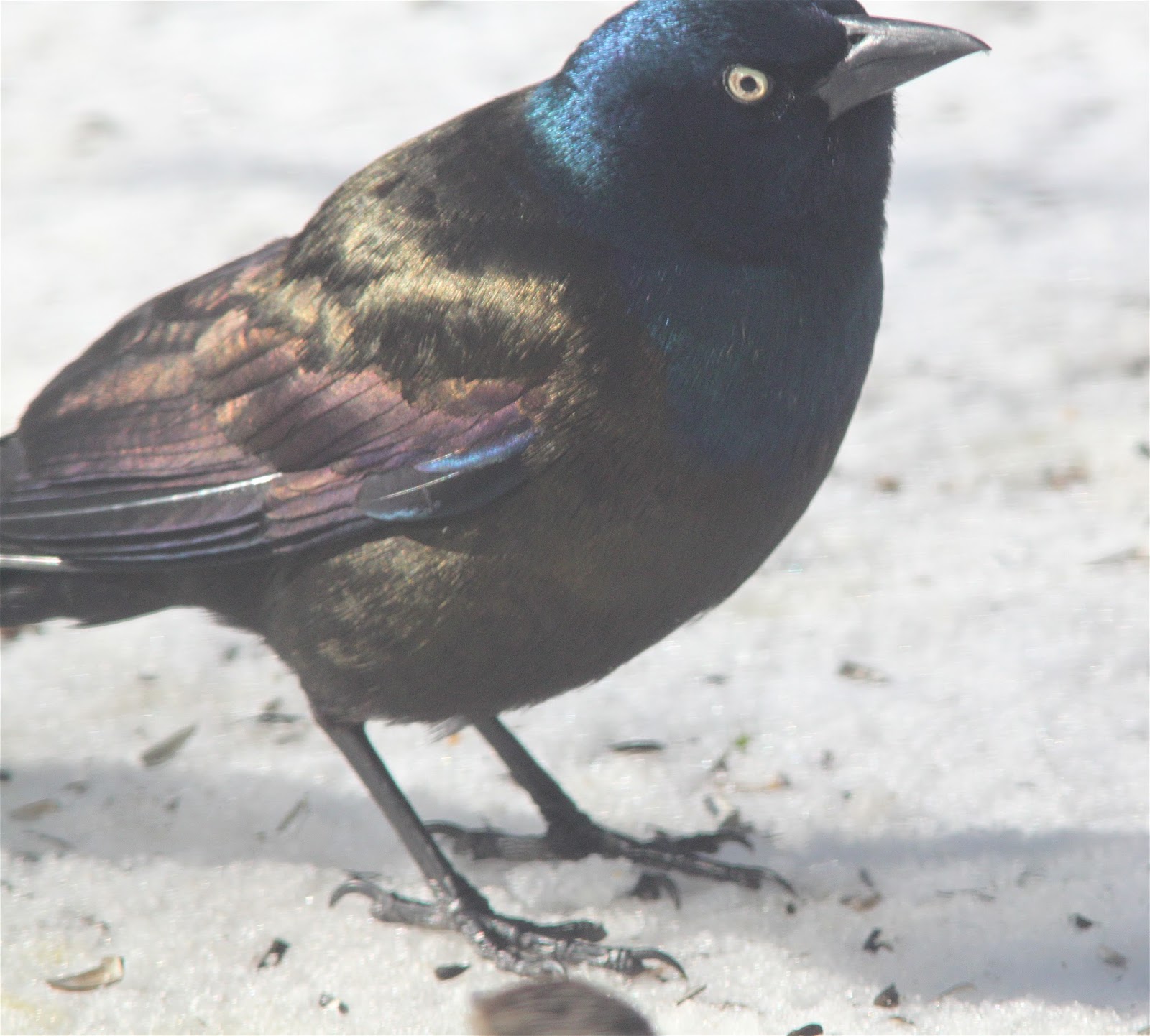
You notice I don't mention Rusty Blackbirds. They are much higher class and more genteel, and no one objects to having them. I've already shown you the Starling. The last abundant bird in the roosts is the Common Grackle, much larger than the others, and a gorgeous bird with a long sweeping tail and bronze and greenish-blue iridescence on its feathers.


Anyway (after that digression), when the blackbirds wake up and leave the roost, many of them come streaming right over our house, and inevitably, one day some of them noticed the small songbirds gathered in our front yard gobbling up the lavish feast we had put out for them. A bunch of the blackbirds peeled off and dropped down to check things out, and suddenly they were coming by the dozens. Now, a few of these birds would be fine at the feeder, but they don't know the meaning of restraint. They are big burly birds and they come like a tsunami, and sweep everything before them, driving off the smaller birds and inhaling the food put out for them faster than I can replace it.


Our birds by this time are fairly tame and pretty much ignore us; the blackbirds are wary. At first all I have to do is tap the glass lightly and wave my hand through the window and they fly off with a rush, so our birds can return to the feeders. But then the blackbirds begin to think we are paper tigers, and ignore us, so I have to rush outside clapping my hands until my palms hurt, which drives them up into the trees. While they are up there, our birds rush in to gulp down a few seeds before the blackbirds come seething back. Here are our starving goldfinches rushing to their niger seed sock while they have time:


Things start getting desperate. I take a bite of lunch, then have to rush outside, a pan and a stick in my hands as a noise maker, and not just chase the blackbirds into the trees, but chase them into the next row of trees beyond our house, then into the trees across the road. I run back to the house and try to get another bite of my lunch, but they have come down behind me and are marching in a phalanx back to the feeders.

We decide to try another tactic.  I put down a smaller amount of food, and put it just under our windows, closer than the blackbirds will come. We keep chasing them persistently, we keep the food out of their reach. They are sitting watching us, but the hope is, they will begin to think it might be more profitable somewhere else. We come out next morning, and they are gone. But so in fact are a lot of our birds. What's happening is, the snow is beginning to wear thin along edges, bits of fields are uncovering, suddenly there are other places to find food.

We are promised temperatures in the 60s in a few days. This weekend, daylight-saving time begins. Perhaps spring really is coming this time. By this time next week maybe, surveying our empty yard, we'll even wish we had our blackbirds back.