We decided, at the beginning of the year (and with the help of an excellent new field guide, Common Spiders of North America, by Richard Bradley, U Cal Press, 2013) to see if we could learn the spiders, a group that had always seemed to us too daunting to even begin on. Well, it's near the end of May, which will mean it has been five months that we began working full-time on this new venture, and I can't believe how much we have learned (I suppose coming from near zero that's not hard to do). We're still seeing one or two new species a day, but the great majority of spiders we see now are familiar ones. It's not that we used to see dozens of unfamiliar spiders every day, it's that we didn't see them at all. It's one more demonstration that if you don't try to put a name on something, you simply don't see it.
The Picasa Web Album I have been keeping now contains images of 130 species we have more or less identified, probably more than anyone besides me is interested in seeing. Even we sometimes feel a bit overwhelmed by the plenty. When I say how many we have identified, I am using the word loosely. Since we are beginners, I have no doubt we have made mistakes, and many of the spiders simply are difficult to pin down to species. Sometimes we see a new spider, find a picture of it in the guide that exactly matches it, read the text and find that its behavior is exactly as we witnessed it, and then, as a sort of afterthought, the author of the guide informs us that there are 47 species exactly like that one, and you need to dissect them to see which particular one you are looking at.
Nevertheless we are coming as close to the identity as we need to for our purposes, and we are noticing so many things about different kinds of webs, different hunting strategies, different courtship ceremonies, that we are getting ample pleasure for our obsession. The main thing: we are walking the same paths we have been walking for years, and seeing them all new. We have lived in the same house for 37 years, and it is an adventure crossing the front yard.
And now we have, in effect, doubled the adventure. You see, it had been in my mind that many, perhaps most, spiders are nocturnal. It was time to explore that side of things. By the simple expedient of putting on our head lamps (that we had used in the tropics for night walks), in the evening last week we went out the door into a brand new world.
With our lights strapped to the middle of our foreheads just above our eyes, the beam went out in the same line as our sight, and the spiders looked directly back at our eyes, and theirs shined up as brilliantly as cat's eyes (well, much smaller). Everywhere we looked out in the leaf litter, the eyes of the wolf spiders glittered back at us. During the day, if we spotted the wolf spiders at all in the leaf litter, they quickly dove out of sight under the leaves. At night with their eyes shining it was easy to see them, and harder for them to see us hidden in the shadows behind our lamps, so that if we didn't clump around too loudly, we could approach them rather easily, and get very nice close-up pictures of them out in the open.
Here are a few of the wolf spiders and crab spiders we saw. First, Varacosa avara, then Gladicosa gulosa, and then, the Leaflitter Crab Spider (not very many spiders have common names).
It is well known that color-blind people can spot camouflaged things more easily than people with normal color vision. Presumably when something has the same patchily-colored pattern as the background, it is difficult to separate it out. But if you don't see its disrupting color, it isn't able to fool you. At night no matter how brightly lighted, you are seeing essentially in black-and-white. So we also discovered this night something we had often heard about before: caterpillars (moth and butterfly caterpillars are another of our obsessions) are much easier to spot separated from their protective coloring. Cheryl was casting her light around in the leaves of a sugarberry tree (one of the larval food plants of the hackberry butterfly) and immediately picked out a number of hackberry butterfly caterpillars. Then she realized she was looking at an adult hackberry butterfly and a moment later saw next to it the chrysalis it had only recently emerged from. The butterfly flew away into the darkness before she could get a photo of it next to its empty chrysalis case, but she quickly began spotting other chrysalises nearby.
This is remarkable because the hackberry chrysalis is one of the most cleverly camouflaged that I know of and we hardly ever spot one though they are in plain sight. Here is the hatched one we saw, and here is another one unhatched, and if I had not put it dead center in the photograph you would not have seen it.
It was a very beautiful evening, warm, a light breeze, almost no mosquitoes. We wandered back to our pond. As my light flashed back and forth with my steps, it picked up a violent battle scene ahead, a large very powerful red carpenter ant (their jaws are strong enough to chew galleries through solid wood) fighting with a spider! By the time we got up close the spider had it wrapped up and was carrying it on a line up off the ground to a twig about three feet up on the trunk of a small tree. It was a small mostly black spider with some white spotting, and must have been an ant specialist. Few spiders can stomach (literally) a formic-acid filled ant, and very few will chance feeding on such a dangerous creature that has a whole army for backup. This spider apparently had dropped down to the ground on a line, caught the ant, and immediately carried it back up out of reach of the many other carpenter ants foraging nearby. In the the field guide the spider that most resembled it was Steatoda albomaculata, and when we read about it in the text, sure enough it was an ant specialist.
In the middle of the yard we saw the bigger shine of a large wolf spider and crept up on it, but our legs kicked some sticks, the movement startling the spider which quickly disappeared down a burrow. A number of spiders live in burrows during the day, then wait just outside them at night for any passing insects. We looked down the burrow, and saw what looked like headlights at the other end of a tunnel. We went off looking for other spiders, then sneaked back more carefully a few minutes later. It was out and allowed me a quick shot before disappearing again. When we looked at the picture later we recognized it as being in the genus Hogna, a group of larger wolf spiders that often live in burrows. We believe it was Hogna lenta.
Other night creatures were out including crickets and katydids of kinds we do not see by day
We went around to the front of the house and found a largeish wolf spider with woolly black front legs. This character identified it as a male of the species Schizocosa ocreata, one I had been hoping to find, so I was carefully zeroing in on it and taking my picture, even as Cheryl was shouting behind me that there was an unbelievable spider on the backporch step. Here's the picture I took quickly so I could run and see what Cheryl was shouting about.
She was right: the spider was beyond belief. It had a tiny body that was held high up off the ground by unimaginably long legs. It looked like some sort of agricultural sprayer that goes out in the field on great high legs so it won't knock down the tall crops.
While we were taking as many pictures of this as we could I noticed out of the corner of my eye a small pale-colored spider hanging to the siding of the house a few feet from my head. It looked so unprepossessing I ignored it, and just as an afterthought before we got up to race in the house and look at our pictures, I took a quick snap of it.
When we got into the house, we spent some time trying to work out what the long-legged spider was. It turned out to be the male of a common species in the yard, the Nursery Web Spider, a spider (the female anyway) of normal proportions famous for building a tent to raise her children in, while she guarded them from the outside. The males of many spider species tend to have a small body with extremely long legs, but this one carried the pattern to its absurdest degree. But while we were working this out I happened to glance at the shot of the pale little spider we had seen last and we realized it was the star of the evening, one of the spiders we were most hoping to see this year. We quickly raced outside to take some more, and more careful, shots of it. It's lucky we did, because a minute later it crawled out of sight somewhere inside the house siding.
It was a Spitting Spider.
This weak-looking species with its drinking-straw legs slowly walks to within 3 or 4 inches of a small fly or other prey item, and while the fly sits quietly, thinking it is a safe distance away from the spider and can fly if it needs to, the spider spits a mixture of glue and venom at it, spraying in a circle around it, and when the fly thinks to fly, it finds itself trapped in the glue and already dying from the poison.
Here are some pictures of the frail but quite elegant creature. Note how the cephalothorax rises up higher towards the rear, to house its glue and poison factory, and note that this is one of the rare six-eyed spiders, three double eyes arranged in a triangle.
The darkness behind us had left us enclosed in the world of these small creatures. For background music we had owls calling and coyotes yipping. We had no sense of time or space but hours had gone by. Under such rapt conditions these harmless little animals that might horrify or disgust some people, or at least call for systematic spraying with chemicals, had seemed to us quite beautiful.
It's addictive. We have gone out three evenings now in our garden, and a fourth time at our friends Jeff and Sue's cabin on Lake Norfork, where we saw a host of new species we are still puzzling out. It was a lovely evening up there and we dragged them and another friend all out and they enjoyed it with us. How impoverished a life without nature would be.
Tuesday, May 28, 2013
Wednesday, April 17, 2013
Butterfly trips
We've been busy for old folks.
We decided to take part in the annual Butterfly Count at Grandview Prairie, partly, I admit, because they were having an explosion of Frosted Elfins down there, an uncommon species we had never seen before. Grandview Prairie is in Hempstead Co. in the southwestern corner of the state, a long way down from Jonesboro. So since we were going that far anyway we decided to make a trip out of it. Our friend Ross said he would come feed our cat for four days. We loaded our cooler with enough food and drink for the trip, and we drove to the lodge at De Gray Lake where we had booked a room for our first stop. (I am saying "we" with the tiniest bit of guilt since Cheryl handled all the logistics.)
We got up next morning and drove to Lake Catherine S.P. and climbed to the top of Horseshoe Mountain and walked along the ridgetop glades. It was teeming with small white butterflies that were whizzing by us with great speed. We could see that lots of them had orange tips to their wings which meant that they were Falcate Orange-tips, a common early spring butterfly. But just as many of them did not have orange tips. Now, the female Orange-tip doesn't have orange tips, only the male. So, logically, a certain percentage of these were female Orange-tips. But we were scrutinizing them for something special, and when one of the all-white ones stopped for an instant on a flower (I got a distant shot of it), we saw greenish markings on the underwing sort of resembling in shape Matisse's dancing women.
This is what we had come for. Horseshoe Mountain is famous for being the most dependable place in the state to find the small butterfly with the charming name of Olympia Marble. The butterfly itself is a charmer, and we were hoping to get some decent photographs of it. This is one of those species that only comes out in early spring for a short time, and if you miss it you have to wait till next year for another chance. We had been here a few times before, and the problem we had always found is the same problem we were finding this day: This was a hilltop, and butterflies gather at hilltops in the spring to find mates. There were probably twenty or thirty Olympia Marbles flying around us, and they were probably all males, and the males do not stop till they find a female. And of course if they do not stop, you cannot photograph them.
About one o'clock in the afternoon we stopped at the highest point on the ridge to have lunch, and it was the height of hilltopping. Swallowtails, Mourning Cloaks, Goatweeds, Pearl Crescents, Juvenal's and Sleepy Duskywings, Falcate Orange-tips, and of course, Olympia Marbles, were swirling all around us. And we found an unexpected goodie, an Eastern Pine Elfin. We had seen a Henry's Elfin a few days before, and had the prospect of seeing a Frosted Elfin at Grandview Prairie: A three-elfin spring! But still no nice portraits of Olympia Marble, and we decided we had missed it again, and came back down off the hill.
But in the back of my mind I thought, We had one more chance. The next day we were going to join a walk with the Nature Conservancy up to the top of Trap Mountain. Trap Mountain was only about ten miles away and even higher than Horseshoe Mountain.
Well, we made the long steep climb to the top of Trap Mountain, a beautiful day, amazing views, and at the very top a cedar glade which looked like it had been lifted there from Horseshoe Mountain. We instantly found Olympia Marbles (it was a new location, and a new country record, for the species), and these were a bit more laid back, and were actually stopping to nectar on the flowers, giving us a chance to take their pictures. When they are freshly emerged, they have a pink tint to their wings. This fresh adult seems to be reflecting back the the color of the flowers it is nectaring on.
We ate our lunch with the group, then slipped and stumbled down the steep rocky slope to the bottom, hopped in our car and drove straight down to Hope, where we had booked a motel. The next morning we went across the road to the Walmart parking lot. At one end of it we saw some rough looking characters in old clothes, bearded and pony-tailed, loitering around some dusty vehicles, and concluded they could only be butterfliers going out for a day of chasing butterflies. This was the meeting spot.
We followed in caravan style to the middle of Grandview Prairie, where the leader pointed to the field we had parked in front of, and said he had seen about twenty Frosted Elfins there yesterday. We ambled into the field trying not to look too eager, and soon began seeing the fabled butterfly. That released the pressure, and we could then all concentrate on finding as many butterflies as we could for the rest of the day. I think the Frosted Elfins had gotten pretty battered during the two or three weeks of their flying life, and had pretty much lost their frosting. Anyway (don't tell anyone I said this) they were the drabbest special new rarity I can remember seeing.
We stayed another night in the motel in Hope, because we meant to drive all the way home to northeast Arkansas the next day, a five-hour trip if we did it non-stop, but we were going to wend our way back along remote forest service roads looking for more stuff to round out our four-day trip.
We stopped first at another Nature Conservancy area, Terre Noire Prairie near Arkadelphia, and saw a number of interesting spiders, but nothing special in the way of butterflies. Then we drove straight up highway 7 until we got north of Hot Springs Village, and turned east onto Forest Service Road 132 north of Jessieville. It runs east some thirty miles before reaching highway 9, and is our favorite stretch of forest service road. We have found numbers of special butterflies there over the years, Leonard's Skipper and Linda's Roadside Skipper and Dreamy Duskywing and Silvery Blue among others. At this time of year we stop at every hilltop along the road, and in fact we found a Silvery Blue at our first stop, sharing a delicious coyote scat with some Sleepy Duskywings.
And then something quite unexpected. As we climbed higher and higher up the winding road we came to some flowering wild plum trees. These only bloom for a couple of weeks in spring and often attract interesting butterflies, so we stopped by each tree and searched them carefully, and on the first one Cheryl spotted a flash of orange and blue, and realized it was a Great Purple Hairstreak, a butterfly as fancy as its name. It was high up and while we were still fumbling around trying to get our cameras in position, it flew off forever. We hardly ever see this species, and we have never gotten a chance to photograph one. They are only out for a short time in spring, and then it is usually at the tip top of a flowering plum tree where we can't get at them.
Well we drove the length of the road, and kept coming to clusters of plum trees, and kept seeing Great Purples on them, which kept appearing high up for a few moments before flying away. We saw six in all, an astonishing number for this seldom glimpsed species. Well, even if we didn't get a picture, anyway we had the pleasure of seeing them, I thought philosophically (in the back of my mind thinking there was another week left of plum blossoms, and wondering how I could justify driving all the way down here just for the remote chance of photographing one of these beauties).
As it happened, the next weekend Cheryl had to attend a meeting for a committee she is on, and the meeting was on the western edge of Little Rock, which was halfway there, so Cheryl booked a motel near Hot Springs Village and we drove there after her meeting. Next morning, when it was barely warm enough for insects to begin stirring, we were already on FR 132. Oh, lots of the plum trees had that pink color from a distance meaning they were through blooming for the year, but some of them still had fresh blossoms, and all of the ones with blossoms had Great Purples on them, many with two on them, a couple with four on them, and by the end of the run we had seen about fifteen, more in one day than we had seen in our life put together before. And while many stayed on the very tops of the trees, others came down closer, within reach, and one was so absurdly tame it fed on some fruit juice on Cheryl's hand.
They are surprisingly reticent with their bright colors, and never show all of them at once. This first typical picture shows the long tail plumes with stained-glass-window base, the red and white spots on the body, the brilliant orange abdomen. It doesn't show the upper side of the wings (which can only be seen in flight), a brilliant iridescent blue. The second picture (of an older individual with broken off tails) shows a flash of iridescent turquoise on the underside of the forewing, which is only revealed for an instant just after they land. The third picture shows Cheryl getting a close-up photograph.
Now we (meaning Cheryl) need to plan a trip to see early summer butterflies.
Tuesday, April 2, 2013
I'll count this as spring.
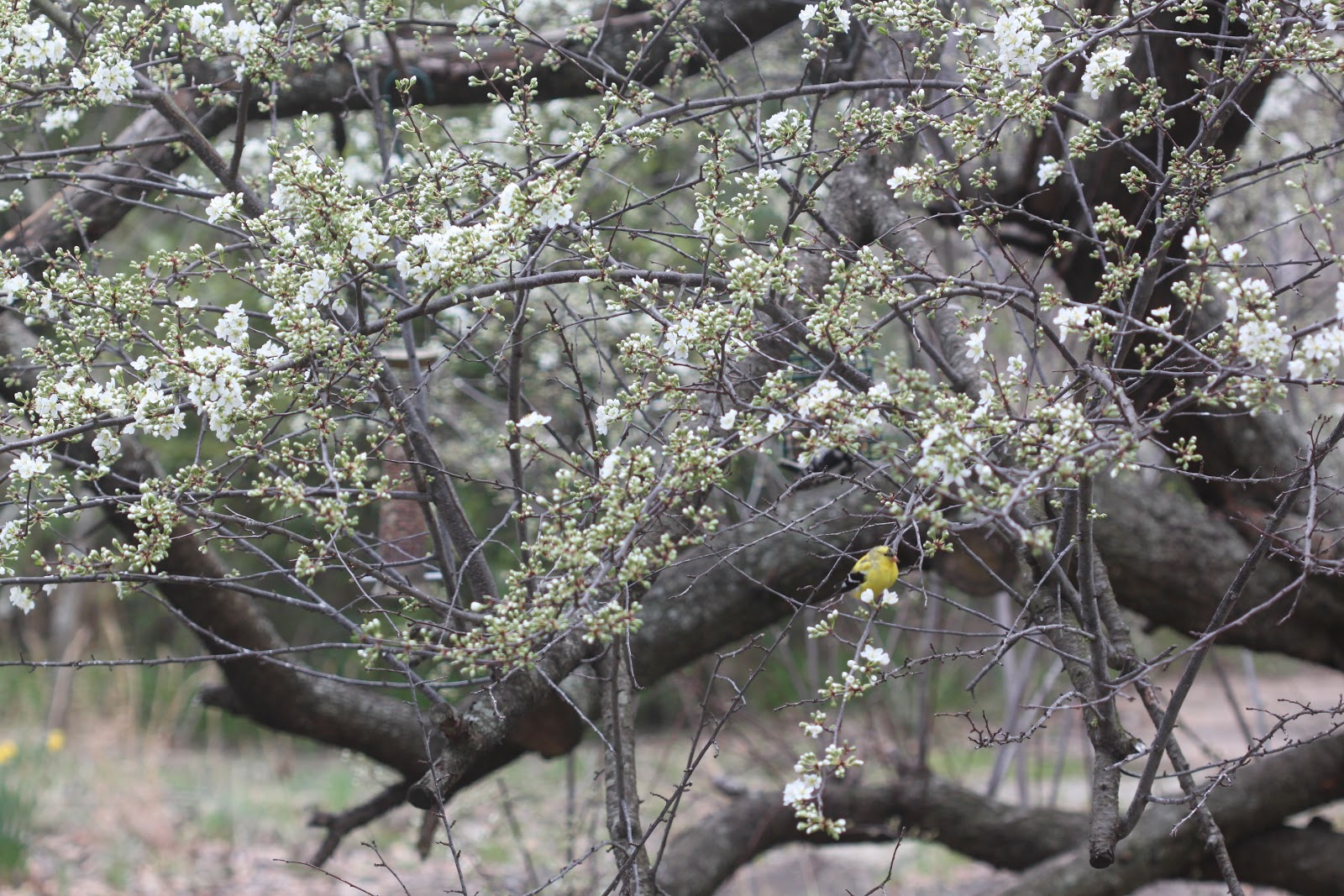
Flowers are blooming and birds are singing, and between the days of rain and gloom there are some warm sunny days that we are very grateful for. The other day I was looking at the plum tree in our front yard and saw that the very first flower was blooming. Here's a picture of it with a goldfinch mostly through its change from dull winter greens to bright summer yellow.
Here's the same tree (probably different bird) four days later.
Also the butterflies are starting to appear. Yesterday was fairly warm and sunny, and we went up to Scatter Creek WMA in Greene Co. and walked some of our favorite trails. We saw some half dozen species, mainly Mourning Cloaks (about twenty), which were so abundant last year that everyone remarked on them, and this year they are if anything even more abundant. But there were also bright orange Goatweed Leafwings, and rather yellow Orange Sulphurs and black Juvenal's Duskywings and blue Spring Azures, and white and orange Falcate Orange-tips (they were teeming; we saw 20+).
But best of all we saw Henry's Elfin, best because it is tiny and special and only comes out at this time of year for a brief time and if you miss it, you have missed it until next year. So there is always a bit of relief when you see that this year, anyway, you didn't miss it. They always land with their wings folded straight up, so that you only ever see the underside of them. Here's a picture of the butterfly from the right side, followed by a picture from the left side. On the left side its wing is partly folded over, so you get a glimpse of the interesting coppery color of its upper side.
The spiders, that we are going to try to learn this year, are suddenly coming faster than we can keep up. But here's a particularly interesting one I can share with you.
This is what we saw first, this 3-4 mm long creature walking steadily in a straight line across the driveway.
We had to look very closely to realize that it was not an ant but actually a tiny ant-mimicking jumping spider, and that the antennae it was waving in front of it were in fact its first pair of legs. Its name is Synemosyna formica. Here is a picture of it blown up so you can see it in more detail.
There are the fake antennae stretched out and waving in front. Note the black line going up the inside of the leg, so that what you see is more like a slender black antenna than like a fat leg. Now note the hind end. Most ants in warmer parts of the country don't have a simple abdomen. Instead the abdomen is constricted into two or three bulges, technically called gasters. This spider has two fake gasters. The antennae, the gasters, indicate to me that whatever creatures the spider wishes to fool are very good entomologists, so the mimicry needs to be detailed and exact. Now, why does a spider want to look like an ant? One theory is, ants are full of formic acid, and therefore most things don't want to eat them. A second possibility is, that the spider itself DOES want to eat ants, and its disguise might allow it to cozy up to a juicy real ant and catch it for dinner.
There is another mystery about this spider. Male spiders, when they are fully adult and ready to mate, have palps (the little leg-like things on either side of their mouth) that are swollen at the ends, carrying a lot of complicated sexual apparatus in them. Before mating, the male loads the palps with his sperm, and then uses them to place the sperm inside the female's sexual opening (which is located towards the front of the abdomen on the underside). The mystery here is, the spider in this picture is a subadult. It needs to shed its skin one more time before it is a mature adult, so even if it were a male, it shouldn't have swollen palps yet. But in fact, it is a subadult FEMALE, yet it has these bright red palps that it shows very prominently.
Here is a (not very good) picture showing the palps, which are the right shape for male palps, but don't seem to contain all the complex machinery. When she sheds into adulthood, she won't have these swollen red palps, but very modestly swollen and barely noticeable black palps (adult males have big complicated black palps which they use to wigwag at promising females, showing them their stuff).
Now I could easily explain the purpose behind all these mysteries, but she's really getting annoyed with me following her around, so I'll just let her go and say goodbye.
Thursday, March 21, 2013
Trying to get started
Two-thirds of the way through March and they're predicting blizzards! Cheryl is afraid this is one of those years when you go from winter directly into the heat of summer, with no spring. The leaves on our red buckeye trees, tricked by a couple of warm days, poised themselves to open, then have been stuck in that position ever since.
This one, anyway, managed to spring open.
On a rare warm day the creatures hibernating in our yard showed their impatience to get the year started. This sluggish ribbon snake, our first serpent of the year, was sunning out by our compost piles.
We're very fond of our snakes. We're less fond of the Eastern Tent Caterpillars that attack our one plum and two cherry trees and would totally defoliate them if we allowed it. We practice ahimsa in our yard, reverence for life, but it is enlightened ahimsa, meaning we defend ourselves against direct attack. Last year I had searched these trees for the tent caterpillar eggs, in a characteristic ring around a slender branch, and removed all those I found. But this morning Cheryl pointed out the kitchen window at our plum tree and there was a white sheen at the end of a branch. An egg ring I overlooked had just hatched. You could see the empty eggs shells, and the tiny caterpillars had already woven their first tent.
On a quite warm day, the queen paper wasps that had hibernated in our eaves and attics and outbuildings came piling out to see what the new year looked like. Most of the four or five species we have behave themselves and I let the new queens start their new nests in or under the eaves. But the big red Carolina paper wasps that always start a nest on a corner of the roof over our front porch behave themselves for a while until their numbers get much above a hundred, and then they start getting uppity and threatening us and finally stinging us. One year they stung Cheryl in the eye and I had to take her to Emergency. Now I try to control them, which is not easy. There is a lot of rotten wood under the eaves right there that allows them a big space inside the roof to build their nest as large as they want, and no matter how much duct tape I stick up there, all the little holes and cracks seem to be impossible to block off completely. It's such a secure and cozy space that most of the queens the nest produced last year hibernated right there.
On the warm day when the new wasps were flying all over I put my ladder up there and bent over to look into the openings in the eaves to see what I might do before there was an established nest and aggressive guards. At that moment the new queens came boiling out and it was clear that they weren't practicing ahimsa for one minute. I decided to get down off the ladder and come back on a cold day when they were sleeping again.
On a more positive note we had a hatch of baby trapdoor spiders. Here on the Mississippi Delta we don't have real tarantulas (they're up in the mountains), but we have the next best thing, trapdoor spiders. They are like somewhat smaller, blacker, less hairy tarantulas. We sometimes see the males walking around looking for females, but for us the females are impossible to find. They live in a tube underground, with a carefully camouflaged trapdoor at the top, which they only open to grab insects which walk by close to them. We only rarely see them when Cheryl accidentally digs one up while gardening. But we know they are there because from time to time we get a hatch of babies that climb up the side of our garage on a sunny day in spring to go ballooning off into the stratosphere. This day when I saw them they had already mostly ballooned, and there were only a dozen or so left. I called Cheryl out to see them, and within an hour they were all gone. Here's one, about a quarter of an inch long, but already looking more impressive than the usual spiderling.
That was a reminder that we had committed ourselves to trying to learn the spiders this year. Now, when you begin the study of a complex new group of living things you want to start at some fairly easy point of entry. Take birds, for instance. A new bird watcher begins by trying to identify common obvious species, robins and cardinals and blue jays, and works up to more difficult groups, the warblers, perhaps, or the ducks. Then after a year or so you begin to crave more and more difficult challenges, like brown streaky sparrows, or sandpipers that are all identical except for the length of their legs or their bills. You have entered the period of decadence in your sport. I don't know where the easy approach to spiders would be. Perhaps the orbweb spiders that hang in front of you in a big web and give you ample time to study them. But I know where decadence would be: the wolf spiders. There are probably a hundred species in Arkansas, many so similar to each other they can only be identified by dissection under a microscope. Instead of sitting in front of you in a web, they are constantly running away from you through the grass and under leaves and bark. Most of them are about the size of dots.
To identify spiders you really need to have adults, or near adults, and here is the catch. The big showy orbweb spiders are adults late in summer; the wolf spiders are the first ones out. They are adult right now, and there are virtually no other kinds of spiders around. So, we must start with decadence and slowly work our way up to the easy ones.
It started one morning when Cheryl found a tiny black dot in the sink. It had fallen in during the night and couldn't get out. She put it in a plastic container for me. It was so tiny I could barely see it. I took a close-up photo of it and blew the picture up on my computer. Here it is.
Now how do I figure out what it is?
Well, I went through the eight pages of plates of wolf spiders in my new Bradley field guide, comparing the illustrations with my spider, and reading the accounts of those which looked possible. I finally came to the page of wolf spiders of the genus Pardosa, and found they had this in common with my spider: long slender legs (compared to other wolf spider genera), with long spines on them. And this picture of Pardosa milvina was the closest match:
The field guide picture exaggerates the pattern for a clarity the live examples seldom have. The bottom figure is a male like mine. Note the long spines on the legs, and note that the legs are banded (many species don't have banded legs, so that it significant). Now you see two black bands going down the sides of the cephalothorax, leaving a pale band down the center. That band is somewhat pinched in behind the eyes. The pale band continues onto the abdomen, now a long narrow shape pointed at each end, with a pair of pale spots immediately beyond it.
Return to my picture, and you see the marking on the cephalothorax is approximately like the illustration, and the long mark at the base of the abdomen is present, but much shorter, as a pale brownish area, and immediately beyond it, a pair of small blueish dots. Also of course the spiny banded legs. Let's look at mine from closer up.
I read the text on this species, Pardosa milvina, and it said they were found on the edges of ponds and streams, and could effortlessly run across water.
Suddenly we were promised an eighty degree day. We went up to Harold Alexander WMA in the Ozarks, and walked along a stream and immediately saw little dot-sized wolf spiders running along. One ran straight across the water, and climbed up on a stalk. Through our binoculars we could see the banded legs, the two black bands across the cephalothorax. We took pictures, and when we got home I downloaded them and wrote on the caption, Pardosa milvina, and thought, now I'm getting started.
But something about it kept bothering me, so after a few days I looked at the picture more critically. Here it is:
The legs were banded, but when I looked at them closely I could see they weren't spiny, instead they were very hairy. Cheryl had already pointed out to me that the black bands on the cephalothorax didn't pitch in behind the eyes, but instead they were parallel sided. The markings on the abdomen didn't look at all alike. I studied the field guide again and finally worked out that it was Schizocosa saltatrix, not even the same genus as the first one. Here is the illustration of S. saltatrix from the field guide.
It was very educational. What I learned was, I didn't know a damn thing about wolf spiders. I felt quite smug about it, because I realized I had reached the same philosophical plateau as Socrates. He had questioned all the smartest people around, and discovered that they only thought they were smart but they actually didn't know anything. Therefore, he reasoned, HE was the actually the smartest person around, because he at least KNEW he didn't know anything.
Saturday, February 23, 2013
Our plans for the rest of the year
I love studying insects, their life histories, their behaviors, their distribution, and because I spend most of my time in Arkansas, a state rich in biodiversity, I especially enjoy studying Arkansas insects. And further, because I live on Crowley's Ridge, this isolated archipelago of hills rising out of the flat Mississippi Delta in NE Arkansas, I like studying the insects of Crowley's Ridge, with their unique nature and complement of relict and unusual species.
The way I like to operate is this: I like to pick out a particular group of insects, and put all my attention on them, I like to read everything I can about them, I like to go out in the field with my close-focusing binoculars and my digital camera with a macro lens, and find and photograph every one I can, and that involves learning what their special habitat is, and what they eat, and what time of year they are present, and what time of day. After two or three or five or six, or however many years I reach a point where I can recognize and identify by sight every species of that group I am likely to see in Arkansas. At that point I don't give up on them, I keep noticing them when I see them, I keep trying to get better pictures of them than I have, I keep trying to record special behavior that I have not witnessed before, but my heavy attention shifts to some other group that I want to learn about.
Of course I do all this together with Cheryl (with her sharp eyes she is usually the first to spot whatever we are looking for), and she has her own specialties, particularly moths and caterpillars, that I help her with. Over the years we have followed this pattern with dragonflies, butterflies, robber flies, moth caterpillars, tiger beetles. For the last two years I have been specializing in grasshoppers. At the time I started on grasshoppers I could identify by name perhaps half a dozen species. Now I have photographed and learned something about 55 species (of perhaps 70-75 that might occur in Arkansas), and the point of diminishing returns has set in. We will go on looking for grasshoppers, but we have done all the easy ones, and from now on I expect we will only find two or three new species every year. Frankly what I want now, what I enjoy most of all, is not the familiarity of a well studied group, but the novelty and steep learning curve of a brand new group.
You can't really study a particular creature without being able to put a name on it. For that reason there are certain things I look for in choosing a new group to study. First of all, a reasonable number of species to get your head around. Tiger beetles, at one extreme, only have 23-24 species occurring in Arkansas. Dragonflies and robber flies are both in the neighborhood of 125 species in the state, butterflies maybe 150, counting all the rare vagrants, grasshoppers less than a hundred. That all sounds very possible. Plus the vast majority of these come out in daytime, making them much easier (and more convenient) to see. And the great majority are flying in the air, or running on the ground or through vegetation, again making them more or less easy to find. Finally, most of the species are visibly different from each other, so that you can pin them down to exact species. Contrast this with, say, beetles or moths, that occur in thousands, many only out at night, or are otherwise invisible, burrowing in the ground, or tunneling through dead wood, with long lines of species so similar they can only be differentiated by dissecting out their genitalia to study under a microscope. For my purposes I would find that unworkable. You can of course pick a narrow group within the larger group, for instance, tiger beetles, but not beetles in general, hawk moths but not moths in general (Cheryl likes moths anyway).
Finally, what makes a real difference, is to have a first-rate field guide based on modern principles, namely, designed so you can identify species while they are alive and in the field, through your close-focusing binoculars, aided by close-up digital photographs. The amazing modern optical technology makes it possible, but the field guide makes it oh so much easier.
I started out in the 80's with dragonflies, helping George Harp, the state expert, making his first collections. There were no field guides as such back then, and we had to catch the dragonflies, make specimens out of them, and identify them by looking at the wing veins under a dissecting microscope. The old Peterson butterfly field guides were not "field" guides at all. They had pictures of rows of pinned specimens with their wings held in artificial positions. The only way you could learn them was to make your own collection and pin them in that artificial way and hold them side by side with the pictures in the field guide. I did that when I tried to learn the butterflies back then, and I found that it worked all right for the "true" butterflies, but the skippers (which are almost 50 percent of the butterflies), were nearly impossible to identify that way, and I gave up in discouragement. Instead I started, with my colleague in insect studies Herschel Raney, to study robber flies, and there were no guides of any kind and we had to start from scratch, collecting species, getting technical papers on different groups, running our specimens through identification keys under a dissecting microscope. Finally, with my web site "The Robber Flies of Crowley's Ridge," I made my own field guide for Arkansas robbers, so far the only robber fly field guide that there is.
But then after the new optics came out that allowed you to study insects in the field from four feet away at eight times magnification, allowing you to see fine details of pattern and structure, the new generation of field guides started coming out one after another, guides illustrated by photographs or paintings of living insects in their natural postures that could really be used to identify species in the field. This all transpired around the end of the century, which conveniently for me, was about the time I retired, and could give these new studies full time. Glassberg's "Butterflies Through Binoculars: The East," came out in 1999, and in the same series Dunkle's "Dragonflies Through Binoculars" in 2000. Later Capinera's "Field Guide to Grasshoppers, Katydids, and Crickets" came out in 2004, Wagner's "Caterpillars of Eastern North America" in 2005, Pearson's "A Field Guide to the Tiger Beetles" came out in 2006, and then more, and constantly improving, butterfly and dragonfly guides have been coming out almost yearly, and a quite full general insect guide, Eaton's "Kaufman Field Guide to Insects of North America," also in 2006.
These books have immeasurably enriched Cheryl's and my lives. They have led us to wild corners in Arkansas we might never have visited, and they have turned on lights, one after the other, that enabled us to see for the first time things that had always been right before our eyes. Now a fine new guide has come out, and I think it is going to direct our lives for the next year or few years. It is "Common Spiders of North America," by Richard Bradley, and very handsomely illustrated by Steve Buchanan (University of California Press, 2013). It's not quite the "ideal" group, as I was describing it above. I know, I know, they aren't insects, but that's not a problem, they are equivalent arthropods. But many stay hidden under stones and bark, or in burrows, etc., or only come out at night, and there are long lines of lookalike species that need dissection to identify, and who knows how many hundreds of species there are. But I don't care: The illustrations in the new field guide won me over at first glance.
Actually, we have always been very fond of spiders. I often kept them as pets when I was a kid, and the big Argiopes, the Black-and-Yellow Garden Spiders, in our yard every summer are virtually pets (our Brown Recluses, for that matter, that live in the house with us, are nearly pets, but we keep a little more distance on them). We have never, however, given spiders in general the close attention they deserve with their many extraordinary behaviors that seem so close to reasoning. When we have been out in the field, and I was concentrating on robber flies or whatever my current obsession was, Cheryl always took pictures of interesting spiders, and I did too, I guess, though never as many.
So that's been the beginning: I have recently gathered together all our spider pictures from the last eight or nine years, put them in a Picasa Web album, and then used the new field guide (with lots of help from BugGuide) to put names on them. It turned out we had about 70-odd species, and although a lot of the ID's are a bit dodgy, I have put some kind of name on most of them. Now I can't wait for the weather to warm up, so I can see the first spiders come out. Let the good times roll! (Unless you are so benighted that you don't like spiders. Well, if you don't like them, I will just have to educate you.)
Let's start with a preview, anyway. The Jumping Spiders (family Salticidae), make up the largest spider family (over 5000 species worldwide), and are one of the most popular groups. Most spiders have eight eyes, and the size and arrangement on the head of these eyes helps identify the different families. In the case of jumping spiders there are two enormous eyes front and center on the very flat face which give them extremely sharp vision and accurate triangulation. They don't spin webs; rather, they spot their prey from a distance and stalk it like a cat, and when they get close enough, they spring, again just like a cat. They come in an infinite number of shapes and color patterns, but they are immediately recognizable by their big eyes and flat faces, and their alert cautious walking, constantly switching around to look at whatever moves ahead of them, and are also recognizable by their responsiveness to you. If you look at them, they will immediately turn and look back at you.
More than that, they have elaborate courtship dances in which they wigwag their long front legs at each other. If you hold up your two index fingers, you can wigwag at them and sometimes get an answer.
Mimicry is a common theme among arthropods. For various reasons, a number of jumping spiders are amazingly accurate mimics of ants. Is it because ants are full of formic acid so most things don't want to eat them, or is it so they can cozy up to a real ant and have it for dinner? Those that mimic ants race along in a straight line exactly like ants, and walk on their back three sets of legs, waggling their first set of legs out in front of them like ant antennae. Look at this nice example.
They are all, of course, terrific hunters.
We will be learning all this, but I am guessing that the first warm sunny day in March, the first Jumping Spiders will be out. It will be fun to see how many species we can find over the year. I'll make another rash guess: 25 species of Jumping Spiders by December.
Monday, February 11, 2013
Skulls
We have all heard the stories of paleoanthropologists digging up a single tooth and working out from it that it belongs to a new species of early-human, and saying something about its diet and behavior and taxonomic relationships and deriving a natural history for it. I myself love creating complex theories out of minimal evidence and feel I missed my calling by becoming an English teacher instead of a paleontologist (Cheryl thinks I did the next closest thing by becoming a fiction writer).
I might very well have gone the other way. As a kid I loved skulls and began building up a collection of them that I'm still adding to, and which is sitting on an entire bookcase shelf just across the room from me as I am writing this. I used to (well, I'm still doing it) keep an eye out for roadkills that weren't too badly smashed up, and if I found some animal whose skull I particularly wanted, I would set it on the shoulder off the road, somewhere out of sight from others (who might steal it from me?), but where I could find it again, and then I would come looking for it several months later. You try to gauge just how long to leave it, to some period where the bugs have mostly cleaned it up, but it hasn't totally disintegrated. But if it was an especially choice animal I would cut the head off right then and bring it straight home and put it in a jar or bucket of water and stick it in the farthest away corner of the yard to let it "macerate." The far corner because it wasn't pleasant to see, and it could really stink. And it took forever, months and months. If you timed it just right, when you poured all the stinky goop out on the ground, the purest whitest most beautiful skull suddenly appeared out of it, which a gentle hosing (trying to be careful no loose teeth were lost) and drying would make into a perfect specimen. If you waited too long every separate bone would fall apart and you would be left with a 1000-piece 3-D puzzle to glue back together.
Skulls are beautiful intricate sculptural objects, and, fair play to the paleontologists, you can learn practically everything about an animal from its skull, especially from its teeth. The reason I am going on about them here is that my son Gawain and his friend Heather saw a book they knew I would like and got it for me as a Christmas present. The book is called "Skulls," and is by Simon Winchester ("The Professor and the Madman," "Krakatoa," etc.), and is about Alan Dudley, who was like me as a kid but raised up a few levels of magnitude, and now has the largest personal collection of skulls in the world. The text says something about Dudley's obsession and so on, but the text is very brief, and mainly the book is page after page of photographs (by Nick Mann) of the skulls themselves, and (at least for an old collector like me) they are wonderful. They have made me look again at my own I admit rather dust-covered collection, and I am pleased to notice that, on its tinier scale I have also tried to create a representative group of different types, particularly of mammals.
What I'm going to do here is to show (well, show off) a few of my own skulls and point out some of the ways the teeth indicate diet and even behavior.
Here for example is an Eastern Mole. It's an insectivore, and this is indicated by its undifferentiated teeth. They are virtually all just the same, simple pegs, which are ideal for picking up an insect or worm, and perhaps ripping it into chunks small enough to swallow without much chewing,
People sometimes ask me if moles are related to mice and rats, because they are similarly small furry animals that live in the ground. But look here at this skull of a Brown Rat. It has highly differentiated teeth. It has two enormous incisors in the front, designed for digging burrows in the ground, or biting off thick plant stocks. It is an omnivore that is fond of eating meat, but there would be no room for canines behind those incisors, so it has no canines, and uses the powerful incisors instead as killing weapons. Any food that comes into the mouth goes straight to the back of the mouth to be chewed up by the molars.
Here is another animal totally unrelated to moles, an armadillo. But because it has a similar insectivorous diet, it has evolved a similar mouth full of simple peg teeth. The teeth, in other words, indicate diet, but can be tricky to use to show taxonomic relationship.
Here is another example of this fact. This is a harbor seal. Note in the second picture how the very large brain has been flattened out to the side to keep the profile of the skull flat, unobstructed, and aerodynamic for smooth fast swimming. But note especially that the canine teeth of this carnivore have been somewhat reduced to be more the size of the other teeth, and all of the teeth are tending towards being pointed. Fish are so fast and swerving that it would be difficult to use an accurate bite with canines to capture them. What is needed is a mouthful of sharp points so that any kind of bite can impale the slippery prey and hold on to it.
Now look at this: Here is a river otter, a totally unrelated animal, a kind of aquatic weasel, but also an animal that catches fish by swimming swiftly after them. Note here that, almost identical to the seal, it has a flat aerodynamic shape to the skull, similarly with its quite big brain (does that mean fishermen have to be smart?) squashed out to the sides to keep the top flat, and most similarly its carnivore's teeth have been modified to be sharp fish-snaggers.
Here is the skull of a domestic cat. The cat is a total carnivore; virtually one-hundred percent of its diet is meat. What you see are very long sharp canines with a gap behind them so that they stand clear of other teeth and can be stabbed their full length into their prey. In this case they are especially designed to go around the neck bones of their small prey and quickly break the spine. Then notice how few back teeth they have. There is not a heavy complement of molars, because cats don't do any chewing. Instead the few molars they have are modified into carnassials. The upper and lower teeth fit together like the blades of a scissors and their function is to slice. They cut meat into small pieces and it is then swallowed directly. The second picture, from the front shows another carnivore adaptation. The incisors are practically nonexistent. Incisors are most useful for biting off plant material, something a cat has no use for.
Here is a bobcat skull. Except for the size (which you can't tell from this picture) it is virtually identical to the house cat. Cats are in fact perfectly designed for their stalk-and-leap style of hunting, with forward-facing eyes (the snout shortened so as not to be in the way) for accurate triangulation, the teeth reduced to a functional minimum (it would take a longer snout to fit more of them in). When cats evolved to fit into another niche, it was to hunt a different size-range of prey. They didn't change their perfect design, they just got larger or smaller.
To show what I mean, here is a puma. (This skull unfortunately has the upper canine broken in half, so in the second picture I will show it turned around to show the length of the full canine.) It's a bit more massive, but it's still the exact same design.
Here they all are together.
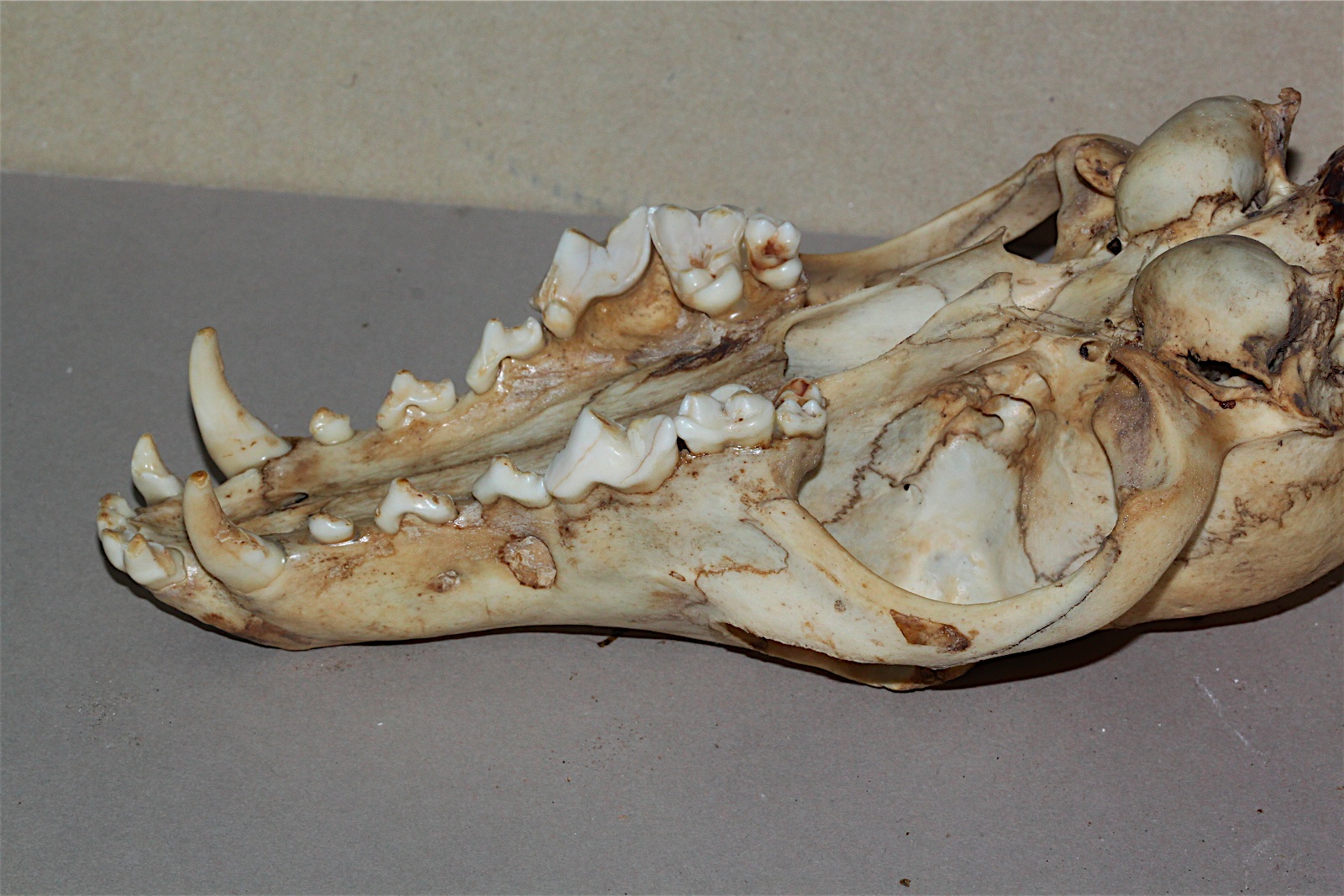
Here is a carnivore with different behavior, a coyote. A cat often makes a surprise leap on sitting prey, and can set its canine teeth accurately. A coyote is often chasing swift and elusive prey (rabbits, for instance), and with its long jaws with canines at the tip end, can nip repeatedly until it gets a good hold, and then can bite to make the kill. But also, as the second picture shows, it has much better developed incisors than a cat, because coyotes eat vegetable food as well, melons and fruits, and for that, as the third picture shows, it has a full set of molars for chewing.
There's one more skull I want to show. This one reminds me of a time I was attending a conference in Washington D.C. and had a few hours off and wandered into the Smithsonian to some rooms full of skeletons and particularly skulls. One room was all primate skulls, from tiny monkey skulls the size of a hen's egg to enormous orangutan and gorilla skulls. No one was around and I was sort of daydreaming as I entered the room, and suddenly I was surrounded by staring faces. After all, we are all primates. These had big craniums, and most had flat faces with two big staring forward-facing eye sockets. I was briefly quite startled. They were all human faces, humans of all different sizes, but what was most unsettling is, they all had big powerful canine teeth. They were monsters, demons, vampires. Several years ago when Gawain came back from a trip to Brazil he brought me a monkey skull, one of my prized possessions. If I hadn't known it was a monkey, if I was just handed the skull and was asked what I could gather about its diet and behavior, I would have guessed that it sneaked into our bedrooms at night and sucked our blood.
Subscribe to:
Posts (Atom)