Thursday, March 21, 2013

Trying to get started

Two-thirds of the way through March and they're predicting blizzards! Cheryl is afraid this is one of those years when you go from winter directly into the heat of summer, with no spring. The leaves on our red buckeye trees, tricked by a couple of warm days, poised themselves to open, then have been stuck in that position ever since.


This one, anyway, managed to spring open.


On a rare warm day the creatures hibernating in our yard showed their impatience to get the year started. This sluggish ribbon snake, our first serpent of the year, was sunning out by our compost piles.


We're very fond of our snakes. We're less fond of the Eastern Tent Caterpillars that attack our one plum and two cherry trees and would totally defoliate them if we allowed it. We practice ahimsa in our yard, reverence for life, but it is enlightened ahimsa, meaning we defend ourselves against direct attack. Last year I had searched these trees for the tent caterpillar eggs, in a characteristic ring around a slender branch, and removed all those I found. But this morning Cheryl pointed out the kitchen window at our plum tree and there was a white sheen at the end of a branch. An egg ring I overlooked had just hatched. You could see the empty eggs shells, and the tiny caterpillars had already woven their first tent.


On a quite warm day, the queen paper wasps that had hibernated in our eaves and attics and outbuildings came piling out to see what the new year looked like. Most of the four or five species we have behave themselves and I let the new queens start their new nests in or under the eaves. But the big red Carolina paper wasps that always start a nest on a corner of the roof over our front porch behave themselves for a while until their numbers get much above a hundred, and then they start getting uppity and threatening us and finally stinging us. One year they stung Cheryl in the eye and I had to take her to Emergency. Now I try to control them, which is not easy. There is a lot of rotten wood under the eaves right there that allows them a big space inside the roof to build their nest as large as they want, and no matter how much duct tape I stick up there, all the little holes and cracks seem to be impossible to block off completely. It's such a secure and cozy space that most of the queens the nest produced last year hibernated right there.

On the warm day when the new wasps were flying all over I put my ladder up there and bent over to look into the openings in the eaves to see what I might do before there was an established nest and aggressive guards. At that moment the new queens came boiling out and it was clear that they weren't practicing ahimsa for one minute. I decided to get down off the ladder and come back on a cold day when they were sleeping again.


On a more positive note we had a hatch of baby trapdoor spiders. Here on the Mississippi Delta we don't have real tarantulas (they're up in the mountains), but we have the next best thing, trapdoor spiders. They are like somewhat smaller, blacker, less hairy tarantulas. We sometimes see the males walking around looking for females, but for us the females are impossible to find. They live in a tube underground, with a carefully camouflaged trapdoor at the top, which they only open to grab insects which walk by close to them. We only rarely see them when Cheryl accidentally digs one up while gardening. But we know they are there because from time to time we get a hatch of babies that climb up the side of our garage on a sunny day in spring to go ballooning off into the stratosphere. This day when I saw them they had already mostly ballooned, and there were only a dozen or so left. I called Cheryl out to see them, and within an hour they were all gone. Here's one, about a quarter of an inch long, but already looking more impressive than the usual spiderling.


That was a reminder that we had committed ourselves to trying to learn the spiders this year. Now, when you begin the study of a complex new group of living things you want to start at some fairly easy point of entry. Take birds, for instance. A new bird watcher begins by trying to identify common obvious species, robins and cardinals and blue jays, and works up to more difficult groups, the warblers, perhaps, or the ducks. Then after a year or so you begin to crave more and more difficult challenges, like brown streaky sparrows, or sandpipers that are all identical except for the length of their legs or their bills. You have entered the period of decadence in your sport. I don't know where the easy approach to spiders would be. Perhaps the orbweb spiders that hang in front of you in a big web and give you ample time to study them. But I know where decadence would be: the wolf spiders. There are probably a hundred species in Arkansas, many so similar to each other they can only be identified by dissection under a microscope. Instead of sitting in front of you in a web, they are constantly running away from you through the grass and under leaves and bark. Most of them are about the size of dots.

To identify spiders you really need to have adults, or near adults, and here is the catch. The big showy orbweb spiders are adults late in summer; the wolf spiders are the first ones out. They are adult right now, and there are virtually no other kinds of spiders around. So, we must start with decadence and slowly work our way up to the easy ones.

It started one morning when Cheryl found a tiny black dot in the sink. It had fallen in during the night and couldn't get out. She put it in a plastic container for me. It was so tiny I could barely see it. I took a close-up photo of it and blew the picture up on my computer. Here it is.


Now how do I figure out what it is?

Well, I went through the eight pages of plates of wolf spiders in my new Bradley field guide, comparing the illustrations with my spider, and reading the accounts of those which looked possible. I finally came to the page of wolf spiders of the genus Pardosa, and found they had this in common with my spider: long slender legs (compared to other wolf spider genera), with long spines on them. And this picture of Pardosa milvina was the closest match:


The field guide picture exaggerates the pattern for a clarity the live examples seldom have. The bottom figure is a male like mine. Note the long spines on the legs, and note that the legs are banded (many species don't have banded legs, so that it significant). Now you see two black bands going down the sides of the cephalothorax, leaving a pale band down the center. That band is somewhat pinched in behind the eyes. The pale band continues onto the abdomen, now a long narrow shape pointed at each end, with a pair of pale spots immediately beyond it.

Return to my picture, and you see the marking on the cephalothorax is approximately like the illustration, and the long mark at the base of the abdomen is present, but much shorter, as a pale brownish area, and immediately beyond it, a pair of small blueish dots. Also of course the spiny banded legs. Let's look at mine from closer up.


I read the text on this species, Pardosa milvina, and it said they were found on the edges of ponds and streams, and could effortlessly run across water.

Suddenly we were promised an eighty degree day. We went up to Harold Alexander WMA in the Ozarks, and walked along a stream and immediately saw little dot-sized wolf spiders running along. One ran straight across the water, and climbed up on a stalk. Through our binoculars we could see the banded legs, the two black bands across the cephalothorax. We took pictures, and when we got home I downloaded them and wrote on the caption, Pardosa milvina, and thought, now I'm getting started.

But something about it kept bothering me, so after a few days I looked at the picture more critically. Here it is:


The legs were banded, but when I looked at them closely I could see they weren't spiny, instead they were very hairy. Cheryl had already pointed out to me that the black bands on the cephalothorax didn't pitch in behind the eyes, but instead they were parallel sided. The markings on the abdomen didn't look at all alike. I studied the field guide again and finally worked out that it was Schizocosa saltatrix, not even the same genus as the first one. Here is the illustration of S. saltatrix from the field guide.


It was very educational. What I learned was, I didn't know a damn thing about wolf spiders. I felt quite smug about it, because I realized I had reached the same philosophical plateau as Socrates. He had questioned all the smartest people around, and discovered that they only thought they were smart but they actually didn't know anything. Therefore, he reasoned, HE was the actually the smartest person around, because he at least KNEW he didn't know anything.


Saturday, February 23, 2013

Our plans for the rest of the year

I love studying insects, their life histories, their behaviors, their distribution, and because I spend most of my time in Arkansas, a state rich in biodiversity, I especially enjoy studying Arkansas insects. And further, because I live on Crowley's Ridge, this isolated archipelago of hills rising out of the flat Mississippi Delta in NE Arkansas, I like studying the insects of Crowley's Ridge, with their unique nature and complement of relict and unusual species.

The way I like to operate is this: I like to pick out a particular group of insects, and put all my attention on them, I like to read everything I can about them, I like to go out in the field with my close-focusing binoculars and my digital camera with a macro lens, and find and photograph every one I can, and that involves learning what their special habitat is, and what they eat, and what time of year they are present, and what time of day. After two or three or five or six, or however many years I reach a point where I can recognize and identify by sight every species of that group I am likely to see in Arkansas. At that point I don't give up on them, I keep noticing them when I see them, I keep trying to get better pictures of them than I have, I keep trying to record special behavior that I have not witnessed before, but my heavy attention shifts to some other group that I want to learn about.

Of course I do all this together with Cheryl (with her sharp eyes she is usually the first to spot whatever we are looking for), and she has her own specialties, particularly moths and caterpillars, that I help her with.  Over the years we have followed this pattern with dragonflies, butterflies, robber flies, moth caterpillars, tiger beetles. For the last two years I have been specializing in grasshoppers. At the time I started on grasshoppers I could identify by name perhaps half a dozen species. Now I have photographed and learned something about 55 species (of perhaps 70-75 that might occur in Arkansas), and the point of diminishing returns has set in. We will go on looking for grasshoppers, but we have done all the easy ones, and from now on I expect we will only find two or three new species every year. Frankly what I want now, what I enjoy most of all, is not the familiarity of a well studied group, but the novelty and steep learning curve of a brand new group.

You can't really study a particular creature without being able to put a name on it. For that reason there are certain things I look for in choosing a new group to study. First of all, a reasonable number of species to get your head around. Tiger beetles, at one extreme, only have 23-24 species occurring in Arkansas. Dragonflies and robber flies are both in the neighborhood of 125 species in the state, butterflies maybe 150, counting all the rare vagrants, grasshoppers less than a hundred. That all sounds very possible. Plus the vast majority of these come out in daytime, making them much easier (and more convenient) to see. And the great majority are flying in the air, or running on the ground or through vegetation, again making them more or less easy to find. Finally, most of the species are visibly different from each other, so that you can pin them down to exact species. Contrast this with, say, beetles or moths, that occur in thousands, many only out at night, or are otherwise invisible, burrowing in the ground, or tunneling through dead wood, with long lines of species so similar they can only be differentiated by dissecting out their genitalia to study under a microscope. For my purposes I would find that unworkable. You can of course pick a narrow group within the larger group, for instance, tiger beetles, but not beetles in general, hawk moths but not moths in general (Cheryl likes moths anyway).

Finally, what makes a real difference, is to have a first-rate field guide based on modern principles, namely, designed so you can identify species while they are alive and in the field, through your close-focusing binoculars, aided by close-up digital photographs. The amazing modern optical technology makes it possible, but the field guide makes it oh so much easier.

I started out in the 80's with dragonflies, helping George Harp, the state expert, making his first collections. There were no field guides as such back then, and we had to catch the dragonflies, make specimens out of them, and identify them by looking at the wing veins under a dissecting microscope. The old Peterson butterfly field guides were not "field" guides at all. They had pictures of rows of pinned specimens with their wings held in artificial positions. The only way you could learn them was to make your own collection and pin them in that artificial way and hold them side by side with the pictures in the field guide. I did that when I tried to learn the butterflies back then, and I found that it worked all right for the  "true" butterflies, but the skippers (which are almost 50 percent of the butterflies), were nearly impossible to identify that way, and I gave up in discouragement. Instead I started, with my colleague in insect studies Herschel Raney, to study robber flies, and there were no guides of any kind and we had to start from scratch, collecting species, getting technical papers on different groups, running our specimens through identification keys under a dissecting microscope. Finally, with my web site "The Robber Flies of Crowley's Ridge," I made my own field guide for Arkansas robbers, so far the only robber fly field guide that there is.

But then after the new optics came out that allowed you to study insects in the field from four feet away at eight times magnification, allowing you to see fine details of pattern and structure, the new generation of field guides started coming out one after another, guides illustrated by photographs or paintings of living insects in their natural postures that could really be used to identify species in the field.  This all transpired around the end of the century, which conveniently for me, was about the time I retired, and could give these new studies full time. Glassberg's "Butterflies Through Binoculars: The East," came out in 1999, and in the same series Dunkle's "Dragonflies Through Binoculars" in 2000.  Later Capinera's "Field Guide to Grasshoppers, Katydids, and Crickets" came out in 2004, Wagner's "Caterpillars of Eastern North America" in 2005, Pearson's "A Field Guide to the Tiger Beetles" came out in 2006, and then more, and constantly improving, butterfly and dragonfly guides have been coming out almost yearly, and a quite full general insect guide, Eaton's "Kaufman Field Guide to Insects of North America," also in 2006.

These books have immeasurably enriched Cheryl's and my lives. They have led us to wild corners in Arkansas we might never have visited, and they have turned on lights, one after the other, that enabled us to see for the first time things that had always been right before our eyes. Now a fine new guide has come out, and I think it is going to direct our lives for the next year or few years. It is "Common Spiders of North America," by Richard Bradley, and very handsomely illustrated by Steve Buchanan (University of California Press, 2013). It's not quite the "ideal" group, as I was describing it above. I know, I know, they aren't insects, but that's not a problem, they are equivalent arthropods. But many stay hidden under stones and bark, or in burrows, etc., or only come out at night, and there are long lines of lookalike species that need dissection to identify, and who knows how many hundreds of species there are. But I don't care: The illustrations in the new field guide won me over at first glance.

Actually, we have always been very fond of spiders. I often kept them as pets when I was a kid, and the big Argiopes, the Black-and-Yellow Garden Spiders, in our yard every summer are virtually pets (our Brown Recluses, for that matter, that live in the house with us, are nearly pets, but we keep a little more distance on them). We have never, however, given spiders in general the close attention they deserve with their many extraordinary behaviors that seem so close to reasoning. When we have been out in the field, and I was concentrating on robber flies or whatever my current obsession was, Cheryl always took pictures of interesting spiders, and I did too, I guess, though never as many.

So that's been the beginning: I have recently gathered together all our spider pictures from the last eight or nine years, put them in a Picasa Web album, and then used the new field guide (with lots of help from BugGuide) to put names on them. It turned out we had about 70-odd species, and although a lot of the ID's are a bit dodgy, I have put some kind of name on most of them. Now I can't wait for the weather to warm up, so I can see the first spiders come out. Let the good times roll! (Unless you are so benighted that you don't like spiders. Well, if you don't like them, I will just have to educate you.)

Let's start with a preview, anyway.  The Jumping Spiders (family Salticidae), make up the largest spider family (over 5000 species worldwide), and are one of the most popular groups. Most spiders have eight eyes, and the size and arrangement on the head of these eyes helps identify the different families. In the case of jumping spiders there are two enormous eyes front and center on the very flat face which give them extremely sharp vision and accurate triangulation. They don't spin webs; rather, they spot their prey from a distance and stalk it like a cat, and when they get close enough, they spring, again just like a cat. They come in an infinite number of shapes and color patterns, but they are immediately recognizable by their big eyes and flat faces, and their alert cautious walking, constantly switching around to look at whatever moves ahead of them, and are also recognizable by their responsiveness to you. If you look at them, they will immediately turn and look back at you.


More than that, they have elaborate courtship dances in which they wigwag their long front legs at each other. If you hold up your two index fingers, you can wigwag at them and sometimes get an answer.


Mimicry is a common theme among arthropods. For various reasons, a number of jumping spiders are amazingly accurate mimics of ants. Is it because ants are full of formic acid so most things don't want to eat them, or is it so they can cozy up to a real ant and have it for dinner? Those that mimic ants race along in a straight line exactly like ants, and walk on their back three sets of legs, waggling their first set of legs out in front of them like ant antennae. Look at this nice example.


They are all, of course, terrific hunters.


We will be learning all this, but I am guessing that the first warm sunny day in March, the first Jumping Spiders will be out. It will be fun to see how many species we can find over the year. I'll make another rash guess: 25 species of Jumping Spiders by December.


Monday, February 11, 2013

Skulls

We have all heard the stories of paleoanthropologists digging up a single tooth and working out from it that it belongs to a new species of early-human, and saying something about its diet and behavior and taxonomic relationships and deriving a natural history for it. I myself love creating complex theories out of minimal evidence and feel I missed my calling by becoming an English teacher instead of a paleontologist (Cheryl thinks I did the next closest thing by becoming a fiction writer).

I might very well have gone the other way. As a kid I loved skulls and began building up a collection of them that I'm still adding to, and which is sitting on an entire bookcase shelf just across the room from me as I am writing this. I used to (well, I'm still doing it) keep an eye out for roadkills that weren't too badly smashed up, and if I found some animal whose skull I particularly wanted, I would set it on the shoulder off the road, somewhere out of sight from others (who might steal it from me?), but where I could find it again, and then I would come looking for it several months later. You try to gauge just how long to leave it, to some period where the bugs have mostly cleaned it up, but it hasn't totally disintegrated. But if it was an especially choice animal I would cut the head off right then and bring it straight home and put it in a jar or bucket of water and stick it in the farthest away corner of the yard to let it "macerate." The far corner because it wasn't pleasant to see, and it could really stink. And it took forever, months and months. If you timed it just right, when you poured all the stinky goop out on the ground, the purest whitest most beautiful skull suddenly appeared out of it, which a gentle hosing (trying to be careful no loose teeth were lost) and drying would make into a perfect specimen. If you waited too long every separate bone would fall apart and you would be left with a 1000-piece 3-D puzzle to glue back together.

Skulls are beautiful intricate sculptural objects, and, fair play to the paleontologists, you can learn practically everything about an animal from its skull, especially from its teeth. The reason I am going on about them here is that my son Gawain and his friend Heather saw a book they knew I would like and got it for me as a Christmas present. The book is called "Skulls," and is by Simon Winchester ("The Professor and the Madman," "Krakatoa," etc.), and is about Alan Dudley, who was like me as a kid but raised up a few levels of magnitude, and now has the largest personal collection of skulls in the world. The text says something about Dudley's obsession and so on, but the text is very brief, and mainly the book is page after page of photographs (by Nick Mann) of the skulls themselves, and (at least for an old collector like me) they are wonderful. They have made me look again at my own I admit rather dust-covered collection, and I am pleased to notice that, on its tinier scale I have also tried to create a representative group of different types, particularly of mammals.

What I'm going to do here is to show (well, show off) a few of my own skulls and point out some of the ways the teeth indicate diet and even behavior.


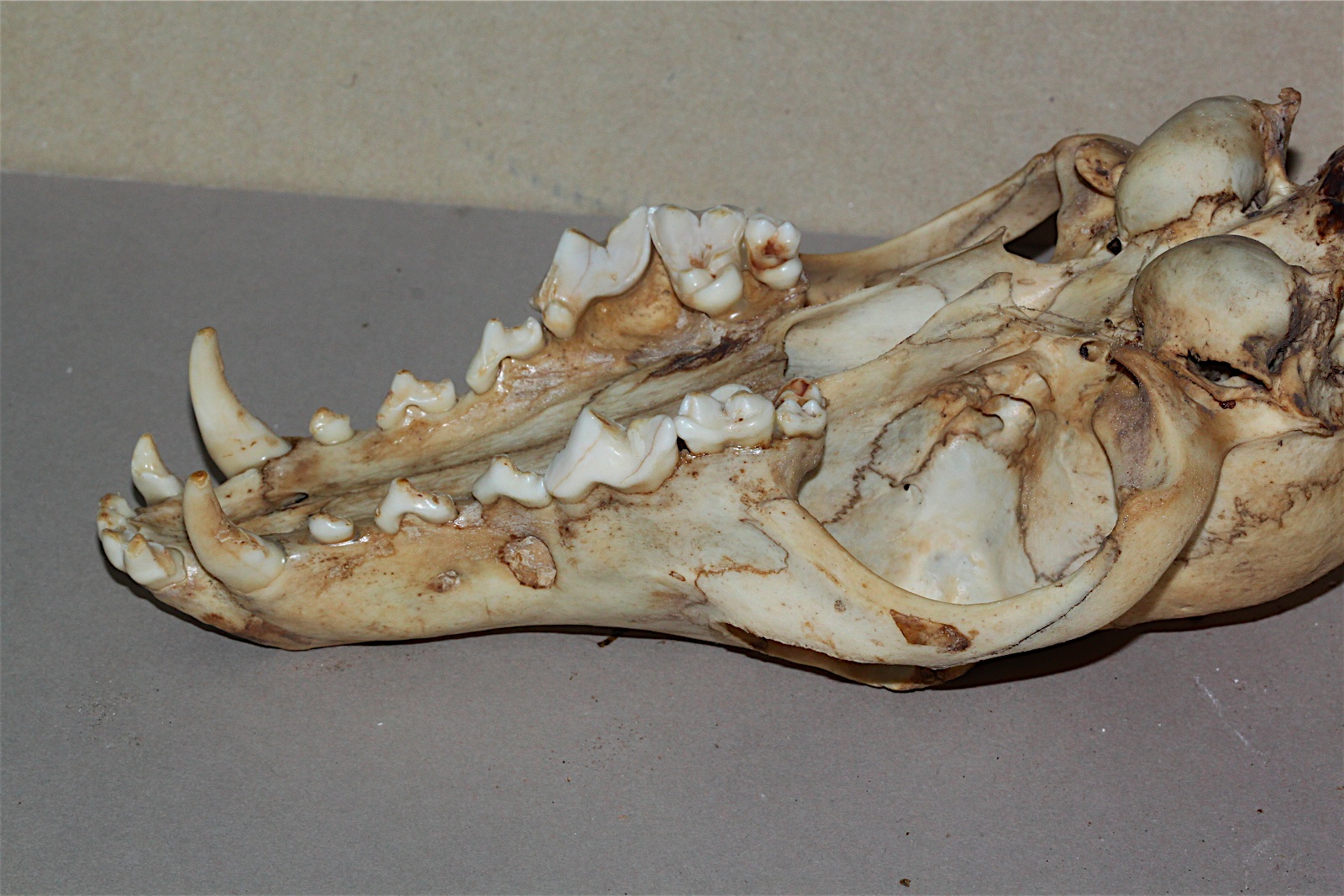
Here for example is an Eastern Mole. It's an insectivore, and this is  indicated by its undifferentiated teeth. They are virtually all just the same, simple pegs, which are ideal for picking up an insect or worm, and perhaps ripping it into chunks small enough to swallow without much chewing,


People sometimes ask me if moles are related to mice and rats, because they are similarly small furry animals that live in the ground. But look here at this skull of a Brown Rat. It has highly differentiated teeth. It has two enormous incisors in the front, designed for digging burrows in the ground, or biting off thick plant stocks. It is an omnivore that is fond of eating meat, but there would be no room for canines behind those incisors, so it has no canines, and uses the powerful incisors instead as killing weapons. Any food that comes into the mouth goes straight to the back of the mouth to be chewed up by the molars.


Here is another animal totally unrelated to moles, an armadillo. But because it has a similar insectivorous diet, it has evolved a similar mouth full of simple peg teeth. The teeth, in other words, indicate diet, but can be tricky to use to show taxonomic relationship.


Here is another example of this fact. This is a harbor seal. Note in the second picture how the very large brain has been flattened out to the side to keep the profile of the skull flat, unobstructed, and aerodynamic for smooth fast swimming. But note especially that the canine teeth of this carnivore have been somewhat reduced to be more the size of the other teeth, and all of the teeth are tending towards being pointed. Fish are so fast and swerving that it would be difficult to use an accurate bite with canines to capture them. What is needed is a mouthful of sharp points so that any kind of bite can impale the slippery prey and hold on to it.


Now look at this: Here is a river otter, a totally unrelated animal, a kind of aquatic weasel, but also an animal that catches fish by swimming swiftly after them. Note here that, almost identical to the seal, it has a flat aerodynamic shape to the skull, similarly with its quite big brain (does that mean fishermen have to be smart?) squashed out to the sides to keep the top flat, and most similarly its carnivore's teeth have been modified to be sharp fish-snaggers.


Here is the skull of a domestic cat. The cat is a total carnivore; virtually one-hundred percent of its diet is meat. What you see are very long sharp canines with a gap behind them so that they stand clear of other teeth and can be stabbed their full length into their prey. In this case they are especially designed to go around the neck bones of their small prey and quickly break the spine. Then notice how few back teeth they have. There is not a heavy complement of molars, because cats don't do any chewing. Instead the few molars they have are modified into carnassials. The upper and lower teeth fit together like the blades of a scissors and their function is to slice. They cut meat into small pieces and it is then swallowed directly. The second picture, from the front shows another carnivore adaptation. The incisors are practically nonexistent. Incisors are most useful for biting off plant material, something a cat has no use for.


Here is a bobcat skull. Except for the size (which you can't tell from this picture) it is virtually identical to the house cat. Cats are in fact perfectly designed for their stalk-and-leap style of hunting, with forward-facing eyes (the snout shortened so as not to be in the way) for accurate triangulation, the teeth reduced to a functional minimum (it would take a longer snout to fit more of them in). When cats evolved to fit into another niche, it was to hunt a different size-range of prey. They didn't change their perfect design, they just got larger or smaller.


To show what I mean, here is a puma. (This skull unfortunately has the upper canine broken in half, so in the second picture I will show it turned around to show the length of the full canine.) It's a bit more massive, but it's still the exact same design.


Here they all are together.


Here is a carnivore with different behavior, a coyote.  A cat often makes a surprise leap on sitting prey, and can set its canine teeth accurately. A coyote is often chasing swift and elusive prey (rabbits, for instance), and with its long jaws with canines at the tip end, can nip repeatedly until it gets a good hold, and then can bite to make the kill. But also, as the second picture shows, it has much better developed incisors than a cat, because coyotes eat vegetable food as well, melons and fruits, and for that, as the third picture shows, it has a full set of molars for chewing.


There's one more skull I want to show.  This one reminds me of a time I was attending a conference in Washington D.C. and had a few hours off and wandered into the Smithsonian to some rooms full of skeletons and particularly skulls. One room was all primate skulls, from tiny monkey skulls the size of a hen's egg to enormous orangutan and gorilla skulls. No one was around and I was sort of daydreaming as I entered the room, and suddenly I was surrounded by staring faces. After all, we are all primates. These had big craniums, and most had flat faces with two big staring forward-facing eye sockets. I was briefly quite startled. They were all human faces, humans of all different sizes, but what was most unsettling is, they all had big powerful canine teeth. They were monsters, demons, vampires. Several years ago when Gawain came back from a trip to Brazil he brought me a monkey skull, one of my prized possessions. If I hadn't known it was a monkey, if I was just handed the skull and was asked what I could gather about its diet and behavior, I would have guessed that it sneaked into our bedrooms at night and sucked our blood.


Monday, January 28, 2013

July, 2011

Here is a continuation of my review of 2011. The month of July.

The month begins with some interesting caterpillars. The first is a Walnut Caterpillar. It's a quite wonderful hairy thing.

These feed on the leaves of walnut and pecan and other types of nut trees. They often appear in a tree by the dozens or hundreds clustered fairly closely together. They have an amazing defense maneuver. When some predator approaches, the individual caterpillar twitches its body violently about once a second. No one knows how they coordinate this, but every caterpillar in the tree begins the body twitch, and they do it in exact synchrony, so that instead of each one looking like a vulnerable and helpless creature, it looks like they are all one big breathing animal. I suspect it might frighten off a bird. But when we have come over to watch this behavior closely, it has usually been parasitic ichneumon wasps attacking them, and the wasps didn't seem to be very impressed.

But the next caterpillar is our absolute favorite of all. It's called The Laugher, and this picture will show you why.


Look at the horrible "teeth" from close up. This guy's been on crystal meths half his life.


Here's another of the dozen or so bumble bee-mimicking robber flies in the genus Laphria that are found in Arkansas. This is Laphria lata.


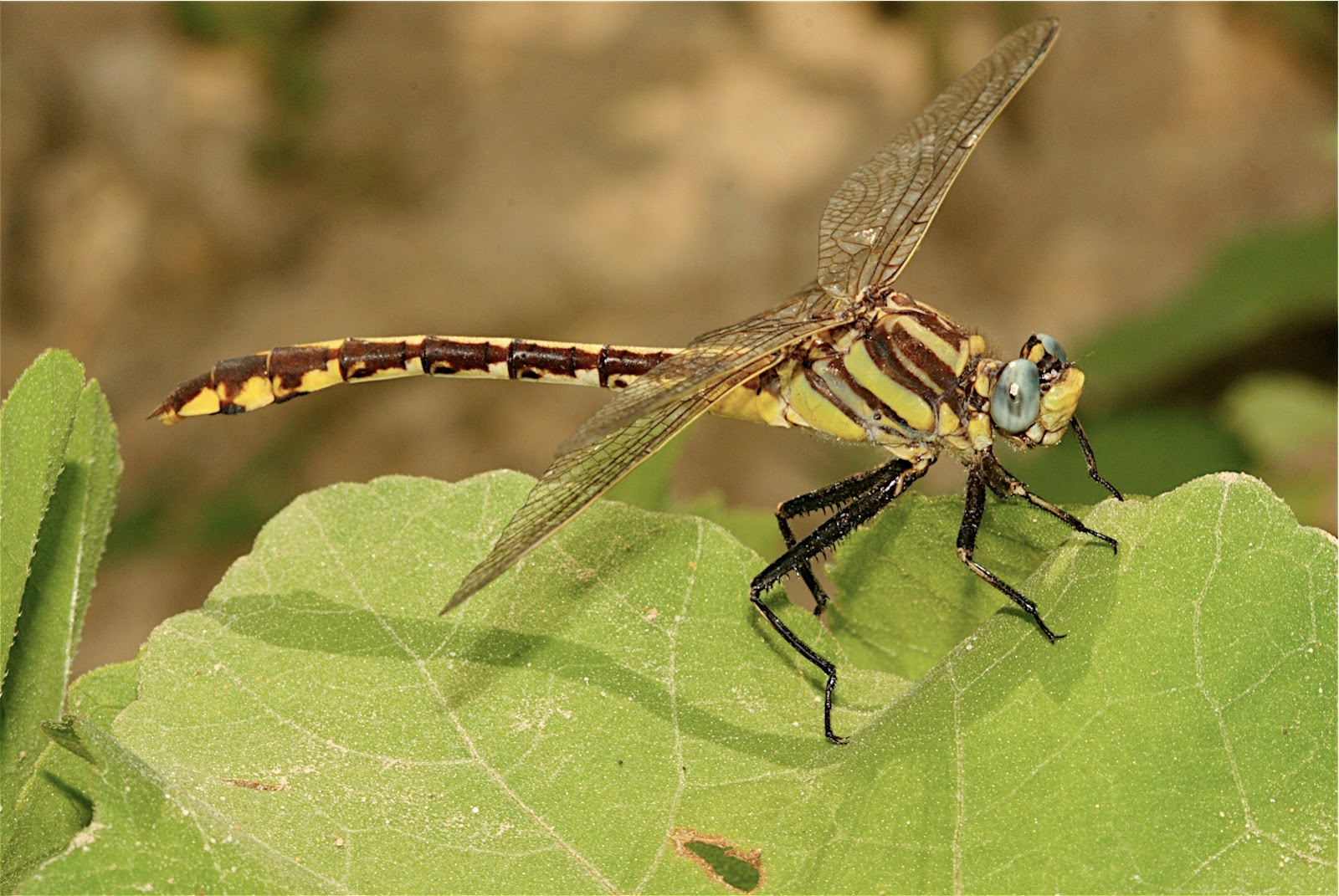
Plains Clubtail, female, Gomphus externus.


The robber fly Ommatius ouachitensis, eating a midge.  Both these creatures have feathery antennae.


The male of the Zabulon Skipper is a small bright yellow and orange butterfly that sets up a territory and drives off everything, including you, that comes too close. The dowdy brown female is the opposite in personality, slipping around quietly down in the shadows. But looked at closely, as here, she is pretty in her own way.


Here's another special caterpillar, the Spiny Oak-Slug, Euclea delphinii.  These atypical moth caterpillars have no legs but slip around sort of like slugs. They are cute, but don't touch. They are armed with stinging spines.


Argiope aurantia, the Black-and-yellow Garden Spider, with a large katydid.


This fancy wasp has a fancy name, Gnamptopelta obsidianator. The larvae are internal parasites of caterpillars.


 Here's a Spot-winged Glider, Pantala hymenaea. On warm days these and their near relatives, the Wandering Gliders, can fill the sky with their swarms.


Promachus fitchii, a handsome robber fly of prairies.


A Seaside Grasshopper disappearing into its background.


Efferia aestuans, female, a rather natty robber fly. Females of the genus Efferia feature long ovipositors.


The robber fly Holcocephala, sometimes called the Goggle Eye. This species is in the subfamily Trigonomiminae, and though there is some debate on this, this is possibly the basic robber fly group from which all other robber flies derive.


Trapdoor Spiders, big black tarantula-like spiders, spend most of their time waiting inside a tube just below the surface of the ground. When some insect comes jauntily strolling by, they suddenly raise the lid of the carefully concealed trap door, rush out, grab the hapless insect, and drag it struggling back down underground, and close the trap door behind them. It all happens so quickly you think you've only imagined it, and if witnessed, is the arachnophobe's nightmare come true. We saw this trapdoor spider during one of its occasional wanderings above ground.


This is a Dusky Dancer, Argia translata, a damselfly with beautiful violet eyes.


Here is the female ovipositing her eggs in the water, the male holding onto her with claspers on the end of his abdomen. He is not bravely protecting her from drowning, he's just keeping a hold on her so no other males try to get in on the act.


A large powerful dragonfly, the Gray Petaltail, Tachopteryx thoreyi, killing a big grasshopper. Dragonflies are among the most primitive insects, and this is the most primitive species of dragonfly.


The Powdered Dancer, Argia moesta, gets its name because as it gets older it gets more covered by a powdery bloom which renders its pattern indistinct.


The Red-legged Grasshopper, Melanoplus femurrubrum (the red is on the hind legs so you can't see it here), is a member of one of the main subfamilies of grasshoppers, the "Spurthroats." The picture shows, between the front pair of legs, the "spur" for which they are named.  But while we are looking at this close-up, notice something else: Insects evidently evolved from a centipede-like creature that had many segments, and a pair of legs on each segment. As insects developed, they collapsed the number of segments into fewer but more complex parts, and did away with all but six legs. But sometimes the legs, instead of disappearing, were co-opted into other jobs. You can easily see here two pairs of what once were legs are arranged around the mouth and are now used to help shovel in food.


This nice moth is the Rose Hooktip, Oreta rosea.


And this one is Harris's Three-spot, presumably named for the three gold spots on each forewing.


The well named Handsome Grasshopper, male, and (even handsomer) female.


Argiope, with some of her husbands (we've seen up to eight) hanging around her.


Here is the robber fly Triorla interrupta again, this time having caught a large and very fierce dragonfly, the Eastern Pondhawk.


A very early instar mantis, and a very early instar Northern Green-striped Grasshopper.


Rabidosa rabida, a big wolf spider.


A bagworm with an especially stylish bag.


And finally, to close out the month of July, this subtly handsome caterpillar of the Virginia Creeper Sphinx, Darapsa myron.