On my last blog I showed pictures I had saved from January through April of 2011. Let me continue now with May of 2011.
To start off this month, here is a handsome big spider called Dolomedes scriptus. It's one of the large fishing spiders, usually closely associated with water, and capable of catching small fish and tadpoles.
Here is a male Oklahoma Clubtail, Gomphus oklahomensis, another early dragonfly. On this species even the male has only a small club.
The spectacular hornet-mimicking robber fly, Laphria saffrana, is from the spectacular mostly bumble bee-mimicking genus Laphria. We'll probably see several more Laphria species through the year.
On this one, the death's head marking on the thorax seems appropriate.
I saw these nymphs of the Eastern Lubber Grasshopper (Romalea microptera) in the southwest corner of the state, the only place they are found in Arkansas. I didn't manage to get down there later at the right time to see the even more colorful adults.
The Rough Green Snake is a tiny harmless creature that nevertheless is a relative of the often venomous tropical vine snakes. Normally it is out of sight up in the trees, but it had to come down here to cross the road.
Southern Spreadwing Damselfly, Lestes australis.
Buck Moth caterpillar. If you brush past him, it will be like brushing past stinging nettles, and every spot where spines broke off in your skin will leave the mark of a little hemorrhage the next day.
We sometimes (in this insect-centered blog) take pictures of warm-blooded vertebrates, but only when they insist on plonking themselves down right in front of us. This is a bittern, trying to make himself invisible in the grass, blowing back and forth with the wind to look even more like the grass.
2011, if any of you remember, was the year of the Thirteen-year Cicada. For months we hardly went anywhere without hearing them. After living underground for thirteen years feeding on tree roots they finally come up for their brief moment in the sun. They have no fear reflex and do nothing to resist being eaten by whatever predator is interested. There are so many millions of them all at once, that everything can eat them to satiety, and there are still millions left to sing and mate and lay their eggs before dying off in long windrows.
Stillwater Clubtail, Arigomphus lentulus. This is the only Arigomphus with blue eyes. There are two more Arigomphus species, both with green eyes, that we should see before we are done.
Dwarf Spider, Aerigononae.
Here are some pretty damselflies with pretty names: Ebony Jewelwing (Calopteryx maculata), male, Stream Bluet (Enallagma exsulans), male, Springwater Dancer (Argia plana), the female in the brown phase, and the same again, the female in the blue phase.
Here's another Laphria robber fly, Laphria thoracica, one of the bumble-bee mimics, and a quite good one. The males of robber flies are generally much smaller than the females (which in fact is true of many kinds of insects, and nearly all spiders).
The Gray Comma is the much scarcer cousin of the Eastern Comma. Here is one that insisted on landing on Cheryl and would not leave her.
Crossline Skipper, picking up some salts from the moisture on the rock.
We all know that when plants want to get pollinated they put out flowers full of sweet nectar to attract insects and bribe them to move pollen from one plant to another. But when plants are being eaten by caterpillars and other browsers some of them produce "extrafloral nectaries," non-flower feeding stations of sweet liquids to attract ants, which will feed from them and in return chase off or devour the plants' enemies.
S-banded Tiger Beetle, an occasional visitor from the Gulf Coast.
Here are some more Odonates: First, an immature male Common Whitetail, Plathemis lydia (when it is mature it will develop a shining white abdomen). Next, a Comet Darner, Anax longipes. These big, brightly colored, dragonflies fly back and forth over small ponds in the Ozarks, and they fly perpetually. But occasionally you get lucky and one lands so you can take its picture. Finally, an Azure Bluet, Enallagma aspersum, male.
Long-eared Sunfish in breeding colors. Shortly the males will separate out and dig little pits in the gravel and defend them from other males, and try to attract females over them to spawn.
Purseweb Spider (Atypidae). These rather exotic spiders make a sort of silken tube up the side of the base of a tree and hide inside it. If an insect lands on it or walks across it the spider grabs it through the tube with its huge fangs.
Sunday, January 13, 2013
Tuesday, January 8, 2013
Well, I've stayed with this blog for most of 2012.
Now I'm looking at 2013. We are recently back from spending the holidays in California with my family. It wasn't all that warm there, but temperatures here are below freezing most nights, and there is still snow along the north side of the house. It's pretty clear there won't be much insect activity for a while, but we'll be watching for the very first signs.
What I'm doing now is looking back over notes and pictures from last year for lines of study that we might want to follow up on this year. The pictures we took in 2012 make up a history of what we saw and marveled at, what we learned, and show I suppose, what things we were particularly interested in. The theme of all the blogs is clear, or I hope it is clear: There is so much that is curious and wonderful right outside our front doors if we just take the time to look at it, if we just learn how to see it. I remember the song running through that wonderful insect film Microcosmos, "beneath our notice, beyond our imagination."
Anyway, the idea of the year's images as a kind of history led me to look back at the pictures we took the preceding year, 2011, and, since I won't have anything better to blog about until probably sometime in February, I thought over the next few blogs I would make a selection from 2011 that showed some highlights of that year. These pictures will not be organized, but will be presented more or less in chronological order, to show the unfolding of the seasons.
I only selected one picture from January, 2011: Cheryl took it of me (for scale) standing on a ridge-top trail on Crowley's Ridge, showing the highly eroded loess soil.
And only one picture from February. I found this very sculptural Wheel Bug (Arilus cristatus) lying dead in the leaf litter and brought it in. These big predators can give a very painful stab with their envenomed beaks.
In March things began to pick up a bit. We found this handsomely colored American Bird Grasshopper, Arkansas' largest and handsomest grasshopper species. It appears to be common in every month of the year. As you are walking through a field of grass or other low vegetation, one or several will fly up, and sail off with strong flight thirty or so feet and land high up in the branches or along the farside trunk of a tree.
The Silvery Blue is a rather special and hard-to-find species, but spring of 2011 they were common along Forest Service roads a few miles north of Hot Springs Village.
The Falcate Orange-tip (this is a female, which doesn't have the orange tips to the forewings) is a spring beauty which here is landed on a Spring Beauty.
In April you know that spring has fully arrived when the duskywing skippers appear. In this cluster piled up three deep on an animal dropping with care you can make out a couple of Sleepy Duskywings, at least one Horace's Duskywing, and the rest Juvenal's Duskywings. The tall thing back right is a Goatweed Leafwing butterfly. Hovering in the foreground is a flower fly waiting for its chance at the delicious dropping.
Another sign of spring is when the young male swallowtails come to stream or puddle edges to pick up the salts in the moisture that rises up through the soil. This one is a Pipevine Swallowtail.
Here a Spicebush Swallowtail is challenging other swallowtails for the choicest bit of moist sand. There is a lot of jostling and flashing of their full hind wings. Finally, in the last picture, they are all settling down. Four of Arkansas' six swallowtail species are present.
Another sign of Spring: At this time of year Eastern Tent Caterpillars (Malacosoma americanum) are busily defoliating all the cherry trees.
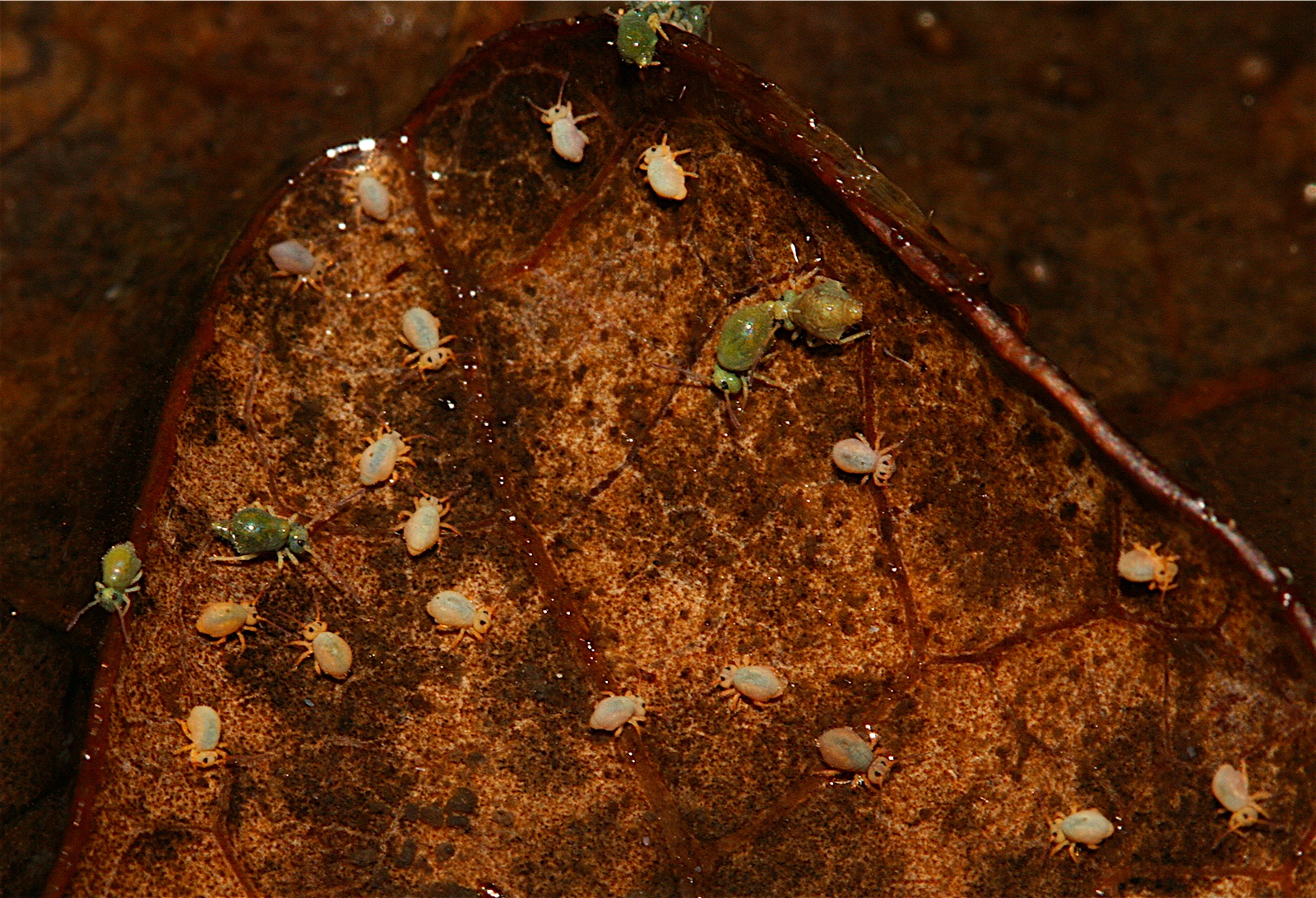
We noticed one day that the emergent vegetation of our backyard pond was swarming with springtails. These little round ones (1 to 3 mm in length) are Globular Springtails (fam. Sminthuridae).
The hippopotamus family enters the Nile River (the micro world echoing the macro).
Beneath the surface of the pond chironomid midge larvae resemble miniature tropical eels. Swimming clams are like tiny chambered nautiluses.
A hairy-necked Tiger Beetle (Cicindela hirticolis).
Forest Tent Caterpillar, Malacosoma disstria, a handsome relative of the Eastern Tent Caterpillar.
Spring is the best time to look for clubtails (fam. Gomphidae). This male Cocoa Clubtail, Gomphus hybridus, I would have thought was out of range on Hatchie Coon Island in NE Arkansas, but then I quickly saw a female (the tail tip is generally less swollen on females) nearby, and finally two or three others. I realized the first one was not a wanderer: These were on their territory, and the published range maps needed to be extended a little bit north and west.
The American Bird Grasshopper I showed earlier gets up to 55 mm long. At the other end of the scale this tiny Pygmy Grasshopper barely reaches 10 mm. The pygmies are hard to tell apart, but this one seems to be Tetrix arenosus, the Obscure Pygmy Grasshopper.
This handsome Geometrid is the Linden Looper. Here is how he travels.
[This blog has covered January through April, 2011. The next blog will begin with May, 2011.]
Subscribe to:
Posts (Atom)