Thursday, August 8, 2013

More nice butterflies

In an earlier post I wrote about chasing after some attractive butterflies in early summer: The Olympia Marble, the Frosted Elfin, the Silvery Blue, and the Great Purple Hairstreak. Three of these have in common being in the group of butterflies known as the Gossamer-wings (family Lycaenidae). The other butterfly groups are more familiar to most people, the big swallowtails, and the whites and sulphurs flying over open fields, and the "regular" butterflies, the painted ladies, the buckeyes, the monarchs, the red-spotted purples.

Least familiar (and therefore most special) are the Lycaenids, which, I have written in another context, are to butterfliers what warblers are to birdwatchers. They are small, fast moving, often brightly or intricately patterned, sometimes appearing in great numbers, often very rare, always appearing unpredictably, always a pleasure to see, even the commonest ones. These are the harvesters, the coppers, the hairstreaks, the elfins, the blues.

Of the four species I wrote about in the earlier post, the marble is a white, but the other three were Lycaenids. Of the four special butterflies we have run into just now in mid summer, once again three are Lycaenids.

The first is not a great rarity, but it is so beautiful we are always grateful to see it. Some years there are a lot around, but some years they can be very scarce. This is the Juniper Hairstreak. A week or so ago we were walking along a dirt road at the Harold Alexander WMA, a road where we had often found special insects in the past. We were looking for tiger beetles, robber flies, grasshoppers, and of course butterflies. Recent rains had moistened the dirt of the road, which always brings dissolved salts to the surface, and freshly emerged male butterflies in their brightest colors were coming down to drink the salts, which they require to get into breeding condition. Cheryl spotted the tiny beautiful green butterfly (not much more than an inch wingspread) mud-puddling so intently it paid no attention to us at all. We could photograph it all we wanted, but, because it was at an awkward angle for us flat on the ground of the road, Cheryl enticed it up on her hand, to drink the salts on her skin.


A day later, taking advantage of the relatively cool settled weather, we were at Big Lake. A couple of weeks before we had been there and seen a few Bronze Coppers that looked like they could have been freshly emerged (the technical term is eclosed) from the chrysalis that day. Bronze Coppers are not only beautiful, they are also, in Arkansas, rare. Some years ago we found them at Wapanocca NWR, and then here at the Moist Soils Unit at Big Lake. So far as anyone knows, these are the only two sites where this species can be found in the state. It seems to be diminishing at Wapanocca, but it is getting commoner at Big Lake. When we found them here this year, we sent out the word, and a number of people had been here to photograph them. Now we were back checking on them, and they were everywhere, and we could not resist taking more pictures ourselves. The best thing was, the females were egg-laying on the water dock, their caterpillar host plant, which is common along the edge of the dirt path around the unit.


This was followed by a bit of serendipity, which it always is when you find a Harvester. You don't look for a Harvester, they just magically appear. This little Lycaenid has a subtle and quite handsome pattern and is noteworthy because it has carnivorous caterpillars. The female Harvester looks for some plant with an infestation of aphids and lays her egg on that plant, and the caterpillar goes off looking for the aphids to devour. But on this day it wasn't a female we found, it was a male who had set up a territory and was waiting for a female to come by (maybe they have as hard a time finding them as we do). The male carves out a territory of about ten feet along a path. He flies up and down the path slowly, showing off his tasteful pattern, and then he lands on a bush at about eye height looking around eagerly. Here he is on his bush.


Well, we don't have a Lycaenid for our fourth species; it barely counts as a butterfly. It is a Silver-spotted Skipper. And indeed we didn't even find the adult skipper, we found its caterpillar. The Silver-spotted Skipper itself is a nice enough creature which flashes a big silver spot on its underwing when it flies, but way too common to rate as being special. But you don't see the caterpillar every day, and get a chance to interact with it.

Cheryl found a rolled up pea leaf and unrolled it, and there was the caterpillar inside, immediately identifiable by its dark head capsule with the huge yellow fake eyes on it, to make it look like something dangerous to any bird that peaked inside the leaf roll. We had exposed it, so it went into its next defensive act, which was to open its jaws as wide as possible and try its best to look like the furious fiend from hell. We were impressed and rolled him back up.


Wednesday, July 24, 2013

Behavior watching

You get your digital camera and your macro lens and you quickly find out what wonderful subjects arthropods make for photography. Then you realize what a learning tool you have, and you blow up the picture you have taken on your computer screen and hold it side by side with the illustration in your field guide, and you match the details, and then you learn the name of your subject, and you read up on it a bit, and then you go back into the field and watch your creature with new, informed eyes. It's a funny thing, but most of us don't really see something until we put a name on it. But once we do, then we are set up for the next stage, which is to begin observing it, really seeing it for the first time. That's when you can start behavior watching, and the very most fun of all, trying to record that behavior on your camera. Maybe in the end I will get a video camera (Cheryl is taking more and more movies on her camera, and perhaps I will try to put them on this blog if I can work out how to do it), but for now I am very pleased if I can catch a glimpse of some interesting behavior just with a series of still photos.

Insects and other arthropods have been fine-tuning their behavior for millions of years, and they are sometimes bizarre beyond belief. Here are a couple I have seen in the last few days.

We have a black walnut tree and a pecan tree in the yard. We don't get nuts from them. Our chief source of pleasure from them is that from time to time they have an outbreak of Walnut Caterpillars. These are wonderful large shaggy black caterpillars, and during an outbreak the tree can look like it has giant tent caterpillars without tents. (They don't by the way do any permanent damage to the tree at all.) Here is the caterpillar.


Here, multiplied by a hundred times, is what they look like during an outbreak.


Now some caterpillars with long hairs have stinging spines and it can be quite painful to touch them, but these do not. These are merely long hairs. They are, however, a first line of defense. It's very hard for birds, for instance, to swallow many of these ready-made hairballs without quickly clogging up their throats and stomachs. For the most part, it is only cuckoos who have the specialized techniques for eating them. And the long hairs also cause some problems for parasitic flesh flies and tachinid flies and the ichneumon and braconid wasps who try to lay eggs or larvae on the skin of caterpillars so they can bore their way inside and devour them from within. It's hard to get through the hair and down to the skin. But the caterpillars have a further line of defense which is quite amazing and amusing to see.

If an ichneumon wasp or a hungry bird turns up in among the caterpillars they all begin sharply jerking their heads and tails perhaps once a second. The wonderful thing is, the hundred or so caterpillars somehow synchronize the jerking, so that they make all their jerks at exactly the same moment. The effect is not of several small caterpillars jerking, but of one very large and perhaps formidable creature doing it. No one quite knows how these insects, with their poor eyesight, manage this precise synchronization with one another.

But that's only the beginning of their talents. Now, as they bolt down leaves and grow fast, from time to time they must pause to shed their skins. While they are shedding, and hardening up after their molt, they are soft, inactive, and very vulnerable to predation. They don't use protective colors to hide themselves, so a large aggregation of them can be seen from a distance. I described them earlier as looking something like tent caterpillars without a tent. Well, tent caterpillars have their tent to take shelter in when they are molting. What do the walnut caterpillars do?

I learned what they do when I came out the other morning and looked at our walnut tree and saw a big ball of some living thing down near the base of the trunk. Here's what it looked like:


And here is what had happened: Every caterpillar on the tree (if you look carefully you can see at least three different age classes) left the leaves at the top of the tree and climbed down to the bottom of the bare trunk and gathered in this ball. Again with magical synchronization, they had all come down to shed their skins at the same moment. As a friend suggested to me, instead of a single vulnerable caterpillar lying exposed, this resembled a big hairy animal.

I kept checking on this ball throughout the day, and as caterpillars hardened up and were ready, one by one at intervals five or so feet apart they marched back up to the top of the tree.


The next morning nothing was left but a bag of head capsules and empty skins.


A couple of days later we put on our headlamps and did a night op looking for spiders. I have reported before in this blog that on an earlier operation I found a small colony of Scytodes spitting spiders living in the siding of one corner of our house, and coming out at night to hunt. This is a frail, slow-moving, and, I imagine, rather timid spider that has perfected a hands-off method of hunting. They walk up close (but not too close) to a suitable small insect, point their fangs forward and they spit a mixture of glue and venom at it. They shiver their fangs, making a criss-crossing stream that envelopes their prey. By the time the prey begins to think it is in danger, it is already pinned to the ground with the venom sinking in.

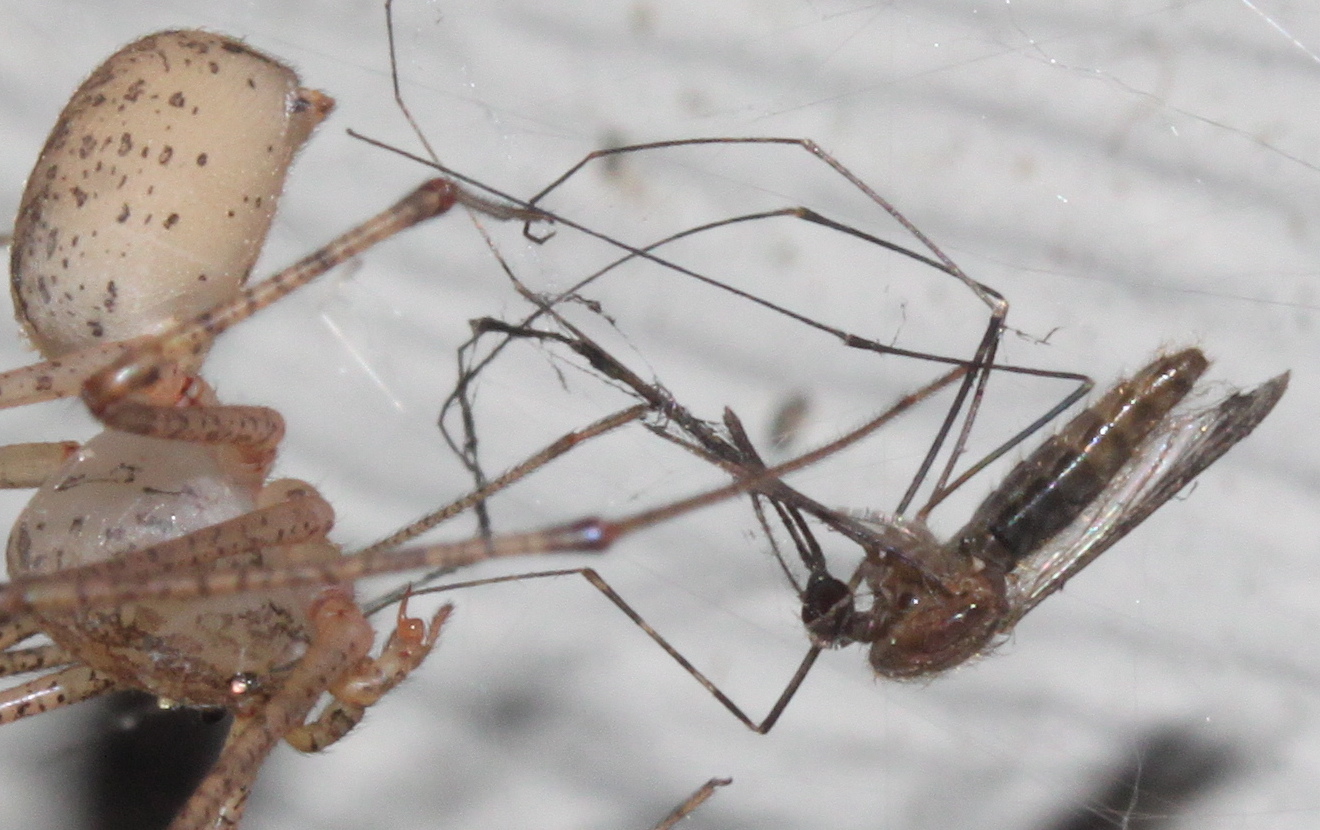
Well, this night I caught one in the act. Mosquitoes around the house roost in large numbers on flat sheetwebs of spiders. They must land so softly and keep so still the spiders don't notice them. And being on the web must give them protection from most non-spider predators. But not this lone mosquito, which made the mistake of roosting on a scrap of Scytodes web.

In this first picture the spider is walking slowly towards the mosquito, spitting as it goes. It looks like a wing and a leg are beginning to get matted up.


In the second picture, slightly more from the side, you can see the chelicerae on the side towards us held out towards the mosquito, with the fang swiveled out (from this angle we can't see the fang on the far side). One wing and one leg are definitely tied up.


In the third picture the legs are completely tied up, the fangs still spitting. You can't actually see the stream of spit. For one thing, this is taken at night with a flash. But many years ago we watched in broad daylight as a spitting spider caught a fly, but we still couldn't see the stream, only little dots appearing where it struck the ground in a ring around the fly.


Let's look at the last two pictures from closer up to see more detail.


We didn't actually see the shivering of the fangs. We only read about that afterward. But the next chance we get, we will watch for that carefully. The more you observe, the more you learn. The more you learn, the more you actually see. For instance, the day after we saw the ball of walnut caterpillars here, we were out at Big Lake, and spotted a ball of walnut caterpillars at the base of a pecan tree there. Without our new knowledge, we would never have noticed it.

Wednesday, July 3, 2013

What's going on around the house lately.

In a blog devoted to invertebrates it might seem inappropriate to mention things with backbones, but our yard is completely overrun with tiny Fowler's Toads. They have only newly emerged from tadpoles and are about half an inch long, and they are in such numbers that as we walk through the yard they withdraw from us like a wave from an outgoing tide.


They're very cute, like characters in Winnie the Pooh. If you notice, the black spots on the the back each have half a dozen red warts in them, which is the sign that they are Fowler's, and not some other species of toad. I can't help wondering what effect they are going to have on the small wolf spiders in the yard, each of which would make a nice mouthful for them. [Update: I went out on a night op last night, making a round of the garden, and I only saw about a dozen pairs of eyes looking back at me. It was as if the yard  had been vacuumed. Maybe I need to devise a toad vacuum!]

Also in the yard right now are a number of Five-lined Skinks. Here is a male with his reddish jaws. The jaws are not as massive and muscular as those on the larger Broadhead Skink. But perhaps to compensate, these retain their blue tails into adulthood. Both Five-lined and Broadhead hatch from the egg with brilliant blue tails, which they flirt around, drawing the attention of predators, so that the losable and regrowable tail is seized while the front end runs away. When the Broadhead Skink matures, it loses it's blue tail. It is so burly and has such a powerful bite it probably doesn't need to rely on deception.


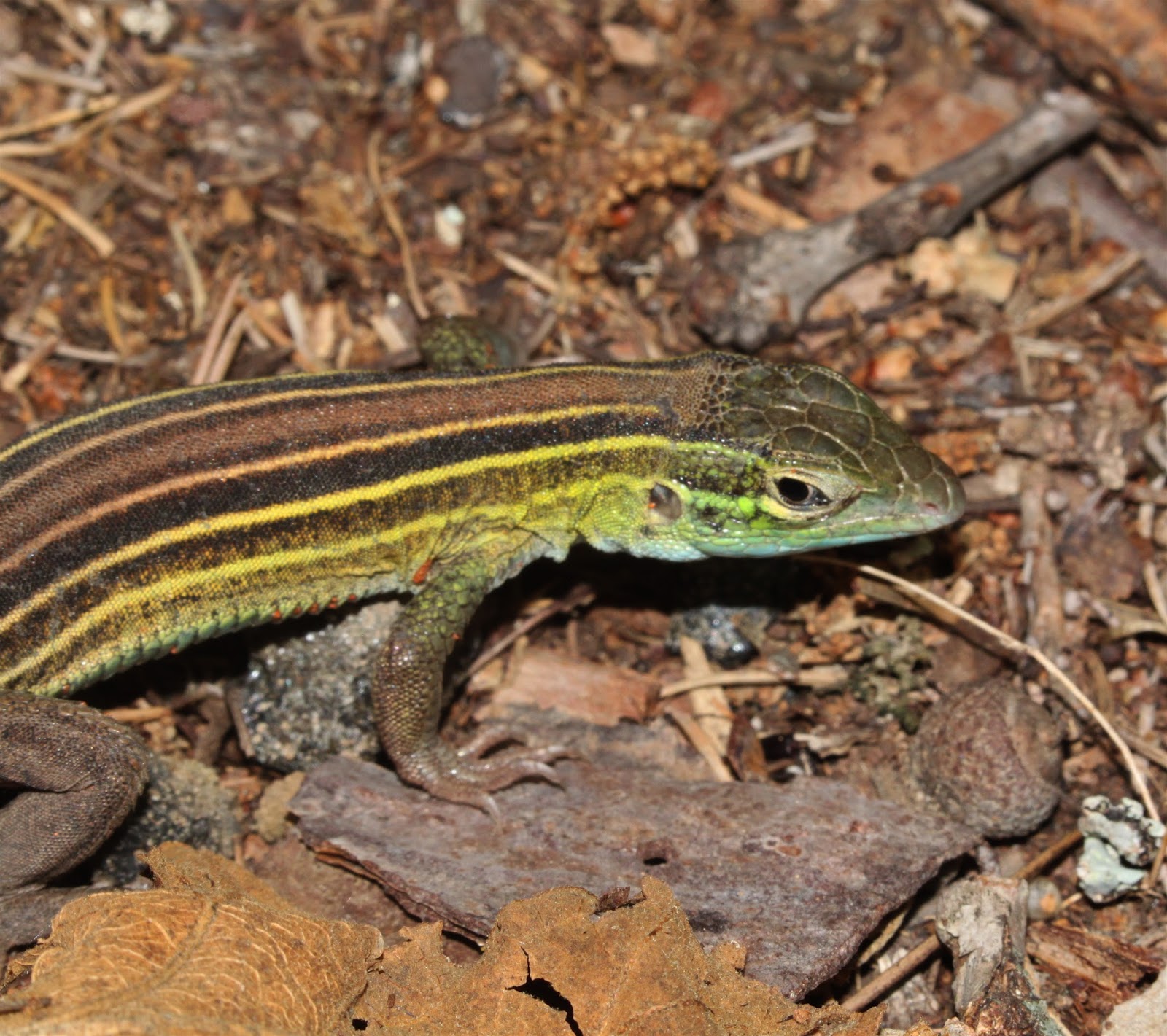
Not in the yard but not far away in the Joneboro Nature Center we saw this more colorful Prairie Racerunner. Like us these days he is covered with tiny orange chiggers. And a little bit farther away, on Hatchie Coon Island we saw this also colorful reptile, a slow-moving Mud Snake.


But now let's get back to small things, which should be our proper subject. In fact as compensation I'll bring up the smallest things we have seen. Here for instance at 1-2 mm long is a False Scorpion, false I presume because he has no venomous tail. They crawl around in the leaf litter and seize springtails with their claws, but from time to time they also climb to the top of flowers and when bees or butterflies land near them they hop on for a free ride to the next flower.


We had seen False Scorpions here before (not recently), so we weren't surprised. But we also found a brand new tiny thing that we had no idea lived here. I have mentioned before that my study is almost filled with Longbodied Cellar Spiders, sort of a daddylonglegs that will gradually fill all the space in a room with cobweb if you don't keep them trimmed back. I had read that there are other species of cellar spider, but most seemed to be found in the desert southwest. It took Cheryl's sharp eyes to realize there was indeed another species of cellar spider around, and in fact there was a population of them living right in the garage that my study is located in. There is a reason I hadn't noticed them: They are only about 2 mm long, which is to say, virtually invisible. They are called Shortbodied Cellar Spiders. They have the disproportionately long legs of the common Longbodied Cellar Spider that I live with daily, but they are still very close to being invisible. They are so tiny they are difficult to photograph. But the moment we got a good look at them we knew they were cellar spiders. You see, when the female cellar spider lays eggs, she puts them into a silk purse that she carries everywhere with her. She carries them in her jaws, and what is so distinctive about them is, she weaves her purse out of so few strands you can barely see the the purse, so the eggs are in plain sight. Here is a picture of our familiar Longbodied Cellar Spider carrying her eggs, and here is a picture (hugely enlarged) of our new Shortbodied Cellar Spider, also carrying her eggs in that purely cellar spider way.


Our usual cellar spider has the normal spider complement of eight eyes, but the tiny cellar spider only has six eyes. Unlike the Brown Recluse and the Spitting Spider which have six eyes (I have showed you pictures of them in this blog: They have three double eyes arranged in a triangle), the Shortbodied Cellar Spider has two triple eyes, the eyes appearing on each side of the head like "normal" eyes. You can see it in these pictures.

What else is new around here? Well, we always have good numbers of fireflies in our yard (all you have to do is have grass in your yard that you don't mow very much and of course never spray), and we know that the flashing of lights is mainly to attract males and females of the right species to each other, and when they meet they mate. But we had never thought much about the next step. But what seems to be common in our yard this year, and I don't know why we have never seen it before, is that we have female fireflies walking around on the ground, and they are walking because their abdomens are so bloated and distended with eggs that they can't get off the ground. Here's an example of one with its abdomen almost double its normal length (usually the abdomen does not extend beyond the ends of the elytra).


There's a smallish spider common in woodlands here called a Filmy Dome Spider. The web is characteristic: It has a tangle of supporting lines, and in the middle is a rising dome like an inverted bowl. I had tried in the past photographing it against a dark background, hoping that would  bring out the shape, but webs (unless they are covered with dew) don't show up very well in photographs) and I only got pictures with the vague suggestion of a dome in the midst of all the other lines. But the other day I was up at dawn and in the backyard there was a dome web between me and the rising sun, and the sun lit up every strand, and I finally got a fairly satisfactory picture.


Now we come to the spider of the month: the Asterisk Spider, so named because it makes a web of single strands sent out in all directions around it, so that it looks somewhat like an asterisk. I have never found the web, though I continue to look hard for it. The spider itself is impossible to find out in the woods (you will see why shortly), but I found this one hiding inside my empty garbage can. After I had photographed him, I placed him on a bush in our yard hoping he would be induced to make his web, and he immediately did his disappearing trick right before our eyes, resembling so closely a bump on a twig that if we had not seen him do it, we wouldn't have believed it. Unfortunately instead of making a web overnight, he simply left. But we got some wonderful bump-on-a-twig pictures.


Tuesday, May 28, 2013

Night ops!

We decided, at the beginning of the year (and with the help of an excellent new field guide, Common Spiders of North America, by Richard Bradley, U Cal Press, 2013) to see if we could learn the spiders, a group that had always seemed to us too daunting to even begin on. Well, it's near the end of May, which will mean it has been five months that we began working full-time on this new venture, and I can't believe how much we have learned (I suppose coming from near zero that's not hard to do). We're still seeing one or two new species a day, but the great majority of spiders we see now are familiar ones. It's not that we used to see dozens of unfamiliar spiders every day, it's that we didn't see them at all. It's one more demonstration that if you don't try to put a name on something, you simply don't see it.

The Picasa Web Album I have been keeping now contains images of 130 species we have more or less identified, probably more than anyone besides me is interested in seeing. Even we sometimes feel a bit overwhelmed by the plenty. When I say how many we have identified, I am using the word loosely. Since we are beginners, I have no doubt we have made mistakes, and many of the spiders simply are difficult to pin down to species. Sometimes we see a new spider, find a picture of it in the guide that exactly matches it, read the text and find that its behavior is exactly as we witnessed it, and then, as a sort of afterthought, the author of the guide informs us that there are 47 species exactly like that one, and you need to dissect them to see which particular one you are looking at.

Nevertheless we are coming as close to the identity as we need to for our purposes, and we are noticing so many things about different kinds of webs, different hunting strategies, different courtship ceremonies, that we are getting ample pleasure for our obsession. The main thing: we are walking the same paths we have been walking for years, and seeing them all new. We have lived in the same house for 37 years, and it is an adventure crossing the front yard.

And now we have, in effect, doubled the adventure. You see, it had been in my mind that many, perhaps most, spiders are nocturnal. It was time to explore that side of things. By the simple expedient of putting on our head lamps (that we had used in the tropics for night walks), in the evening last week we went out the door into a brand new world.

With our lights strapped to the middle of our foreheads just above our eyes, the beam went out in the same line as our sight, and the spiders looked directly back at our eyes, and theirs shined up as brilliantly as cat's eyes (well, much smaller). Everywhere we looked out in the leaf litter, the eyes of the wolf spiders glittered back at us. During the day, if we spotted the wolf spiders at all in the leaf litter, they quickly dove out of sight under the leaves. At night with their eyes shining it was easy to see them, and harder for them to see us hidden in the shadows behind our lamps, so that if we didn't clump around too loudly, we could approach them rather easily, and get very nice close-up pictures of them out in the open.

Here are a few of the wolf spiders and crab spiders we saw. First, Varacosa avara, then Gladicosa gulosa, and then, the Leaflitter Crab Spider (not very many spiders have common names).


It is well known that color-blind people can spot camouflaged things more easily than people with normal color vision. Presumably when something has the same patchily-colored pattern as the background, it is difficult to separate it out. But if you don't see its disrupting color, it isn't able to fool you. At night no matter how brightly lighted, you are seeing essentially in black-and-white. So we also discovered this night something we had often heard about before: caterpillars (moth and butterfly caterpillars are another of our obsessions) are much easier to spot separated from their protective coloring. Cheryl was casting her light around in the leaves of a sugarberry tree (one of the larval food plants of the hackberry butterfly) and immediately picked out a number of hackberry butterfly caterpillars. Then she realized she was looking at an adult hackberry butterfly and a moment later saw next to it the chrysalis it had only recently emerged from. The butterfly flew away into the darkness before she could get a photo of it next to its empty chrysalis case, but she quickly began spotting other chrysalises nearby.

This is remarkable because the hackberry chrysalis is one of the most cleverly camouflaged that I know of and we hardly ever spot one though they are in plain sight. Here is the hatched one we saw, and here is another one unhatched, and if I had not put it dead center in the photograph you would not have seen it.


It was a very beautiful evening, warm, a light breeze, almost no mosquitoes. We wandered back to our pond. As my light flashed back and forth with my steps, it picked up a violent battle scene ahead, a large very powerful red carpenter ant (their jaws are strong enough to chew galleries through solid wood) fighting with a spider! By the time we got up close the spider had it wrapped up and was carrying it on a line up off the ground to a twig about three feet up on the trunk of a small tree. It was a small mostly black spider with some white spotting, and must have been an ant specialist. Few spiders can stomach (literally) a formic-acid filled ant, and very few will chance feeding on such a dangerous creature that has a whole army for backup. This spider apparently had dropped down to the ground on a line, caught the ant, and immediately carried it back up out of reach of the many other carpenter ants foraging nearby. In the the field guide the spider that most resembled it was Steatoda albomaculata, and when we read about it in the text, sure enough it was an ant specialist.


In the middle of the yard we saw the bigger shine of a large wolf spider and crept up on it, but our legs kicked some sticks, the movement startling the spider which quickly disappeared down a burrow. A number of spiders live in burrows during the day, then wait just outside them at night for any passing insects. We looked down the burrow, and saw what looked like headlights at the other end of a tunnel. We went off looking for other spiders, then sneaked back more carefully a few minutes later. It was out and allowed me a quick shot before disappearing again. When we looked at the picture later we recognized it as being in the genus Hogna, a group of larger wolf spiders that often live in burrows. We believe it was Hogna lenta.


Other night creatures were out including crickets and katydids of kinds we do not see by day


We went around to the front of the house and found a largeish wolf spider with woolly black front legs. This character identified it as a male of the species Schizocosa ocreata, one I had been hoping to find, so I was carefully zeroing in on it and taking my picture, even as Cheryl was shouting behind me that there was an unbelievable spider on the backporch step. Here's the picture I took quickly so I could run and see what Cheryl was shouting about.


She was right: the spider was beyond belief. It had a tiny body that was held high up off the ground by unimaginably long legs. It looked like some sort of agricultural sprayer that goes out in the field on great high legs so it won't knock down the tall crops.


While we were taking as many pictures of this as we could I noticed out of the corner of my eye a small pale-colored spider hanging to the siding of the house a few feet from my head. It looked so unprepossessing I ignored it, and just as an afterthought before we got up to race in the house and look at our pictures, I took a quick snap of it.

When we got into the house, we spent some time trying to work out what the long-legged spider was. It turned out to be the male of a common species in the yard, the Nursery Web Spider, a spider (the female anyway) of normal proportions famous for building a tent to raise her children in, while she guarded them from the outside. The males of many spider species tend to have a small body with extremely long legs, but this one carried the pattern to its absurdest degree. But while we were working this out I happened to glance at the shot of the pale little spider we had seen last and we realized it was the star of the evening, one of the spiders we were most hoping to see this year. We quickly raced outside to take some more, and more careful, shots of it. It's lucky we did, because a minute later it crawled out of sight somewhere inside the house siding.

It was a Spitting Spider.

This weak-looking species with its drinking-straw legs slowly walks to within 3 or 4 inches of a small fly or other prey item, and while the fly sits quietly, thinking it is a safe distance away from the spider and can fly if it needs to, the spider spits a mixture of glue and venom at it, spraying in a circle around it, and when the fly thinks to fly, it finds itself trapped in the glue and already dying from the poison.

Here are some pictures of the frail but quite elegant creature. Note how the cephalothorax rises up higher towards the rear, to house its glue and poison factory, and note that this is one of the rare six-eyed spiders, three double eyes arranged in a triangle.


The darkness behind us had left us enclosed in the world of these small creatures. For background music we had owls calling and coyotes yipping. We had no sense of time or space but hours had gone by. Under such rapt conditions these harmless little animals that might horrify or disgust some people, or at least call for systematic spraying with chemicals, had seemed to us quite beautiful.

It's addictive. We have gone out three evenings now in our garden, and a fourth time at our friends Jeff and Sue's cabin on Lake Norfork, where we saw a host of new species we are still puzzling out. It was a lovely evening up there and we dragged them and another friend all out and they enjoyed it with us.  How impoverished a life without nature would be.