Now I'm looking at 2013. We are recently back from spending the holidays in California with my family. It wasn't all that warm there, but temperatures here are below freezing most nights, and there is still snow along the north side of the house. It's pretty clear there won't be much insect activity for a while, but we'll be watching for the very first signs.
What I'm doing now is looking back over notes and pictures from last year for lines of study that we might want to follow up on this year. The pictures we took in 2012 make up a history of what we saw and marveled at, what we learned, and show I suppose, what things we were particularly interested in. The theme of all the blogs is clear, or I hope it is clear: There is so much that is curious and wonderful right outside our front doors if we just take the time to look at it, if we just learn how to see it. I remember the song running through that wonderful insect film Microcosmos, "beneath our notice, beyond our imagination."
Anyway, the idea of the year's images as a kind of history led me to look back at the pictures we took the preceding year, 2011, and, since I won't have anything better to blog about until probably sometime in February, I thought over the next few blogs I would make a selection from 2011 that showed some highlights of that year. These pictures will not be organized, but will be presented more or less in chronological order, to show the unfolding of the seasons.
I only selected one picture from January, 2011: Cheryl took it of me (for scale) standing on a ridge-top trail on Crowley's Ridge, showing the highly eroded loess soil.
And only one picture from February. I found this very sculptural Wheel Bug (Arilus cristatus) lying dead in the leaf litter and brought it in. These big predators can give a very painful stab with their envenomed beaks.
In March things began to pick up a bit. We found this handsomely colored American Bird Grasshopper, Arkansas' largest and handsomest grasshopper species. It appears to be common in every month of the year. As you are walking through a field of grass or other low vegetation, one or several will fly up, and sail off with strong flight thirty or so feet and land high up in the branches or along the farside trunk of a tree.
The Silvery Blue is a rather special and hard-to-find species, but spring of 2011 they were common along Forest Service roads a few miles north of Hot Springs Village.
The Falcate Orange-tip (this is a female, which doesn't have the orange tips to the forewings) is a spring beauty which here is landed on a Spring Beauty.
In April you know that spring has fully arrived when the duskywing skippers appear. In this cluster piled up three deep on an animal dropping with care you can make out a couple of Sleepy Duskywings, at least one Horace's Duskywing, and the rest Juvenal's Duskywings. The tall thing back right is a Goatweed Leafwing butterfly. Hovering in the foreground is a flower fly waiting for its chance at the delicious dropping.
Another sign of spring is when the young male swallowtails come to stream or puddle edges to pick up the salts in the moisture that rises up through the soil. This one is a Pipevine Swallowtail.
Here a Spicebush Swallowtail is challenging other swallowtails for the choicest bit of moist sand. There is a lot of jostling and flashing of their full hind wings. Finally, in the last picture, they are all settling down. Four of Arkansas' six swallowtail species are present.
Another sign of Spring: At this time of year Eastern Tent Caterpillars (Malacosoma americanum) are busily defoliating all the cherry trees.
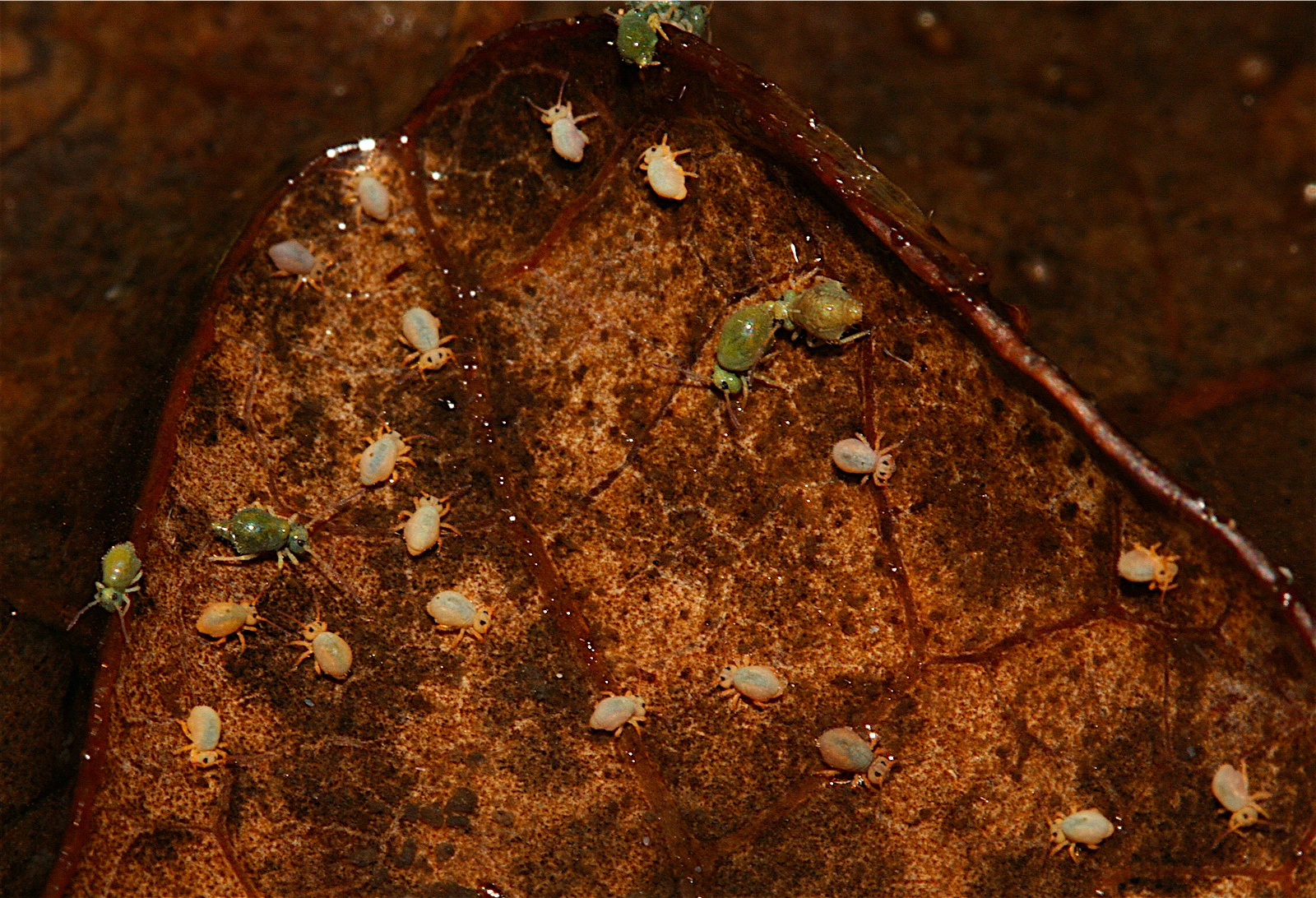
We noticed one day that the emergent vegetation of our backyard pond was swarming with springtails. These little round ones (1 to 3 mm in length) are Globular Springtails (fam. Sminthuridae).
The hippopotamus family enters the Nile River (the micro world echoing the macro).
Beneath the surface of the pond chironomid midge larvae resemble miniature tropical eels. Swimming clams are like tiny chambered nautiluses.
A hairy-necked Tiger Beetle (Cicindela hirticolis).
Forest Tent Caterpillar, Malacosoma disstria, a handsome relative of the Eastern Tent Caterpillar.
Spring is the best time to look for clubtails (fam. Gomphidae). This male Cocoa Clubtail, Gomphus hybridus, I would have thought was out of range on Hatchie Coon Island in NE Arkansas, but then I quickly saw a female (the tail tip is generally less swollen on females) nearby, and finally two or three others. I realized the first one was not a wanderer: These were on their territory, and the published range maps needed to be extended a little bit north and west.
The American Bird Grasshopper I showed earlier gets up to 55 mm long. At the other end of the scale this tiny Pygmy Grasshopper barely reaches 10 mm. The pygmies are hard to tell apart, but this one seems to be Tetrix arenosus, the Obscure Pygmy Grasshopper.
This handsome Geometrid is the Linden Looper. Here is how he travels.
[This blog has covered January through April, 2011. The next blog will begin with May, 2011.]
Tuesday, January 8, 2013
Sunday, December 9, 2012
Finishing unfinished business
It was around 2003. I had been retired for a couple of years, and I think I was still casting around for something to be obsessed by (the un-obsessed life is not worth getting out of bed in the morning for). We were keen birdwatchers in those days, as were many of our friends, but the advent of close-focusing binoculars, that allowed you to observe things a meter away with 8x magnification, was making the field observation of insects possible, and a host of new field guides to insects-through-binoculars, guides that illustrated insects as they look while alive in the field, rather than how they look pinned-out in a box, was beginning to make "insecting" as feasible as "birding." When I was a kid, it was always insects and other invertebrates I dragged home and built cages for and kept as pets. I was won-over at once by this new movement.
A birdwatching friend, Herschel Raney, was also getting into bugs, dragonflies and butterflies especially. In fact, he was leading the charge on butterflies, doing the research, contacting authorities, searching species lists in old railroad surveys, and creating an online state list of butterflies with maps of occurrence and going out in the field and finding all kinds of species no one knew were in Arkansas. His house in Conway, in the Arkansas River Valley, was amazingly well located in a nexus between the Ouachitas, the Ozarks, and the Delta. Bell Slough WMA on Lake Conway, along with the adjacent Camp Robinson, together a large area mostly developed for wildlife, and containing every imaginable kind of habitat, was his center of operations. He invited us down to Bell Slough one day to show us Diana Fritillaries, a species we had thought an almost impossible rarity, but which at Bell, he told us, was fairly common.
So he found us several Dianas, plus Cobweb Skippers and Dusted Skippers and a host of other species we had never seen before. As he was showing off his territory he was walking along and reflexively flicking a finger at everything he saw and naming it. And at one point he said "bumble bee," and I opened my mouth for the first time that day and said, "No, it's a robber fly."
Which stopped us both in our tracks. We walked back a few steps and looked at this thing closely. It was a big hairy black and yellow insect that had all the marks of a bumble bee, but on closer examination it wasn't right. Instead of biting mouth parts it had an enormous beak sticking out in front. It was one of the bumble bee-mimicking robber flies, but how did I know that? I don't know myself, but since the time I was a kid growing up in Berkeley, California, I had known what robber flies were. How did I know? Who told me? Where did I read it? I have a clear memory of when I was, oh, ten years old, sitting in the backyard, doing one of my favorite stunts to gross people out: A mosquito was on my hand and I was watching it fill up, watching its abdomen balloon out and turn pink. And then I became aware of a small robber fly (I knew at the time that's what it was) sitting on my elbow and watching the mosquito. I held my breath. The robber fly made a high curving flight, a mortar-shell trajectory, and grabbed that mosquito and flew off with it. I was thrilled.
This time Herschel and I were both thrilled to look at this large fierce hairy fly, and I think we decided right that moment to begin studying robber flies. Herschel, in his usual systematic and fearless way got on the internet and immediately contacted all the top robber fly authorities in the world, immediately getting friendly replies and offers of help and masses of material that would be the absolutely necessary basis to help us get started. Among others, he contacted Jeff Barnes, the head of the arthropod museum at the University of Arkansas in Fayetteville, who by miracle turned out to be a robber-fly specialist, and that ended up being the greatest help of all. Throughout the summer we followed our various pursuits, but it was in our minds to begin in earnest next summer. For now at least we began noticing robber flies, ones that caught their prey then hung by one arm under a bush while they fed on it, or others that sat at the end of a twig, then sallied out after prey just like flycatchers, immediately returning to their posts. And of course, the bumble bee mimics, that seemed to come in several sizes indicating that they were different species. On November 30th of that year, a time when most insect life had come to a stop, Cheryl and I were walking down a trail in Craighead Forest Park when a smallish rather skinny black fly landed on her backpack. We studied it. It was a robber fly. It was a bit beat-up looking, no doubt because it had survived so late into the year. There was certainly nothing bumble bee looking about it, but the worn and thinning black hairs on its thorax had a sheen of yellow on them. It must have been one of the bumble bee mimics, we decided, perhaps a diminutive male of the species. Wow, it had almost lived into December.
For the next few years we got very serious about robber flies, and after much collecting, studying of specimens under the microscope, reading the various literature, and using our bird-watching skills, Herschel and I got so we could find and identify by sight just about every robber species in the state, and this came to a climax with our paper in the Entomological News, "Robber Flies (Diptera: Asilidae) of Arkansas, U.S.A.: Notes and a Checklist," by Jeffrey K. Barnes, Norman Lavers, and Herschel Raney. When we started, there had been some forty species recorded for the state. We brought that list up over a hundred. Along the way we caught several species of bumble bee-mimicking robbers flies, all of which came out in the spring and summer. But there was one species we didn't find in those early years, Laphria affinis, which we knew came out in the fall and early winter, and which I knew must have been that skinny fly we saw November 30th.
In fact, at the end of our first year of study, on November 30th, Cheryl and I had gone back to that very spot, and sure enough there was a yellow-and-black robber fly there, this time a big one, a fat female, and in my excitement I made a wild sweep with my net, and missed, and it disappeared for ever.
A few more years went by without seeing a single Laphria affinis, and then we learned of their addiction to fallen and rotten pine trees, how if the males want to mate, they have to wait on these logs for the females to come by to lay their eggs, and how the females have no choice but to come to the logs to lay their eggs. So now we find them easily, and we have learned that they are one of the commonest of the bumble bee mimics. And since in the past I twice found them November 30th, I have been attempting to find one just one day later, to get the only December record in the state for a robber fly. Each year when it got into late November I would watch the weather, hoping it would stay mild for just a bit longer, and each year when it hit December, killing frosts and storms came in making the month wipe-out.
This year I tried yet one more time. Late November had a few days where it got below freezing overnight, but not desperately low. And there were no terrible storms. On the other hand, there were heavy overcasts every day. What I needed was a temperature at least in the high 60s, better low 70s, and clear sunny skies. Well, December came in with dense clouds, but at least not bitter cold. December 1st and 2nd were no good, but the forecast for the 3rd suggested some clearing in the afternoon, and perhaps low 70s, and from then on cold and storms. This was it, that one chance on the 3rd.
We got up that morning and it looked very dark and miserable. It lightened up a bit by mid-morning with temps into the low 60s. I told Cheryl we would pack a lunch and go to Crowley's Ridge SP to a pine tree blow-down where we had seen two Laphria affinis a month earlier, about the beginning of November. We got there and walked up the trail to the area where we had seen them and quite magically the sky cleared, the sun instantly raising the temperature several degrees. We picked our way through the tangle of fallen trunks, and there was a male guarding his territory. He was very shy, but he flew up and timidly tried to drive me away, flying around by my head, and then he landed on my back. I held very still and Cheryl got a distant shot of him on my back before he flew. We thought he would disappear, but instead he curved around and landed on his log again facing me, and I got a distant shot of him. There it was, the record was recorded.
There is a very early-appearing robber fly that comes out in February, more than a month earlier than the next earliest robber fly. And now there is this one, coming out nearly a month later than any other. I sent Herschel and Jeff Barnes pictures of this Laphria, and said "Now, if anyone asks you how long the robber fly season is here, tell them you can find robbers in every month but January." Not bad for a state this far north.
And then it didn't seem like all that exciting a thing to be able to say, and I began to have a feeling of anticlimax. What am I going to do next year on the first of December? Probably sit home and read a book.
A birdwatching friend, Herschel Raney, was also getting into bugs, dragonflies and butterflies especially. In fact, he was leading the charge on butterflies, doing the research, contacting authorities, searching species lists in old railroad surveys, and creating an online state list of butterflies with maps of occurrence and going out in the field and finding all kinds of species no one knew were in Arkansas. His house in Conway, in the Arkansas River Valley, was amazingly well located in a nexus between the Ouachitas, the Ozarks, and the Delta. Bell Slough WMA on Lake Conway, along with the adjacent Camp Robinson, together a large area mostly developed for wildlife, and containing every imaginable kind of habitat, was his center of operations. He invited us down to Bell Slough one day to show us Diana Fritillaries, a species we had thought an almost impossible rarity, but which at Bell, he told us, was fairly common.
So he found us several Dianas, plus Cobweb Skippers and Dusted Skippers and a host of other species we had never seen before. As he was showing off his territory he was walking along and reflexively flicking a finger at everything he saw and naming it. And at one point he said "bumble bee," and I opened my mouth for the first time that day and said, "No, it's a robber fly."
Which stopped us both in our tracks. We walked back a few steps and looked at this thing closely. It was a big hairy black and yellow insect that had all the marks of a bumble bee, but on closer examination it wasn't right. Instead of biting mouth parts it had an enormous beak sticking out in front. It was one of the bumble bee-mimicking robber flies, but how did I know that? I don't know myself, but since the time I was a kid growing up in Berkeley, California, I had known what robber flies were. How did I know? Who told me? Where did I read it? I have a clear memory of when I was, oh, ten years old, sitting in the backyard, doing one of my favorite stunts to gross people out: A mosquito was on my hand and I was watching it fill up, watching its abdomen balloon out and turn pink. And then I became aware of a small robber fly (I knew at the time that's what it was) sitting on my elbow and watching the mosquito. I held my breath. The robber fly made a high curving flight, a mortar-shell trajectory, and grabbed that mosquito and flew off with it. I was thrilled.
This time Herschel and I were both thrilled to look at this large fierce hairy fly, and I think we decided right that moment to begin studying robber flies. Herschel, in his usual systematic and fearless way got on the internet and immediately contacted all the top robber fly authorities in the world, immediately getting friendly replies and offers of help and masses of material that would be the absolutely necessary basis to help us get started. Among others, he contacted Jeff Barnes, the head of the arthropod museum at the University of Arkansas in Fayetteville, who by miracle turned out to be a robber-fly specialist, and that ended up being the greatest help of all. Throughout the summer we followed our various pursuits, but it was in our minds to begin in earnest next summer. For now at least we began noticing robber flies, ones that caught their prey then hung by one arm under a bush while they fed on it, or others that sat at the end of a twig, then sallied out after prey just like flycatchers, immediately returning to their posts. And of course, the bumble bee mimics, that seemed to come in several sizes indicating that they were different species. On November 30th of that year, a time when most insect life had come to a stop, Cheryl and I were walking down a trail in Craighead Forest Park when a smallish rather skinny black fly landed on her backpack. We studied it. It was a robber fly. It was a bit beat-up looking, no doubt because it had survived so late into the year. There was certainly nothing bumble bee looking about it, but the worn and thinning black hairs on its thorax had a sheen of yellow on them. It must have been one of the bumble bee mimics, we decided, perhaps a diminutive male of the species. Wow, it had almost lived into December.
For the next few years we got very serious about robber flies, and after much collecting, studying of specimens under the microscope, reading the various literature, and using our bird-watching skills, Herschel and I got so we could find and identify by sight just about every robber species in the state, and this came to a climax with our paper in the Entomological News, "Robber Flies (Diptera: Asilidae) of Arkansas, U.S.A.: Notes and a Checklist," by Jeffrey K. Barnes, Norman Lavers, and Herschel Raney. When we started, there had been some forty species recorded for the state. We brought that list up over a hundred. Along the way we caught several species of bumble bee-mimicking robbers flies, all of which came out in the spring and summer. But there was one species we didn't find in those early years, Laphria affinis, which we knew came out in the fall and early winter, and which I knew must have been that skinny fly we saw November 30th.
In fact, at the end of our first year of study, on November 30th, Cheryl and I had gone back to that very spot, and sure enough there was a yellow-and-black robber fly there, this time a big one, a fat female, and in my excitement I made a wild sweep with my net, and missed, and it disappeared for ever.
A few more years went by without seeing a single Laphria affinis, and then we learned of their addiction to fallen and rotten pine trees, how if the males want to mate, they have to wait on these logs for the females to come by to lay their eggs, and how the females have no choice but to come to the logs to lay their eggs. So now we find them easily, and we have learned that they are one of the commonest of the bumble bee mimics. And since in the past I twice found them November 30th, I have been attempting to find one just one day later, to get the only December record in the state for a robber fly. Each year when it got into late November I would watch the weather, hoping it would stay mild for just a bit longer, and each year when it hit December, killing frosts and storms came in making the month wipe-out.
This year I tried yet one more time. Late November had a few days where it got below freezing overnight, but not desperately low. And there were no terrible storms. On the other hand, there were heavy overcasts every day. What I needed was a temperature at least in the high 60s, better low 70s, and clear sunny skies. Well, December came in with dense clouds, but at least not bitter cold. December 1st and 2nd were no good, but the forecast for the 3rd suggested some clearing in the afternoon, and perhaps low 70s, and from then on cold and storms. This was it, that one chance on the 3rd.
We got up that morning and it looked very dark and miserable. It lightened up a bit by mid-morning with temps into the low 60s. I told Cheryl we would pack a lunch and go to Crowley's Ridge SP to a pine tree blow-down where we had seen two Laphria affinis a month earlier, about the beginning of November. We got there and walked up the trail to the area where we had seen them and quite magically the sky cleared, the sun instantly raising the temperature several degrees. We picked our way through the tangle of fallen trunks, and there was a male guarding his territory. He was very shy, but he flew up and timidly tried to drive me away, flying around by my head, and then he landed on my back. I held very still and Cheryl got a distant shot of him on my back before he flew. We thought he would disappear, but instead he curved around and landed on his log again facing me, and I got a distant shot of him. There it was, the record was recorded.
There is a very early-appearing robber fly that comes out in February, more than a month earlier than the next earliest robber fly. And now there is this one, coming out nearly a month later than any other. I sent Herschel and Jeff Barnes pictures of this Laphria, and said "Now, if anyone asks you how long the robber fly season is here, tell them you can find robbers in every month but January." Not bad for a state this far north.
And then it didn't seem like all that exciting a thing to be able to say, and I began to have a feeling of anticlimax. What am I going to do next year on the first of December? Probably sit home and read a book.
Saturday, November 24, 2012
"The universe in a grain of sand"
When I'm out looking for bugs I am often in a rush. I may, for example, get to a bed of flowers, search it quickly for butterflies, and if I find something interesting, take a couple of photos, then I rush to the next place. Cheryl over the years has tried to teach me that you can sometimes see much more by sitting still and watching the same place for a period of time. If it is not quite a universe in a grain of sand, it may still be an entire complex ecosystem in a square foot.
I made an earlier post, some of you may remember, about sitting and watching the universe of interrelated creatures that met at a road-kill opossum. That's sort of a grim (and stinky) one to recommend to everyone, but here is a much easier and just as interesting one you might try. Some of you can find this one in your garden more easily than you want to: I'm thinking of a plant that is being attacked by aphids. "Attack" might seem too strong a word to use for these bland and brainless creatures that hardly move and spend their day sucking juice out of plant stems. But if you sit still in front of them and watch with your close-focusing binoculars, or better, photograph them from close up with your digital camera, you might be very surprised with all that is going on.
At first all you will see is adults and young ones crammed together bloating up on the sugary phloem they get from the plant. You will at once be reminded of sheep, and wonder how such defenseless things can possibly survive. Well, if you watch them for a while you will discover the main thing they do to survive: They can sit still, not interrupting their constant eating, and pump out live babies all day long, babies that will quickly grow up to squeeze out their own live young, like unending Russian Dolls.
Also it won't be surprising if you see ants walking among them. These are not predators; ants are the earliest pastoralists by millions of years, protecting their herds from enemies, often carrying them from one pasture to another, and even keeping them down in their warm ant nests to get them through the winter. In return, the ants can stroke them with their antennae and receive a drop of sweet honeydew, which can make up an important part of the ants' diet.
But of course all that easy-to-catch and very sweet meat on the hoof is being watched by an amazing diversity of predators. First among them are the flower flies (family Syrphidae). If you watch the flowers that bloom through the year, in addition to bees and wasps and butterflies, you will see they are visited by numbers of bright-colored little flies that are mainly accurate mimics of bees and yellowjackets. Here, for one of nearly a thousand examples in North America, is Syrphus ribesii:
These adult flies drink nectar from the flowers, and are important pollinators. But their translucent and slug-like larvae are major predators of aphids, and if you look closely at almost any aphid-covered stalk of flowers you are likely to find them.
There are three whitish Syrphid larvae in this picture. As you can see in the one on the far left and the one on the far right they have a very specific way of holding an aphid up in the air, and then swallowing it straight down. What is curious here is that ants are tending their aphids, but don't seem to notice these predators. If these had been adult lady beetles (also major predators on aphids), the ants would have attacked them at once and bumped them off the stalk. This next picture shows a different species of Syrphid larva swallowing an aphid down.
In this next picture the flock is feeding calmly, an aphid on the right pumping out a baby, no one seeming to be aware of another wolf in their midst, this one a braconid wasp.
It's selecting a victim.
Now it is pointing the tip of its ovipositor toward the aphid, and will charge it and stab an egg into it.
If you look you will see brown aphids in this picture. They are aphids that are being eaten from the inside by a braconid wasp larva. (The usual mayhem is going on in the rest of the picture.)
When the aphid is completely eaten, the wasp grub will make its pupa inside the hollow husk, and eventually the newly adult wasp will cut its way out. If you come back later in the year you will see a scene like this.
Another possibility is that this pretty little Harvester butterfly might lay its eggs near the aphid outbreak.
The Harvester, you see, is one of the rare butterflies that has carnivorous caterpillars, and they feed entirely on aphids.
Or, if you are watching very closely, you might spot the rather small Aphid Fly, whose larvae are parasitic on aphids.
Or you might see a lady beetle larva, as they are famous devourers of aphids.
The adult lady beetles also eat aphids, and once (only because I was watching so closely) I saw a species of lady beetle new to me that was so tiny it was the size of an aphid, and I got a picture of it eating a baby aphid.
And the predators still go on. Here is a delicate but fierce Green Lacewing, followed by a picture of its aphid-eating larva, and after that a Brown Lacewing and then its aphid-eating larva.
Or you can just go on walking down the path, saying, Well, there isn't much going on today.
(Okay, I admit I had to go out several days over the season to see all of these creatures.)
I made an earlier post, some of you may remember, about sitting and watching the universe of interrelated creatures that met at a road-kill opossum. That's sort of a grim (and stinky) one to recommend to everyone, but here is a much easier and just as interesting one you might try. Some of you can find this one in your garden more easily than you want to: I'm thinking of a plant that is being attacked by aphids. "Attack" might seem too strong a word to use for these bland and brainless creatures that hardly move and spend their day sucking juice out of plant stems. But if you sit still in front of them and watch with your close-focusing binoculars, or better, photograph them from close up with your digital camera, you might be very surprised with all that is going on.
At first all you will see is adults and young ones crammed together bloating up on the sugary phloem they get from the plant. You will at once be reminded of sheep, and wonder how such defenseless things can possibly survive. Well, if you watch them for a while you will discover the main thing they do to survive: They can sit still, not interrupting their constant eating, and pump out live babies all day long, babies that will quickly grow up to squeeze out their own live young, like unending Russian Dolls.
Also it won't be surprising if you see ants walking among them. These are not predators; ants are the earliest pastoralists by millions of years, protecting their herds from enemies, often carrying them from one pasture to another, and even keeping them down in their warm ant nests to get them through the winter. In return, the ants can stroke them with their antennae and receive a drop of sweet honeydew, which can make up an important part of the ants' diet.
But of course all that easy-to-catch and very sweet meat on the hoof is being watched by an amazing diversity of predators. First among them are the flower flies (family Syrphidae). If you watch the flowers that bloom through the year, in addition to bees and wasps and butterflies, you will see they are visited by numbers of bright-colored little flies that are mainly accurate mimics of bees and yellowjackets. Here, for one of nearly a thousand examples in North America, is Syrphus ribesii:
These adult flies drink nectar from the flowers, and are important pollinators. But their translucent and slug-like larvae are major predators of aphids, and if you look closely at almost any aphid-covered stalk of flowers you are likely to find them.
There are three whitish Syrphid larvae in this picture. As you can see in the one on the far left and the one on the far right they have a very specific way of holding an aphid up in the air, and then swallowing it straight down. What is curious here is that ants are tending their aphids, but don't seem to notice these predators. If these had been adult lady beetles (also major predators on aphids), the ants would have attacked them at once and bumped them off the stalk. This next picture shows a different species of Syrphid larva swallowing an aphid down.
In this next picture the flock is feeding calmly, an aphid on the right pumping out a baby, no one seeming to be aware of another wolf in their midst, this one a braconid wasp.
It's selecting a victim.
Now it is pointing the tip of its ovipositor toward the aphid, and will charge it and stab an egg into it.
If you look you will see brown aphids in this picture. They are aphids that are being eaten from the inside by a braconid wasp larva. (The usual mayhem is going on in the rest of the picture.)
When the aphid is completely eaten, the wasp grub will make its pupa inside the hollow husk, and eventually the newly adult wasp will cut its way out. If you come back later in the year you will see a scene like this.
Another possibility is that this pretty little Harvester butterfly might lay its eggs near the aphid outbreak.
The Harvester, you see, is one of the rare butterflies that has carnivorous caterpillars, and they feed entirely on aphids.
Or, if you are watching very closely, you might spot the rather small Aphid Fly, whose larvae are parasitic on aphids.
Or you might see a lady beetle larva, as they are famous devourers of aphids.
The adult lady beetles also eat aphids, and once (only because I was watching so closely) I saw a species of lady beetle new to me that was so tiny it was the size of an aphid, and I got a picture of it eating a baby aphid.
And the predators still go on. Here is a delicate but fierce Green Lacewing, followed by a picture of its aphid-eating larva, and after that a Brown Lacewing and then its aphid-eating larva.
Or you can just go on walking down the path, saying, Well, there isn't much going on today.
(Okay, I admit I had to go out several days over the season to see all of these creatures.)
Subscribe to:
Posts (Atom)